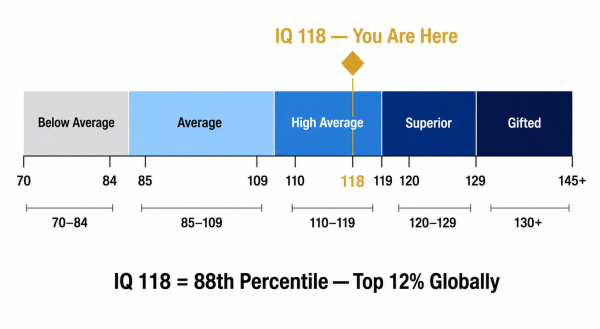
An IQ of 118 is one of the most practically useful scores on the intelligence spectrum — and one of the most underappreciated. It places you at the 88th percentile, meaning you score higher than roughly 88 out of every 100 people. On the Wechsler Adult Intelligence Scale, this falls squarely in the High Average range (110–119).
But here is what makes IQ 118 genuinely interesting: research suggests this score sits right in what some psychologists call the leadership sweet spot — cognitively strong enough to handle complex problems, yet close enough to the population average to communicate and connect with teams effectively. This article unpacks what that means in practice, how this score compares to nearby levels, and what careers align best with it.
If you have not yet confirmed your score, take our free International Standard IQ Test — results in under 20 minutes with no registration required.
What Does an IQ of 118 Mean?
On any standardised IQ test using a mean of 100 and a standard deviation of 15 — including the WAIS, Stanford-Binet, and Mensa admissions test — a score of 118 sits 1.2 standard deviations above the mean. This places it firmly in the High Average classification, one tier below Superior (120–129) and two tiers below Gifted (130+).
In practical cognitive terms, IQ 118 is associated with:
- Above-average learning speed — new concepts, systems, and skills are typically absorbed faster than roughly 88% of peers
- Strong working memory — the ability to hold and manipulate multiple pieces of information simultaneously, supporting effective multitasking and complex decision-making
- Good verbal reasoning — clear articulation of ideas, effective written communication, and above-average comprehension of complex text
- Solid analytical thinking — a natural ability to break problems into components, identify patterns, and evaluate options systematically
- Adaptive problem-solving — comfort with ambiguous, open-ended problems that do not have a single correct answer
Importantly, what IQ 118 does not predict is the ceiling of your success. Research consistently shows that above IQ 115, the marginal cognitive advantage of additional IQ points diminishes sharply relative to non-cognitive factors. Emotional intelligence, conscientiousness, communication skill, and domain expertise each contribute independently and significantly to professional outcomes. For a detailed look at this, see our guide on IQ vs EQ — which matters more?
IQ 118 Percentile: Exactly How Rare Is It?
Using the standard normal distribution with mean 100 and SD 15, an IQ of 118 corresponds to the 88th–88.5th percentile. This means:
- You score higher than approximately 88 out of every 100 people
- Roughly 12% of the global population scores at or above this level
- In a workplace of 50 people selected at random, approximately 6 would share your cognitive level or higher
This places IQ 118 in an interesting position: rare enough to provide meaningful cognitive advantages in most environments, but common enough that you are surrounded by peers of similar ability in most professional settings. It is a score that rarely creates the social friction sometimes associated with higher IQ ranges. For comparison, see our guides on IQ 115 and IQ 120.
The Leadership Sweet Spot: IQ 118's Unique Advantage
This is the angle that most IQ 118 articles miss entirely — and it is the most practically important insight about this score.
A study published in the Journal of Applied Psychology examined the relationship between leader IQ and leadership effectiveness across a large sample of managers and executives. The findings were counterintuitive: leadership effectiveness rose steadily with IQ up to around 120, then flattened and began to decline at higher scores. At IQ levels above 128–130, the correlation between IQ and rated leadership effectiveness actually turned negative.
The proposed explanation is straightforward: leaders who are significantly more intelligent than their teams tend to communicate in ways that are too abstract, use vocabulary that creates distance, and make intuitive leaps that others cannot follow. The result is friction, disengagement, and miscommunication — regardless of how cognitively capable the leader actually is.
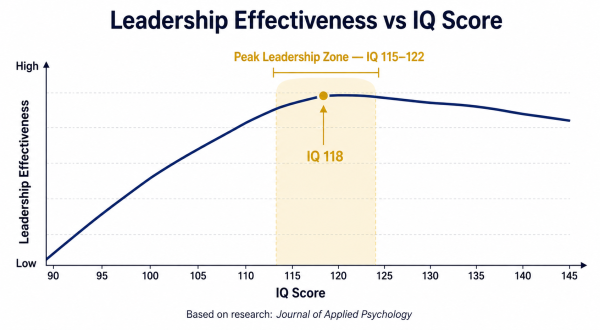
An IQ of 118 sits right at the upper edge of this optimal leadership zone. You have sufficient cognitive ability to handle strategic complexity, synthesise information, and solve non-routine problems — but you remain close enough to the average that communication with teams, clients, and stakeholders stays natural and effective.
This is not a consolation prize for scoring below 120. It is a genuine structural advantage in any role that involves leading, influencing, or collaborating with people. For more on how this plays out in the workplace, see our guides on IQ vs soft skills in hiring and IQ vs EQ.
How IQ 118 Compares to Nearby Scores
| IQ Score | Classification | Percentile | Population % |
| 110 | High Average | 75th | ~25% |
| 115 | High Average | 84th | ~16% |
| 118 | High Average ★ | 88th | ~12% |
| 120 | Superior | 91st | ~9% |
| 125 | Superior | 95th | ~5% |
The practical difference between IQ 118 and IQ 120 is statistically real but functionally small in most everyday and professional contexts. Both scores sit at the upper boundary of High Average and perform similarly across most cognitive tasks. The classification difference — High Average vs Superior — matters more in formal contexts like psychological assessment than in real-world performance. For a full understanding of how the scale is structured, see our IQ scale explained guide.
Best Career Paths for IQ 118
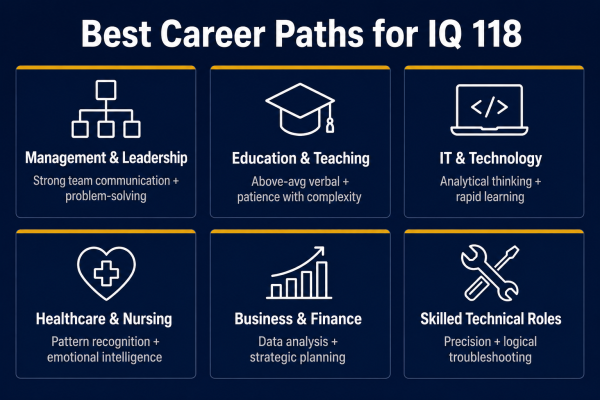
Research on cognitive thresholds in professional performance consistently shows that IQ 118 is well above the minimum cognitive requirement for virtually all occupational categories. The careers where this score provides the strongest advantage are those that combine structured problem-solving with regular interpersonal demands — exactly the combination where the leadership sweet spot effect applies most strongly.
| Career Field | Why IQ 118 Fits | Key Cognitive Demand |
| Management & Leadership | Leadership sweet spot — smart enough to strategise, relatable enough to lead | Strategic reasoning + communication |
| Education & Teaching | Strong verbal reasoning + ability to simplify complex ideas | Verbal comprehension + patience |
| IT & Technology | Logical thinking + fast learning of new systems | Analytical reasoning + adaptability |
| Healthcare & Nursing | Pattern recognition in clinical data + high-stakes decision-making | Working memory + perceptual reasoning |
| Business & Finance | Data interpretation + trend analysis | Quantitative reasoning + processing speed |
| Skilled Technical Roles | Precision problem-solving in defined technical domains | Perceptual reasoning + logical troubleshooting |
For a broader look at how IQ maps to specific professions, see our guides on average IQ of doctors, average IQ of engineers, and what jobs require a high IQ. If you are preparing for a cognitive ability assessment at work, our recruitment IQ test is specifically designed for professional screening contexts.
Cognitive Strengths at IQ 118
The High Average range is associated with specific cognitive advantages that show up consistently in standardised assessment data:
Verbal Comprehension
People scoring around 118 typically demonstrate strong vocabulary, above-average reading comprehension, and an ability to communicate complex ideas clearly. This supports performance in writing, negotiation, teaching, and any role requiring effective communication under pressure.
Working Memory
Above-average working memory means you can follow complex multi-step instructions, hold competing considerations in mind during decision-making, and switch between tasks without significant cognitive cost. This is particularly valuable in management, healthcare, and technical project work.
Processing Speed
Faster-than-average information processing allows quicker adaptation to new information and more efficient handling of time-pressured tasks. Research on cognitive flexibility shows that processing speed at this level meaningfully predicts performance in roles that require rapid situational assessment.
Perceptual Reasoning
Above-average spatial and visual reasoning supports performance in technical disciplines, pattern recognition tasks, and any work involving systems design, visual data interpretation, or three-dimensional thinking. To understand how this type of reasoning is measured, see our guide on verbal and non-verbal intelligence tests.
What IQ 118 Does Not Tell You
A score of 118 captures specific cognitive abilities measured under controlled test conditions. It does not measure — and therefore does not predict — several factors that research consistently shows are equally or more important for real-world outcomes:
- Conscientiousness — the single strongest non-cognitive predictor of academic and professional performance across virtually all occupational categories
- Emotional intelligence — predicts leadership effectiveness, relationship quality, and career satisfaction independently of IQ. Our free EQ test can help you establish a baseline.
- Domain expertise — deep knowledge in a specific field compounds over time and typically outweighs raw IQ advantage in professional performance after 5–10 years in a role
- Motivation and grit — sustained effort over time is a stronger predictor of extraordinary achievement than IQ at virtually any score level above 115
Malcolm Gladwell's research, supported by subsequent academic work, suggests that above an IQ threshold of approximately 115–120, factors like creativity, social skills, and opportunity matter more for extraordinary success than additional IQ points. IQ 118 sits right at this threshold — which means the leverage available to you through developing non-cognitive skills is particularly high. For more on this, see our guides on IQ vs problem-solving and IQ vs critical thinking.
How to Improve Cognitive Performance at IQ 118
While core IQ is largely stable in adulthood, the cognitive performance you can express in practice is meaningfully influenced by lifestyle factors and deliberate practice:
- Sleep quality — the most consistently supported modifiable predictor of cognitive performance. Even mild chronic sleep restriction measurably impairs working memory and processing speed
- Aerobic exercise — increases BDNF and supports neuroplasticity, with measurable effects on fluid intelligence and working memory. See our guide on how exercise affects the brain
- Learning complex new skills — acquiring a second language, musical instrument, or technical domain creates new neural connections that transfer to general reasoning ability
- Deliberate reading — engaging regularly with dense, complex material in unfamiliar domains builds verbal comprehension and abstract reasoning over time
For a full evidence-based review, see our guide on can IQ be improved? and the science behind neuroplasticity.
Final Verdict: Is IQ 118 Good?
Yes — clearly and meaningfully. An IQ of 118 places you at the 88th percentile, in the top 12% of cognitive ability globally, and right at the upper edge of what research identifies as the optimal zone for leadership effectiveness. It reflects genuine cognitive strength across verbal reasoning, working memory, and analytical thinking.
More importantly, IQ 118 sits at a point where the return on developing non-cognitive skills — emotional intelligence, communication, domain expertise, and conscientiousness — is exceptionally high. The cognitive foundation is already strong. What you build on it is the variable that matters most.
IQ 118 is not the ceiling — it is a strong foundation at the exact point where emotional intelligence and domain expertise compound most powerfully into real-world impact.
Ready to benchmark your score or explore a different assessment? Take our free IQ test — no registration, instant results. You can also explore what IQ 115, IQ 120, or IQ 125 look like in practice.
Frequently Asked Questions
Is an IQ of 118 good?
Yes. An IQ of 118 is classified as High Average on the Wechsler scale and places you at the 88th percentile — meaning you score higher than approximately 88 out of every 100 people. It reflects solid reasoning, strong working memory, and above-average learning speed.
What percentile is IQ 118?
An IQ of 118 corresponds to approximately the 88th percentile. This means you scored higher than about 88% of the general population on a standardised IQ test with mean 100 and standard deviation 15.
Is IQ 118 considered gifted?
No. IQ 118 falls in the High Average range (110–119). The gifted threshold begins at IQ 130. However, IQ 118 provides meaningful cognitive advantages in most professional and academic environments and sits in the optimal zone for leadership effectiveness. See our guide on IQ 132 for what the gifted range looks like.
What is the unique leadership advantage of IQ 118?
Research published in the Journal of Applied Psychology found that leadership effectiveness peaks around IQ 120 and declines at higher levels. IQ 118 sits right in this sweet spot — smart enough to solve complex problems, but close enough to the average to communicate naturally and effectively with teams.
What careers suit an IQ of 118?
IQ 118 is well suited to management, teaching, nursing, engineering, IT, business analysis, finance, and skilled technical roles — careers that reward problem-solving, continuous learning, and people management. See our full guide on jobs for IQ 110–120.
How does IQ 118 compare to IQ 115 or IQ 120?
IQ 115 sits at the 84th percentile (High Average), IQ 118 at the 88th (High Average), and IQ 120 at the 91st (Superior). The practical cognitive differences between these three scores are real but modest in most professional contexts. The classification shift from High Average to Superior at IQ 120 matters more in formal assessment contexts than in everyday performance.

Comments
Share Your Thoughts