IQ tests are designed to measure general cognitive ability under standardized conditions, not to function as frequent progress trackers. While curiosity about intelligence is natural, taking IQ tests too often can produce misleading or inflated results. Understanding how IQ tests work—and how often they should be taken—helps ensure that scores remain meaningful rather than confusing.

Why IQ Tests Are Not Meant to Be Taken Frequently
IQ tests aim to estimate relatively stable cognitive traits such as reasoning ability, working memory, and processing speed. These traits change slowly over time, particularly in adults, which is why frequent retesting provides little new insight.
Taking IQ tests too often can introduce several distortions:
- Practice effects: Repeated exposure to similar question types improves familiarity, not intelligence, leading to artificially higher scores (see can IQ be improved?).
- Reduced validity: When pattern recognition replaces reasoning, test results no longer reflect true cognitive ability.
- Emotional distortion: Frequent testing can increase anxiety, trigger overinterpretation of minor score changes, or encourage unhealthy self-comparisons—common issues outlined in mistakes that lower IQ score.
For these reasons, IQ tests are not designed to be taken repeatedly within short timeframes.
What Psychologists Recommend
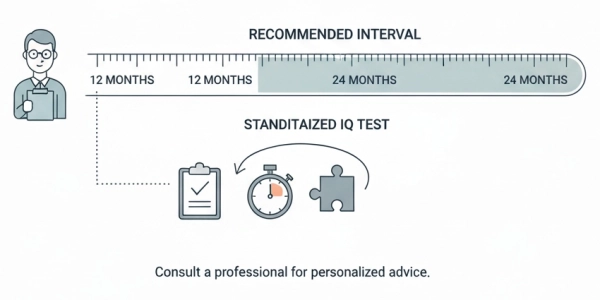
In clinical and educational settings, psychologists typically advise waiting 12 to 24 months before retaking a full, standardized IQ test such as the WAIS or Stanford-Binet.
This interval allows time for:
- Practice effects to diminish
- Emotional reactions to prior results to settle
- Genuine cognitive development or life changes to occur
Shorter intervals are generally discouraged unless there is a clear clinical or developmental reason.
When Retesting May Be Appropriate
Although frequent testing is unnecessary, there are legitimate situations where retaking an IQ test makes sense:
- Clinical evaluation: To monitor cognitive changes after a brain injury, neurological illness, or medical treatment
- Developmental tracking: For children and adolescents, whose cognitive abilities are still evolving
- Educational or occupational reassessment: When updated documentation is required for accommodations or placement
- Poor initial conditions: Illness, extreme anxiety, or major disruptions during the first test may justify a retest
Even in these cases, professionals carefully manage timing, test selection, and interpretation.
Why Scores Can Change Without Real IQ Changes
Many people are surprised when their IQ scores vary slightly across tests or sessions. In most cases, this does not indicate a true change in intelligence.
Common reasons include:
- Differences in test structure or emphasis
- Variations in sleep, stress, or emotional state
- Environmental distractions
- Familiarity with test formats
These factors are explored in detail in factors affecting IQ test results. Small score fluctuations are normal and reflect testing conditions—not cognitive transformation.
The Problem With Taking Multiple Online IQ Tests
Free online IQ tests are often taken repeatedly out of curiosity, but frequent use can be misleading. Repeated online testing may:
- Reinforce inflated or unreliable scores
- Encourage fixation on numbers rather than growth
- Blur the line between entertainment and measurement
Because many online tests lack proper standardization and norming, retaking them adds little value—an issue discussed in are free online IQ tests accurate?.

Can Taking IQ Tests Too Often Be Harmful?
While not physically harmful, excessive IQ testing can have psychological downsides:
- Increased performance anxiety
- Overidentification with a single number
- Discouragement from minor score drops
- Obsession with validation instead of self-development
When self-worth becomes tied to test results, testing loses its purpose.
Better Alternatives to Frequent IQ Testing
Instead of retesting, consider focusing on areas that lead to meaningful improvement:
- Developing specific cognitive skills such as attention, memory, or reasoning
- Improving sleep, stress management, and mental health
- Learning new subjects or problem-solving strategies
- Tracking real-world outcomes like learning efficiency or job performance
These approaches align with the idea that IQ is only one part of intelligence, and not the sole predictor of success (see IQ vs EQ).
How Often Is “Too Often”?
As a general guideline:
- Professionally administered IQ tests: No more than once every 1–2 years
- Online or informal tests: Occasional curiosity use only, not repeated measurement
- Children: Follow professional recommendations based on age and purpose
If your motivation for retesting is reassurance or self-worth, another score is unlikely to provide lasting clarity.
The Bottom Line
IQ tests are tools, not trackers. They are most useful when taken sparingly, under appropriate conditions, and interpreted in context. Taking an IQ test too often does not reveal more about intelligence—it usually reveals more about familiarity, anxiety, or expectations.
For most people, one well-administered test is enough. Real growth is better measured through learning, adaptability, and real-world performance—not repeated numbers on a score report.

Comments
Share Your Thoughts