IQ test results are often treated as fixed indicators of intelligence, but in reality, many factors affect IQ test results. While IQ tests are designed to measure relatively stable cognitive abilities, actual scores can fluctuate depending on conditions, preparation, and individual circumstances.
Understanding factors affecting IQ test results helps you interpret scores more accurately and avoid drawing incorrect conclusions about intelligence or long-term potential.
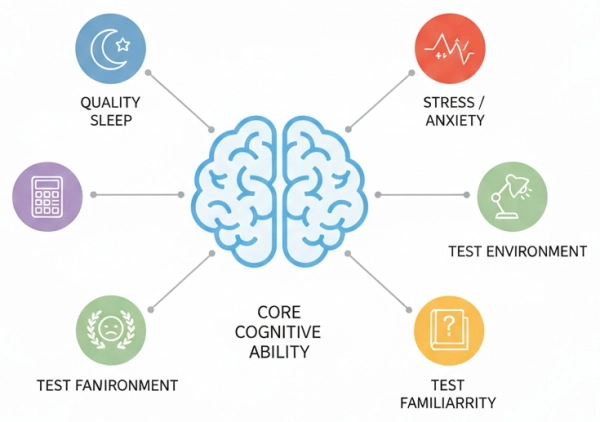
Core Cognitive Ability
At the heart of every IQ test result is general cognitive ability—often referred to as g. This includes how efficiently a person reasons, recognizes patterns, manipulates information in working memory, and processes ideas under pressure. These abilities form the foundation of what we commonly define as intelligence (see what is IQ – a complete guide to intelligence quotient).
Core cognitive ability is relatively stable over time, especially in adulthood, and it sets the broad range within which a person’s IQ scores typically fall. However, an IQ score is not a fixed point—it is an estimate of performance at a specific moment. While ability sets boundaries, many internal and external factors determine where within that range a person actually scores.
Sleep and Physical Condition
Sleep quality has one of the strongest and most consistent effects on cognitive performance. Poor or insufficient sleep reduces:
- Working memory capacity
- Attention and sustained focus
- Processing speed
- Logical reasoning accuracy
Even mild sleep deprivation—losing one or two hours—can lower scores, especially on timed subtests. Physical fatigue, illness, headaches, hunger, or discomfort have similar effects by draining mental energy and limiting cognitive efficiency.
This explains why short-term score changes often reflect temporary performance suppression, not changes in intelligence—an issue frequently discussed in improve IQ test score short term.
Stress, Anxiety, and Emotional State
Emotional state plays a critical role in test performance. Anxiety consumes working memory, which is essential for reasoning and problem-solving. When emotional arousal is high, the brain has fewer resources available for thinking clearly.
Common emotional factors that lower scores include:
- Test anxiety or fear of evaluation
- Pressure to “prove” intelligence
- High stress levels before or during the test
- Negative self-talk after difficult questions
Calm, focused individuals tend to perform closer to their true cognitive capacity. This distinction is one reason IQ alone does not predict real-world success as well as emotional regulation skills—often highlighted in comparisons such as IQ vs EQ.

Familiarity With Test Formats
IQ tests often rely on recurring question types such as matrix reasoning, number or symbol sequences, analogies, and spatial rotations. Familiarity with these formats does not increase intelligence, but it strongly affects performance by:
- Reducing confusion about instructions
- Speeding up pattern recognition
- Lowering cognitive load
- Preventing unnecessary hesitation
First-time test-takers often score lower simply because they are learning how the test works while taking it. Familiarity allows more mental energy to be spent on reasoning itself. Differences between verbal and nonverbal formats can also influence results, particularly for individuals with language or cultural barriers (see verbal and nonverbal test of intelligence).
Time Management and Test Strategy
Many IQ tests are intentionally speed-limited. How efficiently a person uses time can influence results as much as raw reasoning ability.
Common time-related performance issues include:
- Spending too long on difficult items
- Fixating emotionally on one question
- Rushing due to poor pacing
- Trying to solve every problem perfectly
Strategic skipping, steady pacing, and prioritizing easier questions often lead to higher scores without any increase in intelligence. Many avoidable errors are outlined in mistakes that lower IQ score.
Test Environment
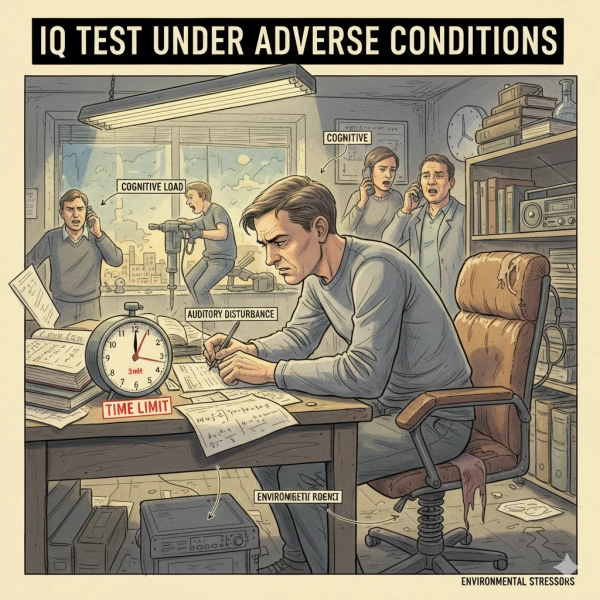
Environmental conditions can significantly affect concentration and mental stamina. Distractions reduce cognitive efficiency and increase mental fatigue.
Factors that commonly interfere with performance include:
- Noise or interruptions
- Poor lighting or screen glare
- Uncomfortable seating or temperature
- Visual or auditory distractions
Professional IQ testing carefully controls these variables because the brain performs best in quiet, stable, and comfortable environments.
Motivation and Engagement
IQ tests require sustained mental effort, sometimes for hours. Low motivation or disengagement can reduce performance, especially on longer assessments.
People may underperform if they:
- Do not take the test seriously
- Feel bored or mentally disengaged
- Believe the results have no value
- Lack incentive to persist on difficult items
Even on ability-based tests, effort matters. Intelligence must be expressed through engagement to be measured accurately.
Education and Language Background
Although IQ tests aim to be education-neutral, some components—especially verbal subtests—are influenced by language proficiency and educational exposure.
Individuals may score lower if they:
- Take the test in a non-native language
- Have limited exposure to formal education
- Are unfamiliar with test-related vocabulary
These factors can affect certain subtests without reflecting true reasoning ability, particularly in non-verbal domains.
Practice Effects
Repeated exposure to IQ-style questions can produce modest score increases due to:
- Faster recognition of common patterns
- Reduced anxiety during testing
- Improved pacing and confidence
Professional assessments control for this through norming, retesting intervals, and large item pools. Practice effects explain small fluctuations, not dramatic or permanent changes—clarifying why IQ is considered relatively stable over time (see can IQ be improved?).
Health and Neurological Factors
Cognitive performance can also be influenced by health-related factors, including:
- Attention disorders
- Depression or chronic stress
- Neurological injuries or illnesses
- Medication side effects
Some of these effects are temporary, while others may be long-lasting. Context matters when interpreting results.
Why IQ Scores Can Vary Between Tests
It is normal for IQ scores to vary slightly across different tests or testing sessions. These differences often reflect:
- Variations in test emphasis
- Differences in testing conditions
- Emotional or physical state on test day
Such changes do not indicate real shifts in intelligence. They fall within the expected range of measurement variability, which is why IQ scores are best understood as ranges rather than precise points on the IQ scale.
How to Interpret IQ Test Results Responsibly
IQ test scores are best understood as estimates within a range, not precise or absolute measurements. A single number cannot capture the full complexity of human intelligence.
When interpreted properly, IQ tests can offer insight into cognitive strengths and weaknesses. When taken out of context, they can be misleading. Intelligence is broader than any test score—and performance is shaped by far more than ability alone.
Final Thoughts
IQ test results are influenced by far more than intelligence alone. Sleep, stress, familiarity, environment, motivation, and health all play meaningful roles.
Understanding these factors allows you to approach IQ testing more realistically and ensures that scores are viewed as tools for insight—not final judgments.

Comments
Share Your Thoughts