Many people believe that success is reserved only for those with high intelligence. If you have been told your IQ is low, it is natural to wonder whether that number limits your future. The truth is far more encouraging: people with low or below-average IQs can and do succeed in life—often in meaningful, financially stable, and fulfilling ways.
This article explains what a low IQ really means, why it does not determine success, and how people at all intelligence levels build successful lives. If you want a foundational understanding first, you may find it useful to read what IQ is and how intelligence quotient works.

What Is Considered a “Low IQ”?
IQ scores are standardized so that 100 represents the population average, with most people scoring close to that number. Statistically, the majority of individuals fall within the 85–115 range, which is considered average intelligence. This distribution is clearly explained in the IQ scale from low to genius.
A low or below-average IQ generally falls into these categories:
- 70–84 – Below average
- Below 70 – Significantly below average
Scores below 70 may be associated with intellectual disability, but only when combined with limitations in adaptive functioning, such as difficulty managing daily life or independent living. An IQ score alone is never enough to make that determination. Common misunderstandings around this topic are addressed in signs of a low IQ.
Importantly, having a low or below-average IQ does not automatically mean someone cannot learn, work, or live independently. Many people in the 70–84 range function normally in everyday life, develop strong practical skills, and successfully manage responsibilities at home and work.
Why IQ Does Not Define Success
IQ tests measure a narrow slice of cognitive ability, focusing mainly on:
- Logical and analytical reasoning
- Pattern recognition
- Verbal comprehension
- Working memory
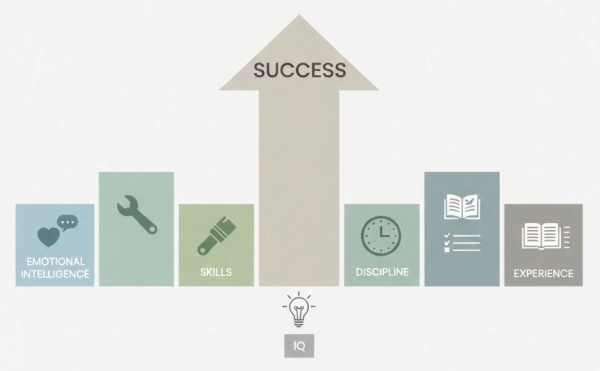
While these skills matter in academic or testing environments, they represent only a small part of what drives real-world success. Research comparing IQ vs problem-solving skills shows that practical reasoning and experience often matter more outside of exams.
Success depends heavily on abilities that IQ tests do not measure, including:
- Emotional intelligence (EQ)
- Motivation, discipline, and self-control
- Social and communication skills
- Creativity and practical problem-solving
- Persistence, resilience and adaptability
In long-term careers and relationships, these qualities often matter far more than raw cognitive ability.
Real-Life Skills Matter More Than Test Scores
In everyday life, success is built through consistent actions, not abstract reasoning ability.
People who succeed over time typically:
- Show up reliably and meet responsibilities
- Learn from mistakes and adjust their approach
- Communicate clearly and cooperate with others
- Manage stress, frustration, and setbacks
- Adapt to change and new challenges
Someone with a lower IQ but strong work ethic and interpersonal skills often outperforms a higher-IQ individual who lacks motivation or teamwork ability. This dynamic is common in leadership and service roles where emotional intelligence in leadership plays a critical role.
Can People With Low IQs Hold Good Jobs?
Yes. People with low or below-average IQs work successfully across many industries and professions.

Common examples include:
- Skilled trades such as electricians, mechanics, and carpenters
- Manufacturing, logistics, and operations roles
- Healthcare support and caregiving positions
- Sales, service, and customer-facing jobs
- Art, crafts, and creative work
- Entrepreneurship and small business ownership
In fact, many careers rely more on reliability, experience, and people skills than on abstract reasoning. This is why stories of success in business with low IQ are more common than many people expect.
What About People With Very Low IQs?
Even individuals with significantly below-average IQs can live meaningful and fulfilling lives, especially when provided with appropriate support and structure.
Success at this level may look different from traditional definitions, such as:
- Independent or semi-independent living
- Stable employment with guidance or accommodations
- Strong social and family relationships
- Personal dignity, confidence, and life satisfaction
Quality of life matters more than comparison, a perspective supported by broader discussions on can someone with a low IQ be successful.
Why Some High-IQ People Struggle
A high IQ does not guarantee success or happiness. Many highly intelligent individuals struggle due to factors unrelated to cognitive ability, such as:
- Poor emotional regulation
- Difficulty with discipline or follow-through
- Social or communication challenges
- Anxiety, burnout, or perfectionism
This contrast highlights an important truth: IQ alone is a weak predictor of life outcomes.
How to Succeed Regardless of IQ
No matter where your IQ falls, there are practical steps you can take to build a successful and satisfying life.
Helpful strategies include:
- Focusing on developing practical, job-relevant skills
- Strengthening communication and interpersonal abilities
- Practicing consistency, discipline, and accountability
- Taking care of your physical and mental health
- Choosing environments that align with your strengths
- Continuing to learn at your own pace
Research into whether IQ can be improved also shows that cognitive performance and adaptability are not fixed traits.
The Bottom Line
So, can a low IQ person be successful in life?
Yes—absolutely.
A low IQ does not define your worth, limit your potential, or determine your future. Success is shaped by habits, effort, emotional intelligence, resilience, and opportunity—not by a single test score.
Intelligence takes many forms, and every person has strengths that can lead to a meaningful, productive and successful life.

Comments
Share Your Thoughts