The IQ scale is one of the most referenced frameworks in psychology — and one of the most commonly misunderstood. Most people know that 100 is "average" and that 130+ is "gifted," but few understand exactly what these numbers represent statistically, what the correct classification system says, or what each range actually predicts about cognitive ability. This guide covers the WAIS-IV classification system precisely, provides exact percentiles for each range, and addresses the most common myths. For the foundational concepts, see the companion article: What Is IQ?
How the IQ Scale Is Constructed
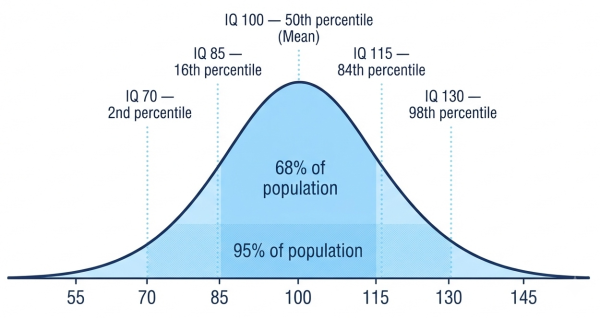
The IQ scale is a statistical construction based on the normal distribution (bell curve). Its key parameters:
- Population mean: 100 — set by definition. The average person in the normative sample scores exactly 100.
- Standard deviation: 15 — the spread of scores around the mean on most major tests (WAIS-IV, Stanford-Binet 5th edition)
- 68% of the population scores within one standard deviation of the mean: IQ 85–115
- 95% of the population scores within two standard deviations: IQ 70–130
- 99.7% of the population scores within three standard deviations: IQ 55–145
Your IQ score reflects your position relative to others in your age group — not an absolute measure of cognitive ability. The scale is re-normed periodically to account for the Flynn Effect (the documented rise in average scores over time). For more on this, see The Flynn Effect guide.
The WAIS-IV Classification System: The Correct Labels
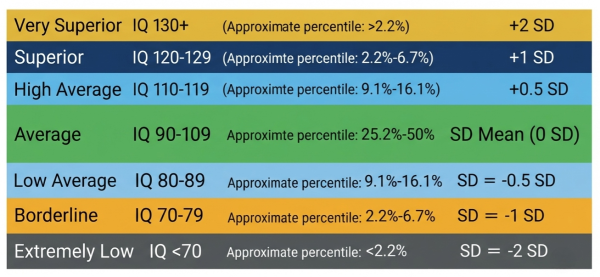
| IQ Score | WAIS-IV Classification | Percentile Range | SD from Mean |
| 130 and above | Very Superior | 98th and above | +2.0 and above |
| 120–129 | Superior | 91st–97th | +1.33 to +1.93 |
| 110–119 | High Average | 75th–90th | +0.67 to +1.27 |
| 90–109 | Average | 25th–73rd | -0.67 to +0.6 |
| 80–89 | Low Average | 9th–23rd | -1.33 to -0.73 |
| 70–79 | Borderline | 2nd–8th | -2.0 to -1.4 |
| 69 and below | Extremely Low | Below 2nd | Below -2.0 |
Important classification notes: "Gifted" and "Genius" are informal cultural labels, not official WAIS-IV categories. Very Superior (130+) is the highest formal classification in the WAIS-IV system. "Borderline" (70–79) does not mean "borderline intellectual disability" — it is a statistical classification describing performance in the 2nd–8th percentile range. A diagnosis of intellectual disability requires meeting three separate DSM-5 criteria, not just an IQ score in the Extremely Low range. See the IQ 70 guide for the full DSM-5 framework.
Key Percentile Benchmarks to Know
The most practically useful reference points on the IQ scale are the standard deviation markers:
- IQ 70 — 2nd percentile — 2 SD below mean: The boundary between Extremely Low and Borderline. Clinically significant for assessment purposes. See borderline IQ guide.
- IQ 85 — 16th percentile — 1 SD below mean: The boundary between Low Average and Average. About 84% of people score above this level.
- IQ 100 — 50th percentile — population mean: Exactly average by definition. Half the population scores above and half below.
- IQ 115 — 84th percentile — 1 SD above mean: High Average threshold. About 84% of people score below this level.
- IQ 130 — 98th percentile — 2 SD above mean: The Mensa threshold and the beginning of the Very Superior classification. About 2% of people score at this level or above.
- IQ 145 — 99.87th percentile — 3 SD above mean: Approximately 1 in 740 people. Beyond standard test calibration on most instruments.
What Each Classification Range Means in Practice
Extremely Low (below 70)
Scores below 70 fall in the Extremely Low classification. Whether this indicates intellectual disability depends on two additional criteria: adaptive functioning deficits (how the person manages daily life tasks) and developmental onset. A score below 70 alone is not sufficient for a diagnosis — see the IQ 70 guide and the borderline IQ guide for the full DSM-5 framework.
Borderline (70–79)
The Borderline range (2nd–8th percentile) is often mischaracterized as pathological. It represents performance in the lowest 8% of the population — measurably below average, but not necessarily functionally limiting depending on adaptive skills and environmental support. Practical implications vary significantly by individual. See IQ 75 and IQ 73 for specific score context.
Low Average (80–89)
The Low Average range (9th–23rd percentile) represents below-average performance but well within the range of ordinary functional daily life. Most academic and vocational challenges at this level respond to appropriate instructional support. See IQ 80 and IQ 85 for specific score context. For research on academic challenges at this level, see low IQ and school failure and low IQ success stories.
Average (90–109)
The Average range contains approximately 50% of the population. It spans the 25th–73rd percentile. Scores at this level are associated with successful navigation of most academic, vocational, and daily life demands. Research places this range as sufficient for most occupations. See IQ 100, IQ 95, and IQ 105.
High Average (110–119)
The High Average range (75th–90th percentile) represents meaningfully above-average cognitive performance. IQ 115 — exactly 1 SD above the mean at the 84th percentile — is associated with strong academic performance and comfortable access to most professional career tracks. Research places the mean IQ of many demanding professions (nursing, teaching, most engineering) in this range. See IQ 110, IQ 115, and IQ 117.
Superior (120–129)
The Superior range (91st–97th percentile) places a person in the top 3–9% of the population. IQ 129 is the highest score within this classification — 1 point below the Mensa threshold and the formal Very Superior classification. Research places the mean IQ of most highly demanding professions (law, medicine, advanced engineering) in this range. See IQ 125, IQ 126, and IQ 129.
Very Superior (130 and above)
The Very Superior classification (98th percentile and above) represents the top 2% of the population — approximately 1 in 50 people at IQ 130, decreasing rapidly with each point above. This range qualifies for Mensa International (98th percentile threshold). For specific scores in this range: IQ 132, IQ 135, IQ 138, IQ 140, IQ 142, IQ 143. For high IQ society thresholds, see the High IQ Societies guide.
Five Common Myths About the IQ Scale
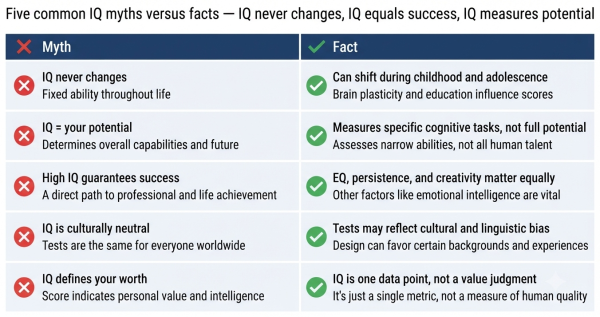
Myth 1: IQ Never Changes
IQ can shift, particularly during childhood and adolescence when neuroplasticity is highest. Research has documented IQ changes of up to 20 points in adolescents over several years based on educational engagement. Population-level IQ has risen substantially over the 20th century due to the Flynn Effect. See whether IQ can be improved and neuroplasticity.
Myth 2: IQ Measures Your Potential
IQ measures specific cognitive performance on specific types of tasks on a specific test day. It does not measure creativity, motivation, persistence, emotional intelligence, wisdom, or practical adaptability — all of which contribute substantially to long-term outcomes. See the Multiple Intelligences Theory guide.
Myth 3: High IQ Guarantees Success
Research consistently shows that the relationship between IQ and outcomes weakens above approximately IQ 120. Emotional intelligence, conscientiousness, communication skills, and situational judgment become the primary differentiators at high cognitive levels. See IQ vs EQ.
Myth 4: "Borderline" Means Borderline Disability
The WAIS-IV "Borderline" classification (70–79) is a statistical label describing performance in the 2nd–8th percentile. It does not mean borderline intellectual disability. Intellectual disability under DSM-5 requires three separate criteria — not just a low IQ score.
Myth 5: IQ Tests Are Culturally Neutral
IQ tests can reflect the cultural and linguistic context in which they were developed. Questions relying on specific vocabulary, cultural references, or reasoning styles familiar to one population may disadvantage those from different backgrounds. Culture-fair tests like Raven's Progressive Matrices attempt to minimize this, but no test is fully neutral. See the guide on IQ and demographic differences.
Frequently Asked Questions
What is the IQ scale based on?
The IQ scale is a statistical normal distribution with mean 100 and standard deviation 15. Scores reflect your position relative to a representative sample of people in your age group. About 68% of the population scores between 85 and 115, and 95% between 70 and 130. See the full statistical breakdown in What Is IQ?
What are the official WAIS-IV IQ classifications?
The WAIS-IV classifications are: Extremely Low (below 70), Borderline (70–79), Low Average (80–89), Average (90–109), High Average (110–119), Superior (120–129), and Very Superior (130+). "Genius" and "Gifted" are informal labels not in the WAIS-IV classification system.
What percentile is IQ 100?
IQ 100 is the 50th percentile — the population mean by definition. Exactly half the population scores below 100 and half above. This is constructed into the scale: 100 is always the average of the current normative sample.
What IQ score is considered gifted?
Most educational programs define gifted as IQ 130 or above — the Very Superior classification at the 98th percentile. Mensa International requires the 98th percentile, corresponding to approximately IQ 130 on SD-15 tests. For Mensa details, see the What Is Mensa guide.
What does IQ 115 mean?
IQ 115 is the 84th percentile — exactly 1 standard deviation above the population mean. It falls in the High Average classification (110–119). About 84% of people score below this level. For detailed context, see the IQ 115 guide.

Comments
Share Your Thoughts