Intelligence isn’t one-dimensional. While some people express their intelligence through words and logical reasoning, others shine through spatial thinking, pattern recognition, or problem-solving — abilities commonly measured in modern IQ tests. That’s why psychologists use two primary types of assessments — verbal and nonverbal tests of intelligence. Understanding the differences between these two helps you interpret your IQ scores, identify cognitive strengths, and tailor personal learning strategies.
What Is a Verbal Test of Intelligence?
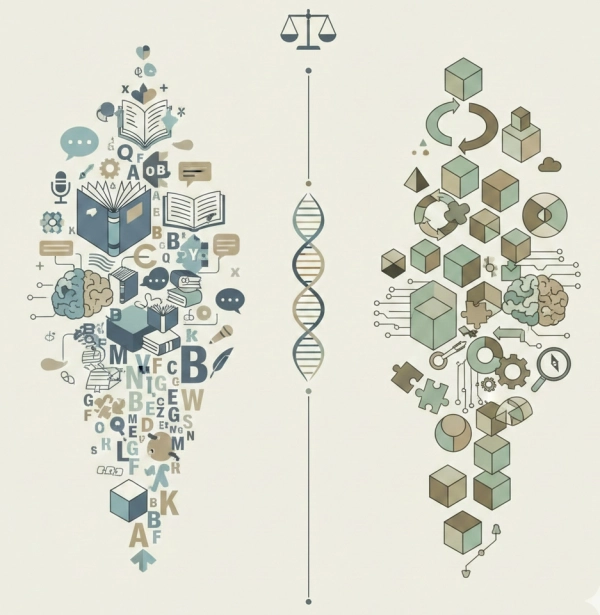
A verbal intelligence test measures your ability to understand, process, and use language effectively. It’s a core part of many international standard IQ tests, which include language-based reasoning tasks. Common components include vocabulary knowledge, reading comprehension, analogies and similarities, sentence completion, and verbal reasoning. Well-known examples include the Wechsler Adult Intelligence Scale (WAIS) — with verbal subtests like Similarities, Vocabulary, and Comprehension — and the Stanford–Binet Intelligence Test, which assesses verbal reasoning and language-based problem-solving. Verbal intelligence is especially relevant in communication-heavy fields and is often emphasised in recruitment IQ tests for roles requiring analytical communication skills.
What Is a Nonverbal Test of Intelligence?
A nonverbal intelligence test evaluates reasoning, pattern recognition, and problem-solving without relying on language — making it ideal for multilingual individuals or children, as seen in IQ tests for kids. Common components include visual puzzles or pattern sequences, spatial reasoning, abstract problem-solving, and matrix reasoning (identifying missing pieces in visual patterns). Examples include Raven’s Progressive Matrices (measuring abstract reasoning using shapes and visual patterns), the TONI (Test of Nonverbal Intelligence), and the Cattell Culture Fair Test (designed to minimize the influence of culture and language). Nonverbal IQ often reflects fluid intelligence — the ability to think logically and solve new problems without relying on prior knowledge.
Verbal vs. Nonverbal Intelligence: Key Differences
Although both test types aim to measure intellectual ability, they assess different cognitive pathways and types of reasoning. Understanding these distinctions helps explain why two individuals with the same IQ score might still think and learn in very different ways.
1. Verbal Intelligence: The Power of Language and Logic
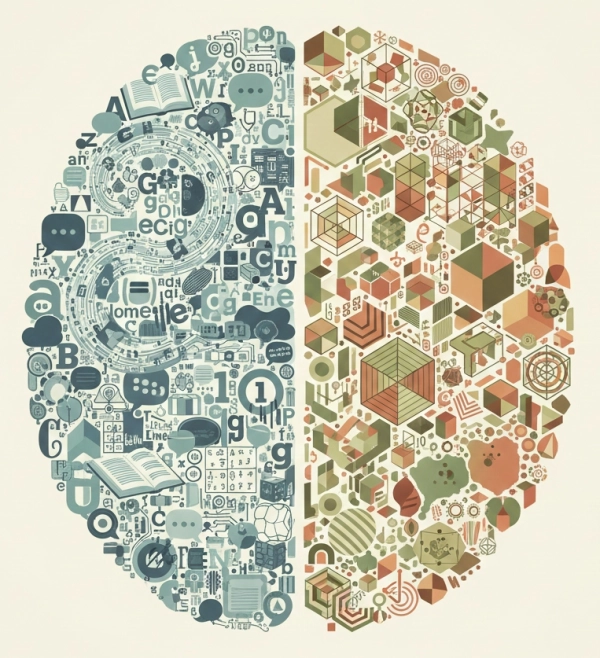
Verbal intelligence represents how effectively you use words to understand, communicate, and reason. It’s closely linked to crystallized intelligence — the knowledge and verbal skills accumulated through education and life experience. People with strong verbal intelligence tend to learn best through reading or listening, excel in explaining ideas, storytelling, and debating, perform well in literature, philosophy, and social sciences, and show strong analytical thinking when problems involve logical or linguistic patterns.
2. Nonverbal Intelligence: The Art of Visual Thinking
Nonverbal intelligence taps into your ability to think abstractly, identify patterns, and solve problems without relying on words. It is primarily associated with fluid intelligence — the capacity to reason through new situations, detect relationships, and find solutions to unfamiliar problems. Individuals with high nonverbal intelligence often excel in recognising shapes, designs, or spatial relationships, think visually and intuitively, learn effectively through observation, diagrams, or hands-on experience, and show strong performance in STEM fields, design, and engineering.
3. A Detailed Comparison
| Aspect | Verbal Intelligence | Nonverbal Intelligence |
|---|---|---|
| Primary Focus | Language-based reasoning, comprehension, and logic | Visual-spatial and abstract reasoning |
| Test Format | Reading passages, verbal analogies, sentence completion | Puzzles, pattern sequences, image matching, spatial problem-solving |
| Best Suited For | Native speakers, strong readers, advanced language skills | Children, multilingual individuals, those with language challenges |
| Examples | WAIS Verbal, Stanford–Binet Verbal Reasoning | Raven’s Matrices, TONI, Cattell Culture Fair Test |
| Type of Intelligence Measured | Crystallized intelligence (knowledge-based) | Fluid intelligence (problem-solving-based) |
| Real-Life Strengths | Communication, teaching, writing, leadership | Design, strategy, innovation, technical problem-solving |
In essence, verbal tests measure what you know, while nonverbal tests measure how you think. A well-balanced individual often demonstrates strengths in both — the verbal side helps with expression and logic, while the nonverbal side powers adaptability and creative problem-solving.
Why Both Tests Matter
Assessing intelligence through only one type of test provides an incomplete picture. A person might have extraordinary reasoning ability but struggle with language — or vice versa. That’s why most modern intelligence assessments, such as the WAIS-IV and the Stanford–Binet Intelligence Scales, integrate both verbal and nonverbal subtests to calculate a more holistic Full-Scale IQ (FSIQ) score.
A combined approach balances language and culture: verbal tests can be biased toward individuals fluent in the test language, while nonverbal tests minimize this bias for people from different linguistic or cultural backgrounds. It also reveals hidden cognitive strengths — someone who performs poorly on verbal tests due to limited vocabulary may still demonstrate exceptional reasoning on nonverbal measures. Educators and psychologists can use the contrast between scores to understand how a person learns best, design tailored learning programs, and support clinical diagnoses of conditions such as dyslexia or language processing deficits.
Real-World Example
Imagine a bilingual student who recently moved to an English-speaking country. On a verbal test they might score below average due to limited English vocabulary, but on a nonverbal test they might excel in pattern recognition and spatial reasoning — revealing strong cognitive flexibility that a language-based test alone would have overlooked. By combining both results, educators can recognise this student’s true intellectual potential and provide appropriate academic support.
Applications of Verbal and Nonverbal Intelligence Tests
1. Education
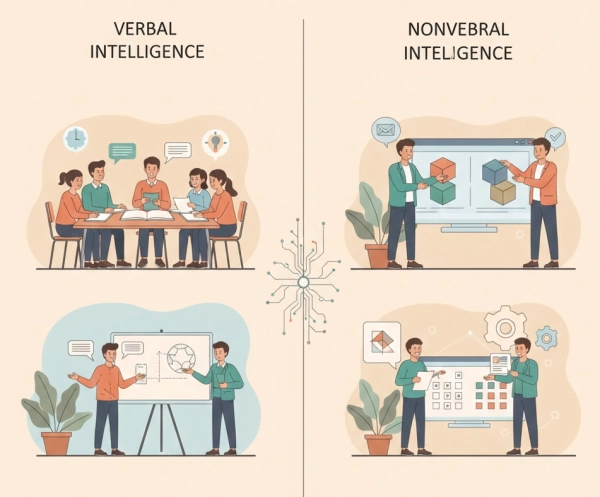
These tests help teachers and administrators tailor instruction to individual learning profiles — identifying gifted students, recognising learning disabilities (where a student struggles with verbal reasoning but excels nonverbally, suggesting dyslexia rather than low intelligence), and designing personalised learning plans such as using visual aids for nonverbal learners or discussion-based learning for verbal thinkers.
2. Clinical Psychology
Psychologists use both verbal and nonverbal subtests to detect deficits caused by developmental disorders, dementia, or traumatic brain injury. Nonverbal tests are particularly useful for assessing children or patients who have speech or communication difficulties, and repeated testing helps clinicians monitor cognitive rehabilitation progress.
3. Employment and Career Assessment
Many companies use reasoning-based assessments to identify candidates who excel in analytical thinking, creativity, or adaptability. Career counsellors use verbal vs. nonverbal profiles to guide individuals toward professions that match their cognitive strengths — writers and lawyers for high verbal intelligence, engineers and designers for high nonverbal intelligence. A balance between both is often linked to effective leadership, negotiation, and strategic planning.
4. Research and Cognitive Science
In academic research, these tests are indispensable for exploring how heredity, upbringing, and culture shape intellectual ability, enabling fairer cross-cultural comparisons (especially with nonverbal tests that minimize linguistic bias), and examining how different brain regions support verbal and visual-spatial processing.
Improving Verbal and Nonverbal Intelligence
Although genetics influence baseline intelligence, scientific evidence shows that both verbal and nonverbal intelligence are highly trainable through deliberate practice and mental engagement.
1. How to Boost Verbal Intelligence
Strengthen verbal intelligence by reading widely and deeply to expand vocabulary and comprehension, analysing complex ideas to sharpen critical thinking, writing regularly through journaling or essay writing, engaging in debates and discussions, and learning new languages to enhance verbal agility and metalinguistic awareness.
2. How to Strengthen Nonverbal Intelligence
Improve nonverbal intelligence by playing strategic or logical games like chess, Sudoku, or Rubik’s cubes, engaging in visual puzzles and brain teasers, practising arts and spatial skills such as drawing, architecture, or 3D modeling, trying new environments and hands-on skills, and exercising regularly to increase oxygen flow to the brain and improve cognitive flexibility.
Over time, these practices enhance neuroplasticity — the brain’s ability to form new neural connections — ultimately improving both verbal and nonverbal reasoning.
Final Thoughts
Verbal and nonverbal intelligence tests together offer a holistic understanding of human cognition. Verbal intelligence reveals how we articulate, reason, and communicate; nonverbal intelligence uncovers how we visualise, analyse, and adapt to new challenges. Neither form is superior — they complement each other to shape balanced, effective thinkers. True intelligence lies in integrating both: using language to express ideas clearly, applying logic and creativity to navigate complex situations, and adapting thought patterns to different people, tasks, and cultures. Explore more in our IQ Guides collection.
References
- Wechsler, D. (2008) – Wechsler Adult Intelligence Scale (WAIS-IV). Pearson.
- Raven, J. (2000) – Raven’s Progressive Matrices. Oxford Psychologists Press.

Comments
Share Your Thoughts