IQ and creativity are often linked in popular culture. Many people assume that highly intelligent individuals are naturally more creative, and that genius-level IQ automatically leads to artistic brilliance or groundbreaking ideas. In reality, the relationship between IQ and creativity is far more complex, as explored in research comparing IQ vs creativity.
While intelligence and creativity can complement each other, they are distinct cognitive traits. A high IQ does not guarantee creativity, and highly creative individuals do not always have exceptionally high IQ scores.
What Is IQ?
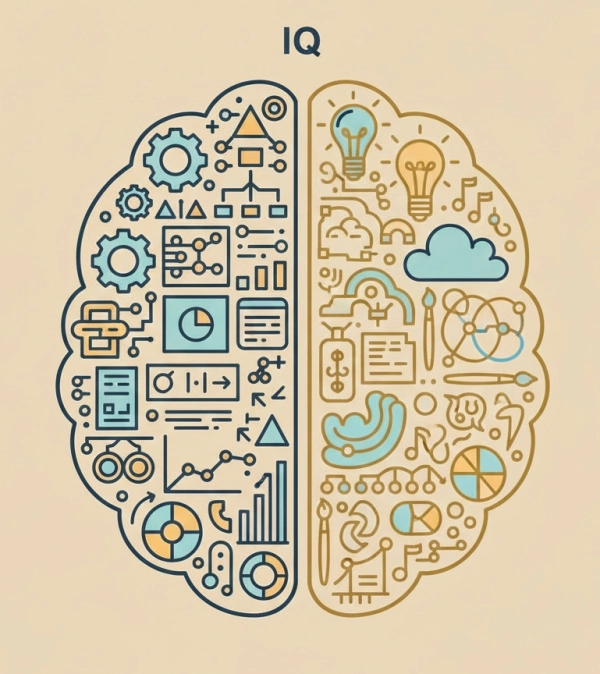
IQ (Intelligence Quotient) is a standardized measure designed to evaluate a person’s general cognitive ability. Rather than testing accumulated knowledge, IQ focuses on how efficiently the brain processes information, reasons through problems, and adapts to new challenges. A more detailed explanation can be found in this complete guide to IQ.
Most IQ tests assess a combination of core mental skills, including:
- Logical and abstract reasoning, which allows individuals to understand rules, relationships, and theoretical concepts
- Pattern recognition, the ability to detect regularities and structures in visual or numerical information
- Problem-solving speed and accuracy, especially when working under time constraints
- Spatial and mathematical reasoning, which support mental manipulation of objects, symbols, and quantities.
IQ reflects how effectively a person operates within structured systems that have clear rules and correct answers. This is why IQ correlates strongly with performance in areas that prioritize analytical precision, such as engineering or technical problem-solving, as discussed in IQ vs problem-solving skills.
However, IQ primarily measures convergent thinking—the ability to arrive at one correct solution. It does not capture imagination, emotional insight, or originality, which are central to creative thinking.
What Is Creativity?
Creativity is the capacity to produce novel, original, and meaningful ideas. It involves moving beyond established patterns of thought, making unexpected connections, and approaching problems from unconventional angles.
Creativity can manifest in many domains, including:
- Artistic expression, such as visual art, music, writing, and design
- Scientific insight and innovation, where new theories or solutions emerge
- Entrepreneurial problem-solving, including new business models or products
- Conceptual and strategic thinking, where ideas reshape how problems are defined
Unlike IQ, creativity is difficult to quantify with a single standardized measure. It is shaped by personality traits such as curiosity, openness to experience, tolerance for ambiguity, and intrinsic motivation—factors closely linked to cognitive flexibility and emotional awareness rather than raw processing speed.
Creativity relies heavily on divergent thinking—the ability to generate multiple possible solutions or ideas rather than narrowing down to one correct answer.
How IQ and Creativity Are Related
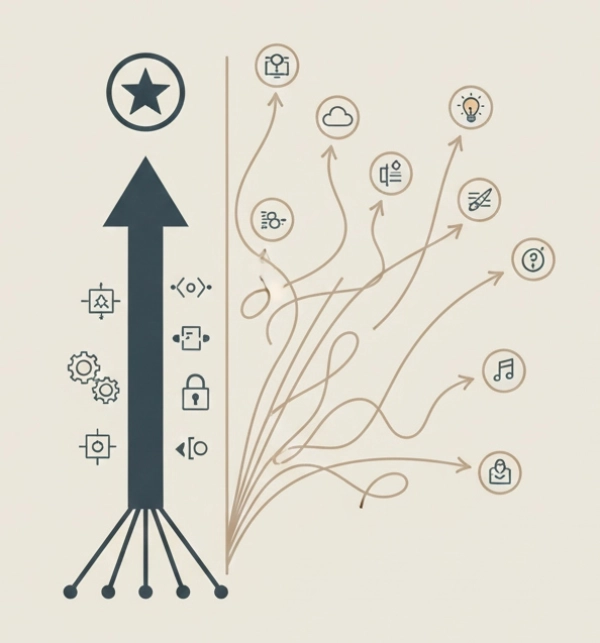
Research indicates that IQ and creativity are related but not directly proportional. Studies often support the concept of a threshold effect, which suggests that intelligence supports creativity only up to a point.
- Below an IQ of approximately 110–120, increases in intelligence tend to support greater creative potential
- Beyond this threshold, higher IQ scores do not consistently predict higher creativity
This aligns with broader findings about the IQ scale and cognitive ranges, showing that once basic cognitive efficiency is established, other factors become more influential.
Beyond the threshold, creativity depends more on personality, motivation, emotional openness, and environmental factors than on raw intellectual power.
Are Geniuses Always Creative?
The short answer is no.
Many individuals with very high IQs excel at analytical reasoning and structured problem-solving but struggle with creativity. They may prefer clarity, predictability, and logical certainty—traits often reinforced by educational systems that reward correctness over originality. This distinction is also reflected in discussions around IQ vs critical thinking.
On the other hand, many highly creative individuals operate outside traditional academic or intellectual frameworks. Some have average IQ scores but display extraordinary originality, intuition, and imaginative capacity. Their strength lies not in processing speed or logic, but in seeing possibilities others miss.
This distinction exists because creativity and intelligence rely on different cognitive processes. IQ tests measure convergent thinking, while creativity depends on divergent thinking. Although related, these processes serve different mental functions.
Why Some High-IQ Individuals Are Less Creative
Several factors can inhibit creativity among highly intelligent individuals:
- A strong preference for rules, structure, and proven methods
- Fear of being wrong, failing, or appearing incompetent
- Overreliance on logic while undervaluing intuition and emotion
- Educational systems that reward correctness, efficiency, and compliance over originality
In some cases, high intelligence can lead to mental rigidity, where individuals optimize within existing frameworks instead of challenging them. Creativity, by contrast, often requires comfort with uncertainty, mistakes, and unconventional ideas.
What Drives Creativity Beyond IQ?
Creativity depends largely on non-cognitive factors, including:
- Openness to experience and intellectual curiosity
- Intrinsic motivation and enjoyment of exploration
- Emotional depth, sensitivity, and imagination
- Willingness to take risks and tolerate uncertainty
- Exposure to diverse cultures, ideas, and perspectives
These traits are often associated with emotional intelligence and self-awareness rather than IQ alone, as explained in IQ vs EQ and emotional intelligence and self-awareness.
When IQ and Creativity Work Together
The most powerful innovations occur when high intelligence and strong creativity intersect. Individuals who combine analytical precision with imaginative thinking can turn abstract ideas into practical, impactful solutions.
This combination is especially valuable in fields such as:
- Scientific research and technological innovation
- Product design and advanced engineering
- Architecture and urban planning
- Entrepreneurship, strategy and leadership
In these contexts, IQ provides structure and feasibility, while creativity supplies vision and originality—an interaction often strengthened by neuroplasticity of the brain and lifelong learning.
Final Insight
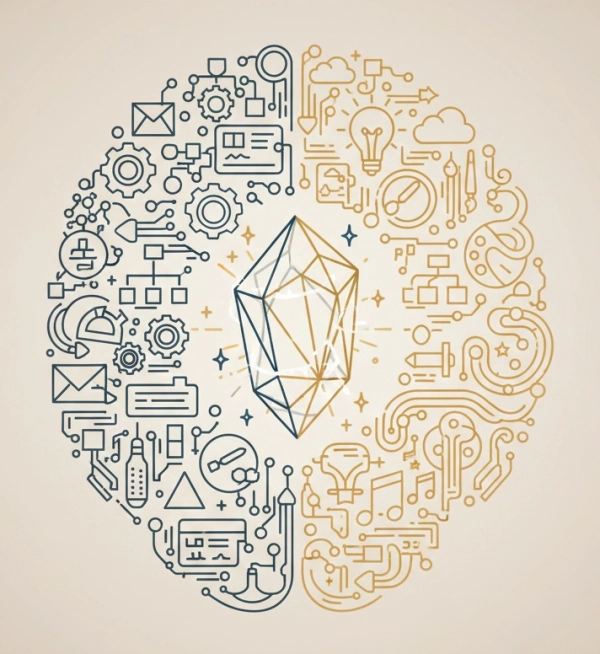
High IQ does not guarantee creativity, and creativity does not require genius-level intelligence. Intelligence defines how efficiently the mind works within rules, while creativity reflects the ability to reshape or transcend those rules.
True genius often emerges not from IQ alone, but from the balance between analytical ability, emotional openness and imaginative freedom.

Comments
Share Your Thoughts