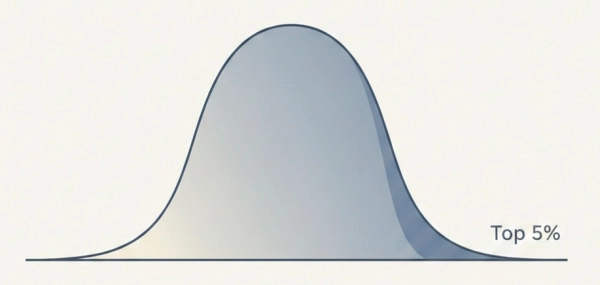
An IQ score of 125 is considered high, placing an individual roughly in the top 5% of the population. According to the IQ scale explained from low to genius, this range sits just below the commonly cited “genius” threshold but still represents a significant cognitive advantage.
People in this range typically demonstrate strong reasoning ability, fast learning speed, and a high capacity for understanding complex systems. While not necessarily in the extreme high-IQ category, an IQ of 125 supports success across many intellectually demanding professions. Insights from IQ 125 explained: what it means & where you fit further clarify how individuals at this level tend to perform.
Choosing the right career at this level is less about finding roles that are “hard enough” and more about aligning intelligence with interest, motivation, and long-term growth.
What an IQ of 125 Typically Indicates
An IQ score of around 125 places an individual well above the average range and reflects a high level of general cognitive ability. People in this range often process information faster, recognize patterns more easily, and adapt to new intellectual challenges with minimal difficulty—traits frequently measured by international standard IQ tests.
Individuals with an IQ of 125 commonly demonstrate:
- Advanced logical and abstract reasoning, supporting work with complex systems
- Rapid comprehension of new concepts in technical or analytical fields
- Strong verbal and analytical skills, enabling clear explanation and structured argumentation.
- High-level pattern recognition and problem-solving ability
- The capacity to manage large amounts of complex information without cognitive overload
Rather than thriving in narrowly defined or repetitive roles, people in this IQ range tend to perform best in environments that offer meaningful intellectual challenge combined with real-world application. This balance between reasoning depth and adaptability is closely related to cognitive flexibility.

Jobs Well-Suited for an IQ of 125
1. Software Engineer or Systems Developer
Software engineering is a natural fit for individuals with an IQ of 125. The role requires abstraction, logical structuring, and continuous learning as technologies evolve.
Research on IQ for software engineers shows that professionals in this range often move beyond basic coding into system design, optimization, and architectural thinking without needing extreme theoretical specialization.
2. Data Analyst or Data Scientist
Data-focused careers involve extracting meaning from large datasets, identifying trends, and building models to guide decisions. While mathematics and statistics are important, success also depends on reasoning clearly and interpreting results in context.
An IQ of 125 supports efficient analysis, hypothesis testing, and the ability to recognize non-obvious relationships—skills aligned with advanced problem-solving aptitude.
3. Engineer (Applied and Advanced Fields)
Engineering disciplines such as electrical, mechanical, biomedical, and industrial engineering align well with this IQ range. These fields emphasize practical problem-solving, system optimization, and technical precision.
High intelligence allows engineers to diagnose failures, refine designs, and understand how components interact within complex systems—key themes explored across the broader IQ guides.
4. Medical Doctor or Specialized Healthcare Professional
Many medical professionals, particularly those in diagnostic or technically demanding specialties, fall within this IQ range. Medicine requires absorbing vast amounts of information, making high-stakes decisions, and integrating data under time pressure.
However, long-term success depends not only on cognitive ability but also on emotional regulation and interpersonal skills, echoing the importance of IQ vs EQ in healthcare settings.
5. Economist or Policy Analyst
Economists and policy analysts model complex systems influenced by social, political, and economic variables. They must analyze data, interpret trends, and evaluate potential outcomes under uncertainty.
An IQ of 125 supports the abstract reasoning and analytical depth needed to understand these multifaceted systems.
6. Lawyer or Legal Analyst
Legal careers demand structured reasoning, detailed analysis, and strong verbal intelligence. Lawyers and legal analysts interpret statutes, evaluate evidence, and construct coherent arguments.
This IQ range allows for rapid comprehension of legal frameworks and effective problem-solving in complex cases.
7. Architect or Urban Planner
Architecture and urban planning require balancing technical constraints, regulatory requirements, and human-centered design. Professionals must think long-term while managing detailed specifications.
High cognitive ability supports system integration, spatial reasoning, and strategic planning across multiple dimensions.
8. Researcher or Academic (Non-Theoretical Fields)
Applied research roles in areas such as psychology, economics, technology, or social sciences are well-suited for individuals with an IQ of 125. These positions involve forming hypotheses, analyzing data, and refining theories based on evidence.
They offer intellectual stimulation without requiring extreme levels of abstraction found in purely theoretical disciplines.
9. Strategic Consultant or Business Strategist
Consultants and strategists work on ambiguous, high-level problems across industries. They synthesize information, identify core issues, and propose actionable solutions.
The combination of reasoning speed, pattern recognition, and adaptability mirrors the strengths highlighted in discussions of IQ vs critical thinking.
10. Product Manager or Technical Lead
Product managers and technical leads coordinate between engineering, business, and user needs. These roles require big-picture thinking, prioritization, and structured decision-making.
An IQ of 125 supports managing complexity while maintaining clarity and strategic direction.
Roles That May Feel Understimulating
Despite offering stability, some roles may feel limiting for individuals in this IQ range, particularly those that are:
- Highly repetitive or procedural
- Lacking intellectual challenge or growth opportunities
- Strictly rule-bound with little room for optimization or innovation
Over time, such positions can lead to disengagement, even if they are financially secure—a pattern sometimes seen in discussions about careers for IQ 110–120 versus higher cognitive ranges.

IQ Is a Tool, Not a Limit
An IQ of 125 provides a strong cognitive advantage, but it does not guarantee success, fulfillment, or career satisfaction. Long-term outcomes are shaped by factors such as:
- Motivation and work ethic
- Emotional intelligence and communication skills
- Curiosity and adaptability
- Commitment to developing expertise over time
The most suitable careers for someone with an IQ of 125 are those that challenge the mind while aligning with personal interests, values, and long-term goals. Intelligence opens doors—but how it is applied determines how far those doors lead.

Comments
Share Your Thoughts