An IQ score between 110 and 120 is considered above average, placing you roughly in the top 15–25% of the population. According to the IQ scale explained from low to genius, this range reflects strong general reasoning ability without entering the territory of extreme abstraction. People in this range typically learn faster than average, think logically, and adapt well to new information — without necessarily being drawn to highly abstract or theoretical work. Many individuals discover their score through assessments such as an international standard IQ test or a free IQ test with instant results. Success, however, depends just as much on skills, interests, and work habits as on raw cognitive ability — a theme consistently reinforced in IQ vs academic achievement research.
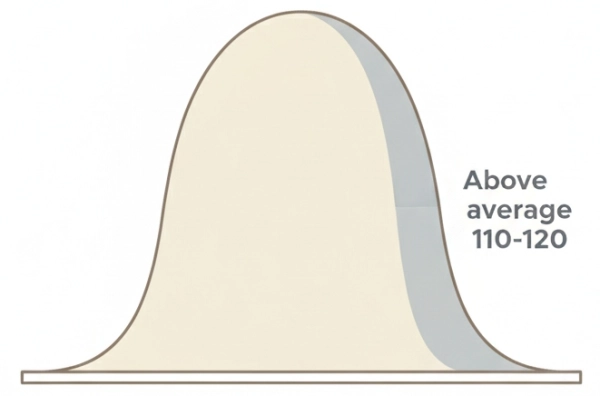
What an IQ of 110–120 Typically Indicates
People in this range are often quick learners who can grasp new concepts faster than most, especially when information is presented in a structured or logical way. Common cognitive characteristics include strong verbal and written communication skills supporting collaboration and explanation, effective logical reasoning and problem-solving skills in familiar or moderately complex situations, faster-than-average learning speed for rule-based or technical material, reliable memory and information processing, and confidence handling multi-step tasks without cognitive overload.
Rather than excelling in highly abstract or theoretical domains, individuals in this range tend to perform best in environments that reward practical intelligence, organisation, and steady decision-making. This aligns closely with findings discussed in IQ vs critical thinking. This IQ range is more than sufficient for long-term career success across a wide variety of professional fields.

Best Careers for People with an IQ of 110–120
1. Software Developer or Web Developer
Software and web development are strong career paths for individuals in this IQ range. These roles emphasise logical thinking, system understanding, and incremental learning over extreme abstraction. Persistence and structured problem-solving matter more than exceptional IQ scores in most development environments.
2. Business Analyst or Operations Manager
Business analysts and operations managers focus on improving efficiency, reducing waste, and optimising workflows. These roles require interpreting data, understanding organisational systems, and translating insights into actionable recommendations. An above-average IQ supports structured thinking, trend recognition, and evidence-based decision-making — making this a strong fit.
3. Engineer (Non-Theoretical Fields)
Applied engineering fields such as civil, industrial, mechanical, and electrical engineering prioritise implementation, safety standards, and real-world constraints. Professionals in these roles benefit from strong reasoning without needing the extreme abstraction associated with very high IQ ranges. Explore more in our IQ Guides.
4. Accountant or Financial Analyst
Accounting and finance demand precision, rule-following, and numerical reasoning. Professionals must analyse financial data, ensure compliance with regulations, and identify discrepancies or risks. An IQ of 110–120 supports efficient learning of financial principles and strong attention to detail, both of which are critical in this field.
5. UX Designer or Product Specialist
UX designers and product specialists blend analytical reasoning with user-centred thinking. They analyse feedback, test hypotheses, and refine products — making these roles a good fit for individuals who balance IQ and creativity rather than relying purely on abstraction.
6. Healthcare Professional (Non-Physician Roles)
Roles such as registered nurse, medical technologist, physical therapist, or healthcare administrator require strong applied intelligence. Research on average IQ by age suggests this IQ range is more than sufficient for mastering complex healthcare procedures and protocols.
7. Marketing Strategist or SEO Specialist
Modern marketing is increasingly data-driven. SEO specialists and marketing strategists analyse performance metrics, conduct experiments, and adjust campaigns based on results. Pattern recognition, analytical reasoning, and strategic thinking — core strengths of this IQ range — are essential for success in these roles.
8. Technical Sales or Solutions Consultant
Technical sales professionals assess client needs and recommend appropriate solutions. These roles require understanding complex products well enough to explain them clearly and logically. Strong communication combined with above-average reasoning makes this a natural fit for people in the 110–120 range.
9. Project Manager
Project managers oversee timelines, resources, and team coordination. Their success depends on organisation, planning, and risk management rather than deep technical expertise. Strong reasoning, prioritisation, and communication skills make this a natural fit for people in this IQ range.
10. Educator or Corporate Trainer
Teaching and training roles — especially in professional, technical, or vocational settings — require clarity, structure, and adaptability. Above-average intelligence supports lesson design, while long-term success depends heavily on emotional and interpersonal skills, echoing themes from IQ vs EQ.
Skills That Matter More Than IQ in This Range
For individuals with an IQ of 110–120, career growth is often shaped more by behavioural and professional skills than by intelligence alone. The most important factors include consistency and discipline in daily work, clear communication and collaboration, deep domain-specific knowledge, time management and reliability, and a willingness to learn, adapt, and improve. These traits frequently outweigh small differences in IQ and explain why many professionals with above-average intelligence outperform peers with higher scores, as discussed in can someone with a low IQ be successful.

Final Thoughts
An IQ of 110–120 provides a strong cognitive foundation for a wide range of successful careers. While it may not place someone in the realm of extreme abstraction or elite theoretical research, it is more than sufficient for leadership roles, technical professions, and high-impact practical work. Choosing a career aligned with your interests, strengths, and work style will always matter more than chasing roles based solely on IQ. Explore more at our Careers hub.

Comments
Share Your Thoughts