Not everyone with high intelligence naturally excels at emotional or social interaction. Some people have very high IQs — strong analytical, logical, and problem-solving abilities — but lower emotional intelligence (EQ), meaning they may find interpersonal communication, empathy, or emotional regulation more challenging. To understand this distinction more clearly, you can explore the differences between IQ and emotional intelligence (EQ). The good news is that many careers reward cognitive strength far more than emotional fluency, prioritising precision, logic, deep focus, and independent work — making them well suited for individuals who think exceptionally well but prefer minimal emotional or social demands.
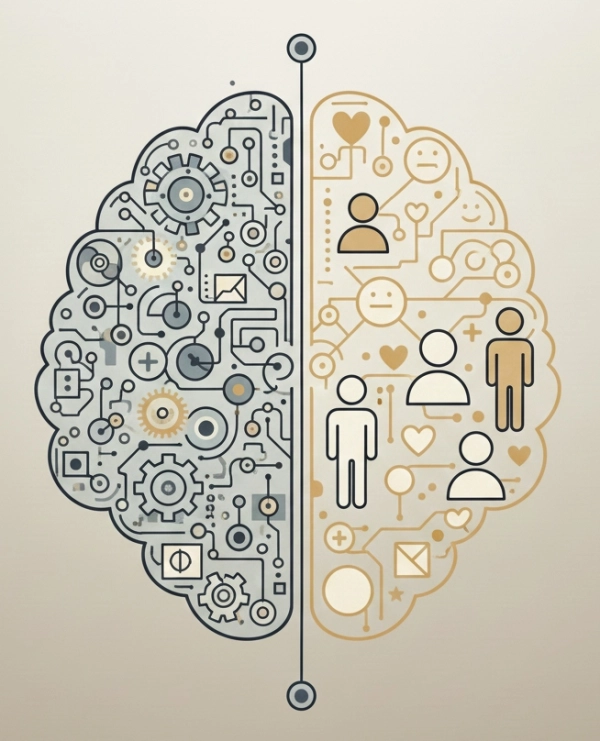
Understanding High IQ and Low EQ
High IQ is typically associated with advanced logical reasoning, strong pattern recognition, abstract thinking, and the ability to learn complex concepts quickly. Individuals with high IQ often excel at analysing systems, identifying inefficiencies, and solving difficult problems with precision and depth. Low EQ, however, does not imply a lack of emotions or personal value. Instead, it reflects challenges in emotional and social processing: interpreting subtle social cues or unspoken expectations, managing interpersonal conflict or emotionally charged situations, expressing emotions clearly or comfortably, and navigating group dynamics or office politics.
People with this cognitive profile may feel mentally energised by complex problems but drained by social interaction. Research on emotional intelligence and self-awareness shows that these skills are learned and situational, not indicators of overall intelligence or worth. When placed in the right setting, individuals with high IQ and low EQ can produce exceptional work without constant emotional negotiation.
Ideal Work Environments for High IQ, Low EQ Individuals
Career satisfaction and performance greatly improve when cognitive strengths align with workplace expectations. Individuals with high IQ and low EQ typically thrive in roles that offer clear rules, systems, or frameworks that reduce ambiguity; objective performance metrics such as accuracy, speed, or output quality; independent or deep-focus work with minimal interruptions; limited customer or client interaction; and logical, data-driven decision-making rather than emotionally influenced judgements. These environments reduce social strain and allow people to focus on reasoning and problem-solving.

Careers Well-Suited for High IQ but Low EQ Individuals
1. Software Engineer or Programmer
Software development strongly rewards logical reasoning, abstraction, and systematic problem-solving. Much of the work involves interacting with code rather than people, and success is judged by whether a system functions correctly and efficiently. This makes programming a natural fit for individuals whose strengths lie in analytical intelligence and structured thinking.
2. Data Scientist or Statistician
Data scientists and statisticians focus on extracting insights from large datasets, building predictive models, and identifying hidden patterns. These roles emphasise analytical accuracy and mathematical reasoning over emotional communication. Most collaboration is technical and structured, reducing the need for emotional nuance or persuasive social skills.
3. Research Scientist
Research roles — especially in fields such as mathematics, physics, computer science, or engineering — often involve long periods of independent work. Researchers are evaluated based on the rigour, originality, and accuracy of their findings rather than their interpersonal style. Success depends on intellectual persistence, precision, and deep focus rather than emotional intelligence.
4. Mathematician
Pure mathematics is among the most cognitively demanding professions and places minimal emphasis on social interaction. Mathematicians work almost exclusively with abstract concepts, logical proofs, and symbolic systems. In this field, emotional intelligence plays little role, while clarity of thought and reasoning ability are essential.
5. Engineer in Highly Technical Fields
Engineering disciplines such as aerospace, electrical, and systems engineering value structure, logic, and analytical rigour. Engineers often work with specifications, simulations, and models rather than emotional feedback or interpersonal negotiation. Precision and problem-solving ability are prioritised over social fluency.

6. Cybersecurity Analyst or Cryptographer
Cybersecurity professionals focus on identifying vulnerabilities, modelling threats, and designing secure systems. Cryptographers rely heavily on mathematical reasoning and adversarial thinking. These roles reward scepticism, attention to detail, and logical analysis rather than emotional sensitivity or social engagement.
7. Actuary
Actuaries use advanced mathematics and statistics to evaluate risk in insurance, finance, and pensions. Their work is highly structured, data-driven, and governed by strict models and regulations. Interpersonal demands are relatively low, making this career well suited for individuals who prefer numbers over emotions.
8. Technical Writer or Documentation Specialist
For individuals who prefer structured communication over emotional expression, technical writing offers a clear and logical framework. The focus is on accuracy, clarity, and completeness rather than persuasion or emotional connection. This role allows for effective communication without heavy social interaction.
9. Quantitative Analyst
Quantitative analysts develop mathematical and statistical models for financial markets. The work requires rapid analysis, pattern recognition, and abstract reasoning. Success depends far more on numerical intelligence than emotional awareness.
10. Philosopher or Logician
Analytical philosophy and formal logic require extreme precision of thought and intellectual discipline. These fields prioritise argument structure, clarity, and consistency over social skills or emotional engagement. Although not widely pursued for financial reasons, they strongly align with high-IQ, low-EQ cognitive profiles.
Challenges to Be Aware Of
Even in careers that minimise emotional demands, low EQ can still create obstacles in workplace collaboration and teamwork, performance reviews and feedback discussions, leadership or management responsibilities, and career advancement beyond purely technical roles. Developing functional emotional literacy — without changing one's personality — can significantly improve professional outcomes. As discussed in research on emotional intelligence and adaptability, even small improvements can reduce friction and increase career stability.
Final Perspective
High IQ combined with low EQ is not a flaw — it is a specific cognitive configuration. When aligned with the right career and environment, this profile can lead to exceptional productivity, innovation, and professional satisfaction. The key is choosing roles that value thinking over feeling, precision over persuasion, and results over relationships. Explore more at our Careers hub.

Comments
Share Your Thoughts