The question "which matters more — IQ or EQ?" is one of the most asked in psychology and career development. The honest answer from research: it depends on the domain, the career stage, and what outcomes you're measuring. IQ and EQ are distinct, largely independent cognitive capacities — and understanding what each predicts is more useful than declaring one winner. This guide covers what both measures actually assess, what the research shows about their respective predictive validity, and how to develop both. To measure your own cognitive abilities, take the International Standard IQ Test and the EQ Test.
What IQ Measures
IQ — Intelligence Quotient — measures specific cognitive capacities on standardized tests. For a complete explanation of how IQ works, see What Is IQ? The core domains measured by modern IQ tests:
- Abstract reasoning: Identifying patterns and logical rules in novel problem types
- Verbal comprehension: Understanding and using language at depth — vocabulary, analogies, conceptual relationships
- Working memory: Holding and manipulating information in active attention simultaneously
- Processing speed: How quickly and accurately the brain performs cognitive operations
- Spatial-visual reasoning: Understanding and mentally manipulating shapes and spatial relationships
IQ does not measure creativity, motivation, persistence, social judgment, emotional regulation, or wisdom. It measures a specific subset of cognitive capacities — important ones, but not the full picture of what makes someone effective in complex environments.
What EQ Measures
EQ — Emotional Quotient or Emotional Intelligence — was introduced in academic psychology by Salovey and Mayer (1990) and popularized for mainstream audiences by Daniel Goleman's 1995 book. Goleman's widely cited model identifies five components:
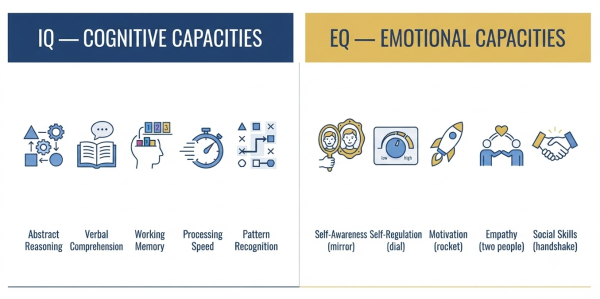
- Self-awareness: Recognizing your own emotions as they occur and understanding how they affect your thinking and behavior
- Self-regulation: Managing impulsive emotional responses and maintaining composure under pressure
- Motivation: Internal drive toward goals beyond immediate external rewards — persistence, optimism, and resilience under setbacks
- Empathy: Perceiving and responding appropriately to others' emotions — the foundation of effective communication and leadership
- Social skills: Building relationships, influencing, resolving conflict, and communicating with different audiences
The key distinction from IQ: EQ describes how you navigate the emotional and interpersonal dimensions of experience — not how quickly or abstractly you reason in isolation.
IQ vs EQ: Core Differences
| Dimension | IQ (Cognitive) | EQ (Emotional) |
| What it measures | Reasoning, logic, pattern recognition, memory | Self-awareness, empathy, regulation, social skills |
| How it's assessed | Standardized cognitive tests (WAIS, Stanford-Binet) | Behavioral observation, self-report, situational tests |
| Strongest predictor of | Academic performance, technical job success, learning speed | Leadership effectiveness, team performance, relationship quality |
| Changeability in adults | Relatively stable after adolescence | Meaningfully trainable throughout life |
| Correlation with each other | Low — high IQ does not predict high EQ, or vice versa | |
What the Research Actually Shows
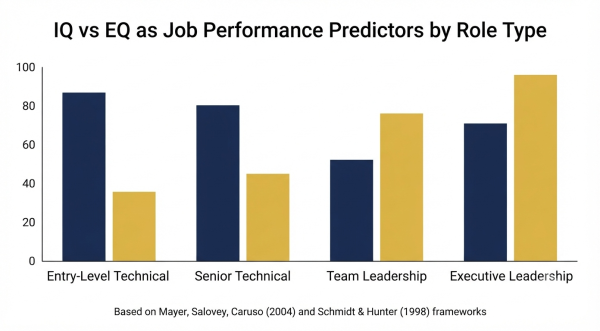
The research on IQ and job performance is extensive and clear: IQ is one of the strongest known predictors of job performance across most roles, particularly those requiring learning, information processing, and technical problem-solving (Schmidt & Hunter, 1998). The more cognitively demanding the role, the stronger the IQ-performance correlation.
The research on EQ is more recent and shows a different pattern. EQ is a strong predictor of:
- Leadership effectiveness — the ability to motivate, influence, and navigate organizational complexity
- Performance in high-EQ-demand roles: sales, counseling, teaching, negotiation, client management
- Team outcomes — how effectively groups collaborate and manage interpersonal dynamics
- Life satisfaction and wellbeing — people with high EQ report greater psychological resilience and relationship quality
Critically: IQ and EQ are largely independent of each other — the correlation between them is low. Knowing someone's IQ score tells you relatively little about their EQ, and vice versa. Both contribute independently to outcomes.
The research does not support the claim that EQ matters more than IQ overall — it supports the claim that they matter for different things, and that both matter significantly in complex professional environments. The relative importance shifts with role complexity and seniority.
How the Balance Shifts Across Career Stages and Roles
The most accurate way to frame the IQ vs EQ question is not "which is more important" but "which is more important for what":
Early Career, Technical Roles
IQ is the stronger predictor of success at entry-level technical positions — software engineering, data analysis, accounting, research. Learning speed, problem-solving efficiency, and technical accuracy are primary determinants of performance, and these correlate strongly with IQ. EQ still matters for team collaboration and communication, but the IQ signal is stronger.
Mid-Career and Senior Roles
As roles become more complex — involving coordination across teams, managing ambiguity, influencing stakeholders, and developing others — EQ becomes progressively more important. Research on leadership consistently finds EQ as a strong differentiator between average and exceptional leaders. IQ remains important, but EQ becomes the limiting factor for many high-IQ individuals who struggle with interpersonal or organizational dynamics. For career context, see high IQ low EQ career outcomes and jobs where EQ beats IQ.
High-EQ Demand Roles at All Levels
Some roles are primarily EQ-demanding regardless of seniority: therapy, counseling, nursing, teaching, social work, sales. In these contexts, empathy, emotional regulation, and communication ability are more directly predictive of performance than cognitive reasoning speed. See emotional intelligence in leadership and EQ vs IQ in the workplace.
Can You Have High IQ and High EQ?
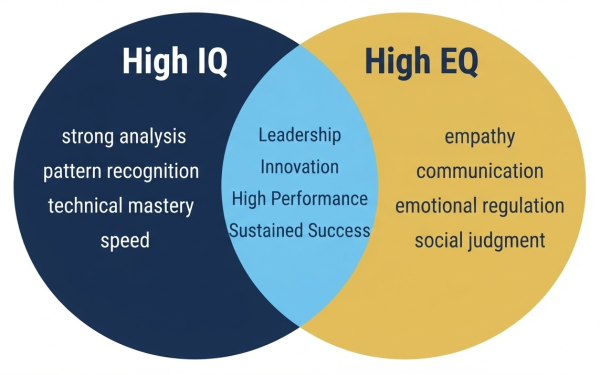
Yes — and the combination is particularly valuable. Because IQ and EQ are largely independent, high performance on both is entirely possible. The intersection of strong analytical reasoning and high emotional intelligence is associated with:
- Effective technical leadership — translating complex work for non-technical stakeholders while maintaining analytical rigor
- Creative innovation — combining systematic analysis with the interpersonal sensitivity to understand what others need
- Sustained high performance in complex environments — where both cognitive demand and interpersonal navigation are continuous requirements
Developing both is the highest-leverage investment for most professional contexts. Neither alone is the complete formula.
Can EQ Be Improved?
EQ is more trainable than IQ across adulthood. Research supports that emotional self-awareness, empathy, self-regulation, and social skills can be meaningfully developed through deliberate practice. Evidence-based approaches:
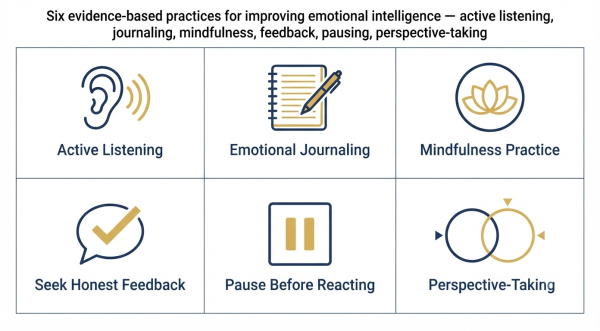
- Active listening practice: Focusing fully on the speaker before formulating any response — builds empathy and interpersonal attunement
- Emotional journaling: Writing about emotional experiences strengthens self-awareness and helps identify patterns in emotional response
- Mindfulness practice: Regular meditation builds the capacity to observe emotional states without being dominated by them — the foundation of self-regulation
- Seeking structured feedback: Asking trusted colleagues or coaches how you come across in difficult situations provides data that self-assessment often misses
- Pause before reacting: The deliberate insertion of a gap between emotional trigger and response — over time, this builds the self-regulation muscle
- Perspective-taking exercises: Deliberately modeling how others experience situations — "how would this feel from their position?" — develops empathy more systematically than good intentions alone
For your current EQ baseline, take the EQ Test. For more on the scientific framework, see the Daniel Goleman EQ model and how to improve your EQ.
IQ, EQ, and Wellbeing
One dimension often overlooked in this comparison: both IQ and EQ relate to wellbeing, but differently. IQ shows a modest positive correlation with life satisfaction — likely through income, educational attainment, and health decision-making. EQ shows a stronger and more consistent correlation with psychological wellbeing — through relationship quality, emotional resilience, and the capacity to manage stress effectively.
High IQ without EQ can be associated with analytical overthinking, social disconnection, and difficulty translating intellectual ability into satisfying relationships. High EQ supports the emotional regulation and interpersonal effectiveness that research consistently links to wellbeing across life domains. For more on this intersection, see IQ and mental health.
Frequently Asked Questions
What is the difference between IQ and EQ?
IQ measures specific cognitive capacities: abstract reasoning, verbal comprehension, working memory, processing speed, and pattern recognition. EQ measures emotional capacities: self-awareness, self-regulation, motivation, empathy, and social skills. They are largely independent — high IQ does not predict high EQ, and vice versa. Both contribute independently to different outcomes.
Which is more important for career success?
It depends on the role and career stage. IQ is a stronger predictor of performance in technically demanding entry-level and specialist roles. EQ becomes increasingly predictive of leadership effectiveness, team performance, and client-facing success as seniority increases. The research does not support a simple "EQ is more important than IQ" conclusion — it supports understanding which matters more for specific contexts.
What are the five components of EQ?
Daniel Goleman's model identifies: (1) Self-awareness — recognizing your emotions and their effects; (2) Self-regulation — managing impulses and staying composed; (3) Motivation — internal drive toward goals; (4) Empathy — perceiving and responding to others' emotions; (5) Social skills — building relationships and communicating effectively. See the Daniel Goleman EQ guide.
Can EQ be improved?
Yes. EQ is more trainable than IQ across adulthood. Evidence-based practices include active listening, emotional journaling, mindfulness, structured feedback, pausing before reacting, and deliberate perspective-taking. Research supports meaningful EQ development through consistent practice. See how to improve EQ.
Can someone have high IQ and high EQ?
Yes — because IQ and EQ are largely independent, high performance on both is entirely possible. The combination is associated with effective technical leadership, sustained high performance in complex environments, and the ability to translate analytical insight into interpersonal impact. Developing both is the highest-leverage approach for most professional contexts.

Comments
Share Your Thoughts