Many students and parents worry that a low IQ score means academic failure is inevitable. Seeing a number below average can feel discouraging, especially in a school system that often emphasizes test scores and grades. However, the reality is far more nuanced.
A low IQ does not automatically mean you will fail at school. Academic success depends on many factors beyond IQ, including learning style, motivation, teaching quality, and support systems. This misconception is explored in more depth in does a low IQ mean you will fail at school?.

What Does a “Low IQ” Mean in an Academic Context?
IQ scores are standardized so that 100 represents the population average, with most students scoring between 85 and 115. This range is considered normal and includes the majority of learners in any classroom. If you want to understand how these ranges are defined, see the IQ scale explained from low to genius.
In general, IQ scores are interpreted as follows:
- 85–99 – Average (lower range)
- 70–84 – Below average
- Below 70 – May indicate intellectual disability when combined with significant adaptive difficulties
It is important to note that IQ scores do not exist in isolation. A student in the 70–84 range often demonstrates normal classroom behavior, can follow instructions, and is capable of learning grade-level material—especially when instruction is clear, structured, and appropriately paced. Many myths around this topic are addressed in signs of a low IQ.
A low IQ does not mean a student lacks intelligence. Instead, it suggests that the student may process certain types of information more slowly or benefit from different teaching approaches.
Why IQ Is a Weak Predictor of School Success
IQ tests measure a limited set of cognitive abilities, including:
- Logical and analytical reasoning
- Pattern recognition
- Verbal comprehension
- Working memory
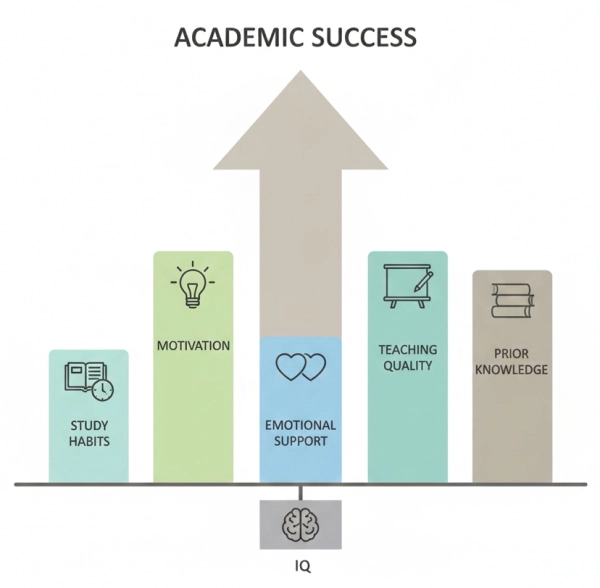
While these abilities matter, they do not fully predict academic outcomes. Research comparing IQ vs academic achievement consistently shows that grades and long-term school success depend on many non-IQ factors.
Academic success depends heavily on factors such as:
- Attention and sustained focus
- Study habits and organizational skills
- Motivation, effort, and persistence
- Quality of teaching and instructional support
- Emotional regulation, confidence and mindset
Many students with average or even high IQ scores struggle academically due to anxiety, poor study habits, or lack of motivation. At the same time, students with lower IQ scores often succeed by developing effective routines and using structured learning strategies.
Learning Style Matters More Than IQ
Students with lower IQ scores often benefit most from instruction that matches their learning style.
Effective approaches may include:
- Clear, step-by-step explanations
- Frequent repetition and guided practice
- Visual aids, diagrams, and demonstrations
- Hands-on activities and real-world examples
When teaching aligns with how a student learns best, outcomes can improve dramatically—regardless of IQ score. This connects closely to the idea of verbal and nonverbal tests of intelligence, which show that students vary widely in how they process information.
The Role of Effort and Consistency
In many academic settings, effort and consistency can outweigh cognitive ability.
Students who consistently:
- Complete assignments on time
- Ask questions when they do not understand
- Practice skills regularly
- Seek help early rather than waiting often achieve better outcomes than students who rely solely on natural intelligence. Studies comparing IQ vs GPA highlight how sustained effort plays a major role in academic outcomes.
School success is best viewed as a long-term process, where steady effort over time leads to meaningful progress.
Can Students With Low IQs Graduate?
Yes. Many students with below-average IQs successfully:
- Pass their classes
- Graduate from high school
- Earn vocational certificates
- Complete college degrees, especially in applied or career-focused programs

This aligns with broader evidence that someone with a low IQ can still be successful academically and professionally when appropriate support is in place.
When Additional Support Helps
Some students perform significantly better when provided with targeted support, such as:
- Individualized Education Plans (IEPs) or 504 plans
- Extra time on tests and assignments
- One-on-one tutoring or academic coaching
- Smaller class sizes or more structured learning environments
These supports do not lower academic standards. Instead, they help students demonstrate their true abilities and reduce unnecessary barriers to learning.
Why Some High-IQ Students Fail at School
A high IQ does not guarantee academic success. Some highly intelligent students struggle due to:
- Poor discipline or inconsistent study habits
- Weak time management skills
- Test anxiety or perfectionism
- Low motivation or lack of engagement
This reinforces the key idea behind IQ vs critical thinking: intelligence alone does not determine educational outcomes.
How to Succeed in School With a Low IQ
Students with lower IQ scores can improve their chances of success by:
- Creating consistent daily study routines
- Breaking assignments into smaller, manageable steps
- Using active learning techniques such as summarizing or teaching others
- Asking for help as soon as confusion arises
- Prioritizing sleep, nutrition, and stress management
Parents and educators play a critical role by offering encouragement, structure, patience, and realistic expectations.
The Bottom Line
So, does a low IQ mean you will fail at school?
No. A low IQ does not doom a student to academic failure.
School success is influenced by many factors, including learning strategies, effort, support systems, and emotional well-being. With the right approach and resources, students at all intelligence levels can learn, grow, and achieve meaningful academic success.

Comments
Share Your Thoughts