IQ scores are often treated as fixed measures of intelligence, but many people wonder whether it’s possible to improve an IQ test score in the short term. The short answer is: yes, short-term improvement is possible—but only within clear limits. Understanding those limits is essential for setting realistic expectations, as explained in can IQ be improved?.
What an IQ Test Actually Measures
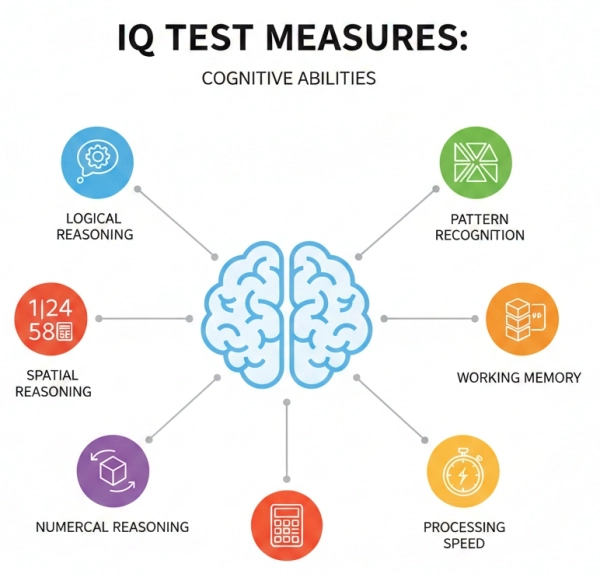
IQ tests are designed to assess general cognitive ability under standardized conditions. Rather than measuring knowledge or education, they focus on how efficiently your brain processes information. For a foundational overview, see what is IQ – a complete guide to intelligence quotient.
Core abilities typically assessed include:
- Logical and abstract reasoning
- Pattern recognition and rule detection
- Working memory capacity
- Processing speed and mental efficiency
- Spatial and numerical reasoning
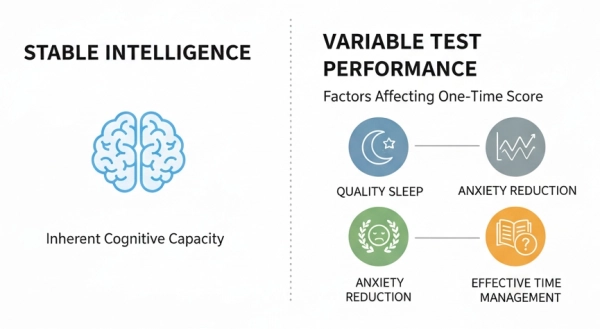
These abilities are considered relatively stable traits, particularly after adolescence. Short-term preparation does not alter underlying intelligence—but it can influence how clearly these abilities are expressed during testing.
IQ tests are also time-limited, which means attention, stamina, and emotional regulation strongly affect performance. Many fluctuations in scores are explained by external and situational influences, not changes in intelligence itself (see factors affecting IQ test results).
What “Short-Term Improvement” Really Means
When people talk about improving an IQ score in the short term, they are rarely referring to a genuine increase in intelligence. In practice, short-term improvement usually means:
- Reducing preventable performance losses
- Becoming familiar with common test formats
- Improving speed and decision efficiency
- Minimizing anxiety, fatigue, and distraction
In other words, preparation removes obstacles that suppress performance. This distinction is emphasized in improve IQ test score short term.
The goal is not to inflate your score—but to ensure it reflects your true cognitive ability rather than avoidable errors.
Ways You Can Improve Your Score Short-Term
1. Familiarity With Question Types
Most IQ tests rely on recurring formats such as matrix reasoning, analogies, sequences, and spatial rotations. Exposure to these formats helps you:
- Identify patterns more quickly
- Understand what each question is asking without hesitation
- Reduce mental effort spent on interpretation
This does not teach answers. It reduces unnecessary cognitive load—allowing your reasoning ability to work more efficiently. Differences between verbal and nonverbal reasoning formats can also influence familiarity effects (see verbal and nonverbal tests of intelligence).
2. Better Time Management
Many test-takers lose points not because they lack ability, but because they misuse time. IQ tests often reward speed and accuracy together.
Short-term improvements often come from learning to:
- Skip unusually difficult questions
- Avoid emotional attachment to any single item
- Prioritize easier, higher-probability questions first
Strategic pacing prevents one challenging problem from undermining overall performance—a common mistake outlined in mistakes that lower IQ score.
3. Optimizing Sleep, Nutrition and Focus
Your physical and mental state has a measurable impact on test performance. Short-term gains often result from simple, evidence-based adjustments:
- Getting 7–9 hours of quality sleep
- Eating a light, balanced meal before the test
- Staying hydrated
- Minimizing environmental distractions
These steps do not increase intelligence—but they prevent cognitive suppression caused by fatigue or poor concentration.

4. Reducing Anxiety and Mental Interference
Anxiety consumes working memory, a core component of IQ testing. Even mild stress can noticeably reduce reasoning efficiency.
Effective short-term strategies include:
- Slow, controlled breathing
- Reframing the test as measurement, not judgment
- Accepting that some questions are intentionally difficult
This aligns with research on emotional regulation and cognitive performance, often discussed in comparisons between IQ and EQ.
What You Cannot Improve Short-Term
There are clear and important limits to what short-term preparation can achieve. You cannot:
- Dramatically raise your underlying IQ
- Transform average intelligence into exceptional intelligence
- Overcome large cognitive gaps with test-taking tricks
- Sustain large score increases across multiple professional assessments
Most short-term improvements fall within a modest range—often 5 to 10 points, depending on anxiety reduction, familiarity, and test conditions. Understanding where these scores fall on the IQ scale helps maintain perspective (see the IQ scale explained from low to genius).
Why Practice Effects Exist
Repeated exposure to IQ-style questions can lead to higher scores because:
- Patterns become easier to recognize
- Instructions require less mental effort to process
- Test anxiety decreases with familiarity
Professional IQ tests account for this by using large item banks and controlled norms, which limits how much repeated practice alone can influence results. This is why guidance on how often you should take an IQ test matters (see how often should you take an IQ test).
Why Short-Term Gains Don’t Always Transfer
An improvement on one IQ test does not always carry over to others. Different tests emphasize different abilities, and gains based on familiarity may not generalize across formats or testing conditions.
This is one reason psychologists consider IQ to be relatively stable over time, even though small fluctuations are normal.
The Real Goal of Short-Term Preparation
The realistic goal of preparing for an IQ test is performance optimization, not score manipulation.
Effective preparation helps you:
- Avoid underperforming due to fatigue or stress
- Express your true abilities more clearly
- Reduce anxiety-driven errors
- Obtain a more accurate reflection of your cognitive strengths
In short, preparation helps your score reflect who you actually are—not who you appear to be on a bad day.
Final Answer: Yes, But Within Limits
Yes, you can improve your IQ test score in the short term—but only by removing obstacles that suppress performance. You cannot fundamentally change your intelligence overnight, but you can ensure the test measures you at your best.
The purpose of preparation is not to become smarter—it’s to avoid being unfairly measured as less capable than you truly are.

Comments
Share Your Thoughts