Discussions about average IQ in Asia often appear in research related to education, psychology, and human development. However, IQ statistics can easily be misunderstood when taken out of context. Used responsibly, these figures can help highlight how education systems and cultural environments influence cognitive test performance — without labelling or ranking populations. This article explores average IQ patterns in Asia by focusing on educational and cultural factors that shape test outcomes, while emphasising limitations and careful interpretation. For a broader comparative perspective, see our IQ by Country hub.
What IQ Scores Measure
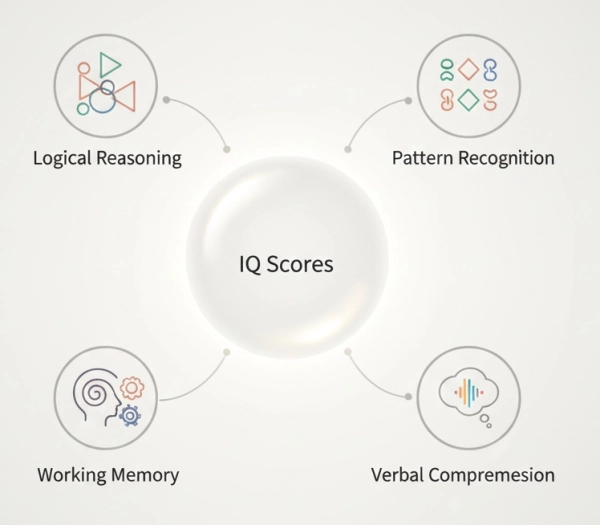
IQ, or Intelligence Quotient, is a standardised score designed to assess performance on a specific set of cognitive tasks, typically including logical reasoning, pattern recognition, verbal comprehension, and working memory. Modern IQ tests are calibrated so that 100 represents the average score for a defined population and age group. A clearer explanation of score ranges can be found in the IQ scale explained from low to genius.
IQ tests measure only a limited slice of human cognition. They do not assess creativity, emotional intelligence, leadership, or practical skills — areas explored in IQ vs EQ. An IQ score should never be interpreted as a complete measure of intelligence or personal potential.
Average IQ Patterns Across Asia

Across Asia, reported average IQ scores generally cluster near the standardised mean when measured using internationally normed tests. This pattern is consistent with global trends observed in other regions, such as those discussed in average IQ in Europe. While some studies report small differences between countries or regions, these variations are usually modest and influenced by sampling methods, test versions and updates, language adaptation, and educational exposure. Because IQ tests are regularly updated and renormed, national and regional averages tend to remain relatively stable over time — a trend connected to the Flynn Effect.
The Role of Education in IQ Test Performance
Education plays a significant role in shaping how individuals perform on standardised cognitive tests. In many parts of Asia, educational systems emphasise skills that align closely with IQ assessment tasks.
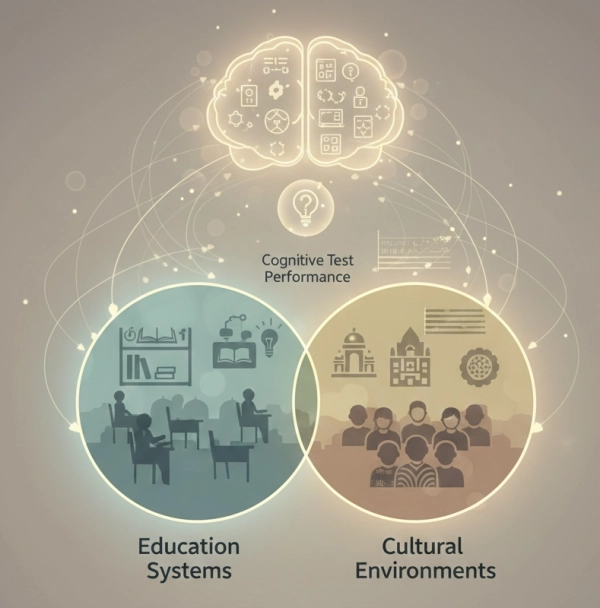
Key educational influences include a strong focus on early literacy and numeracy, structured and sequential learning environments, regular exposure to analytical and problem-solving tasks, and familiarity with exam-based and standardised testing formats. These factors can improve test performance by strengthening specific cognitive skills. Importantly, education affects skill development and practice — not innate intelligence.
Cultural Factors and Cognitive Skills
Cultural context also plays an important role in how cognitive abilities are expressed and measured. In many Asian societies, cultural values may emphasise academic effort and persistence, learning through repetition and gradual mastery, respect for structured instruction, and collective responsibility, discipline, and long-term planning. These cultural patterns can support performance on standardised tests that reward accuracy, focus, and rule-based reasoning. However, alignment with test formats reflects learning experience, not superior intelligence.
Language and Testing Context
Language is a critical factor in IQ testing, particularly for assessments that include verbal components. Performance can be influenced by whether a test is taken in a person's native language, the accuracy and clarity of test translation, and cultural familiarity with test concepts and examples. Even minor linguistic differences can affect scores, which is why cross-country comparisons must be interpreted cautiously.
Why Average IQ Scores Vary Across Regions
Variations in average IQ scores across Asia are best understood as the combined effect of environmental and social factors: access to consistent, high-quality education; childhood nutrition and overall health; socioeconomic stability and resources; and familiarity with standardised testing methods. These factors shape population-level test performance, not individual intelligence or future success. For more on this, see our article on can someone with a low IQ be successful.
What Average IQ Scores Do — and Do Not — Mean
An average IQ score may suggest typical performance on standardised cognitive tasks, normal learning and reasoning ability, and comparable test performance relative to peers. However, IQ scores do not measure creativity or original thinking, emotional intelligence or empathy, communication and social skills, motivation, perseverance, or self-discipline, or artistic, mechanical, or hands-on talents. Many skills essential for success fall entirely outside the scope of IQ testing.
Responsible Interpretation of IQ Data in Asia
When discussing average IQ data in Asia, responsible interpretation is essential: avoiding rankings or competitive comparisons between countries or regions, recognising the influence of education, culture, and testing conditions, acknowledging the limitations of standardised intelligence tests, and focusing on opportunity, learning, and development rather than judgement. Used thoughtfully, IQ data can support educational research and policy discussion without reinforcing stereotypes or misconceptions.
The Bottom Line
The average IQ in Asia, like in other regions of the world, generally reflects how standardised intelligence tests are designed and how educational and cultural factors influence test performance. Small regional variations are normal and are shaped largely by environment rather than innate differences. IQ statistics provide insight into test performance, not human worth or potential — intelligence is complex, multifaceted, and influenced by education, culture, experience, and opportunity, far beyond what any single number can capture. Explore more at our IQ by Country hub.

Comments
Share Your Thoughts