Average IQ scores have risen systematically throughout the 20th century — approximately 3 points per decade across dozens of countries. This pattern, known as the Flynn Effect after political scientist James R. Flynn who documented it comprehensively, is one of the most important and most frequently misunderstood phenomena in intelligence research. This guide covers what the Flynn Effect is, what causes it, how it's been documented, and — critically — what it means for how IQ scores should be interpreted. For the foundational IQ framework, see What Is IQ?
What the Flynn Effect Actually Shows
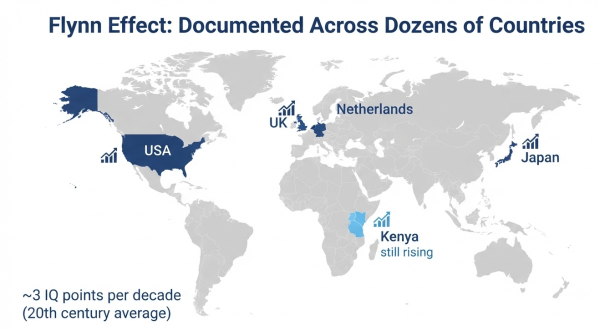
James Flynn began systematically documenting IQ score changes across countries in the 1980s, noticing that when IQ tests were periodically re-normed — recalibrated so that 100 remained the population average — the old test's scores had to be adjusted upward relative to the new normative sample. This meant that average performance had genuinely risen.
Across the 20th century, studies estimate that average IQ scores rose by approximately 30 points in many developed countries — roughly 3 points per decade. This pattern has been documented in:
- United States (rising through the 20th century, data from military testing going back to WWI)
- Netherlands (one of the most thoroughly documented cases — 20 points in a single generation)
- United Kingdom, France, Germany, Japan, and other developed nations
- Many developing nations, where gains continue as environmental conditions improve
The gains were largest on fluid intelligence tests — particularly nonverbal, pattern-based assessments like Raven's Progressive Matrices — and smaller on verbal and crystallized intelligence tests. This suggests the effect reflects primarily gains in abstract reasoning ability, not just accumulated knowledge. For more on these intelligence types, see the guide on can IQ be improved.
The Critical Implication: These Gains Cannot Be Genetic
The most important interpretive point about the Flynn Effect: the gains are far too rapid to reflect genetic change. Evolution in cognitive capacities operates across thousands of generations, not tens of years. This means the Flynn Effect is, by definition, evidence that environmental factors substantially shape measured IQ — not just genetic inheritance.
The Flynn Effect is the most powerful evidence available that IQ is substantially responsive to environmental conditions. If you're asking "can IQ be improved?", the Flynn Effect is the strongest population-level answer: yes, it already has been — by approximately 30 points across the 20th century in many countries.
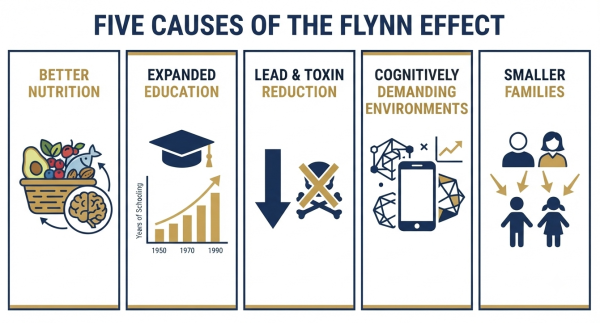
What Causes the Flynn Effect? Five Leading Explanations
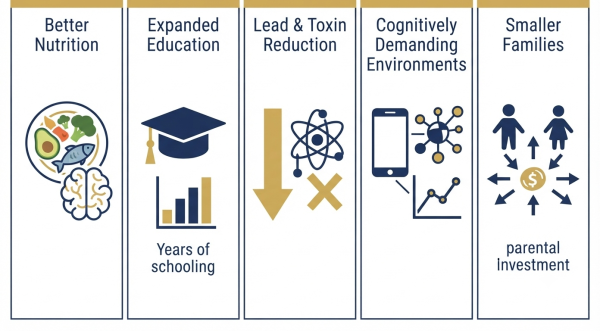
1. Improved Nutrition and Reduced Malnutrition
Malnutrition, iodine deficiency, and iron deficiency during prenatal development and early childhood impair brain development and are associated with significantly reduced IQ. Widespread improvements in nutrition across the 20th century — fortified foods, better access to protein, reduced micronutrient deficiencies — likely account for a substantial portion of the Flynn Effect gain, particularly at the lower end of the distribution where malnutrition was most prevalent. See nutrition and IQ.
2. Expanded Formal Education
More years of schooling, higher quality instruction, and earlier childhood education have been consistently linked to higher IQ scores. Each additional year of education is associated with approximately 1–5 IQ points in research studies. The expansion of secondary and tertiary education across the 20th century represents a major cognitive investment in the population. See average IQ by education level.
3. Reduced Lead and Neurotoxin Exposure
The removal of lead from gasoline in the 1970s–1990s in the United States and other countries is associated with measurable IQ gains at the population level. Lead exposure in early childhood is neurotoxic and has been linked to IQ reductions of multiple points per unit of blood lead concentration. The elimination of other environmental neurotoxins through regulation has likely contributed to Flynn Effect gains as well.
4. More Cognitively Demanding Daily Environments
Modern daily life requires constant abstract reasoning, symbolic processing, and pattern recognition — navigating technology, reading digital information, making decisions with complex information. This continuous low-level cognitive demand may train the abstract reasoning capacities that IQ tests measure. Video games, smartphones, and digital media — whatever their drawbacks — require spatial reasoning and pattern recognition that previous generations never encountered.
5. Smaller Families and Greater Per-Child Investment
As family sizes have decreased across the 20th century, the cognitive investment per child — in terms of parental time, educational resources, and enrichment activities — has increased. This pattern correlates with Flynn Effect gains across countries and may explain some of the cross-national variation in the rate of gains. See related research in can you improve your child's IQ.
The Reverse Flynn Effect: Where Gains Have Stopped
Beginning roughly in the 1990s–2000s, data from several developed nations show that the Flynn Effect has leveled off or reversed. Countries where this "reverse Flynn Effect" has been documented include:
- Norway: Study of military conscripts (Bernt Bratsberg and Ole Rogeberg, 2018) found IQ declining after peaking around 1975
- Denmark: Military testing data showing leveling and slight decline
- Finland: Similar pattern in military data
- Netherlands: After some of the largest 20th-century gains, data show a plateau
- United Kingdom: Some studies show leveling of the trend
The reverse trend appears primarily in fluid intelligence measures — the same component that rose most sharply during the main Flynn Effect. Proposed explanations include:
- Environmental ceiling effects: Nutrition and basic education may have reached near-optimal levels in developed nations, exhausting the most impactful environmental gains
- Changes in cognitive engagement: Declining reading habits, increased passive media consumption, and education systems that may emphasize rote performance over reasoning
- Environmental pollutants: Continued exposure to neurotoxic substances (microplastics, air pollution) may be reversing some gains
- Demographic shifts: Some researchers point to changes in population composition, though this explanation is contested
In developing nations with rapidly improving nutrition, education, and health infrastructure, the Flynn Effect continues. The pattern suggests the effect is environmentally driven and will track the quality of relevant environmental conditions. For how this relates to global intelligence data, see IQ by country.
The Most Important Practical Implication: IQ Test Re-Norming
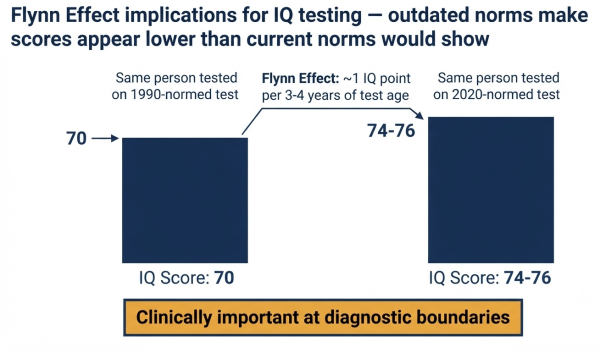
The Flynn Effect has a direct, practical implication for how IQ tests are used clinically and educationally: IQ tests must be periodically re-normed. Because average performance rises over time, a test that keeps the same questions but remains calibrated to a 1990 normative sample will systematically underestimate current performance relative to a test normed on today's population.
This is clinically significant, particularly at diagnostic thresholds:
- An observed IQ score of 70 on a test normed in 1990 may correspond to approximately 73–76 on a test normed in 2020
- This 3–6 point difference can affect whether someone meets Criterion A for intellectual disability diagnosis under DSM-5
- Clinical guidelines specifically recommend using recently normed tests and accounting for test publication date in score interpretation
- The Flynn Effect correction has been explicitly raised in legal contexts where IQ scores affect decisions (e.g., capital punishment eligibility determinations)
For more on how this affects specific score interpretations, see the IQ 70 guide and the IQ Scale Explained guide.
What the Flynn Effect Does — and Doesn't — Tell Us About Intelligence
A common misinterpretation: "the Flynn Effect proves people are getting smarter." The more precise framing: the Flynn Effect shows that people are getting better at the specific cognitive tasks that IQ tests measure — particularly abstract pattern recognition and fluid reasoning. Whether this constitutes "greater intelligence" depends on how you define intelligence.
What the Flynn Effect does not show:
- That wisdom, creativity, or moral reasoning have improved at comparable rates
- That working memory or crystallized knowledge (vocabulary, facts) have risen as dramatically as abstract reasoning
- That all populations have experienced equal gains — substantial variation exists across socioeconomic groups and nations
Flynn himself, in his later work, raised concerns that rising IQ test scores may not fully correspond to rising real-world problem-solving ability, and that the specific cognitive skills being assessed by tests may be shifting relative to what matters most in daily life. For more on this complexity, see IQ vs critical thinking and IQ vs problem-solving.
Frequently Asked Questions
What is the Flynn Effect?
The Flynn Effect is the documented, sustained rise in average IQ test scores — approximately 3 points per decade — observed across the 20th century in dozens of countries. Named after James R. Flynn, who documented it systematically, the effect is too rapid to be genetic and is attributed to environmental improvements: nutrition, education, healthcare, and more cognitively demanding daily environments.
Why does the Flynn Effect matter for IQ test interpretation?
Because IQ norms must be periodically updated, an outdated normative sample causes scores to appear systematically lower than they would on a current test. An observed IQ of 70 on a 1990-normed test may correspond to 73–76 on a 2020-normed test — a clinically significant difference at diagnostic thresholds. Clinical guidelines recommend using recently normed tests and accounting for test age in score interpretation.
What caused the Flynn Effect?
The leading explanations are: improved nutrition (especially reduced malnutrition and iodine deficiency), expanded formal education, removal of lead and other neurotoxins from the environment, more cognitively demanding daily environments, and smaller family sizes enabling greater per-child cognitive investment. The effect is almost certainly multi-causal.
Is the Flynn Effect still happening?
In developing nations, where environmental conditions are still improving, yes. In several developed nations — Norway, Denmark, Finland, Netherlands, UK — data show the trend leveling off or reversing (the "reverse Flynn Effect"). The reversal appears to track the exhaustion of the main environmental gains that drove the original rise.
How much have IQ scores risen due to the Flynn Effect?
Approximately 30 points across the 20th century in many developed countries — about 3 points per decade. If someone who scored at average in 1950 took a current normative IQ test, they would score significantly below 100 — not because they were less intelligent, but because the test is calibrated against a population with more developed test-relevant cognitive skills. For more on what IQ scores mean, see the IQ Scale Explained guide.

Comments
Share Your Thoughts