China's estimated average IQ sits at approximately 104–106 in the most widely cited national intelligence datasets, placing it among the top five countries globally alongside Japan, Singapore, Taiwan, and South Korea. Some recent compilations rank China even higher. But China's national IQ estimate comes with a methodological caveat more significant than that of almost any other country: the data is disproportionately drawn from urban China — and urban China is not representative of the full country of 1.4 billion people.
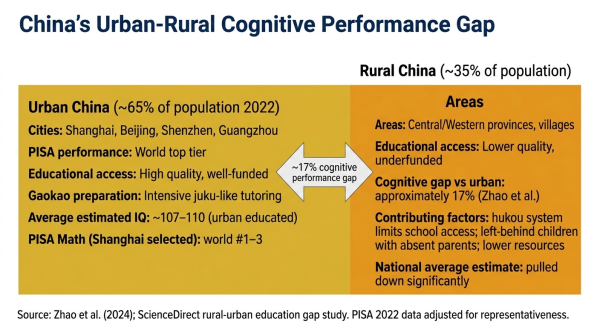
This is known in the research literature as the "Shanghai Problem" — a term referring to the fact that China's initial PISA participation (from 2009) involved Shanghai only, and subsequent expansion included only four of China's most economically developed provinces. These provinces represent China's educational elite, not its national average. Research has documented an approximately 17% cognitive performance gap between urban and rural Chinese students — a gap driven by dramatically unequal educational resources, the hukou household registration system that limits rural children's access to quality urban schooling, and the phenomenon of "left-behind children" whose parents have migrated to cities for work.
This guide covers China's IQ data honestly: what the estimates show, why they carry more uncertainty than Japan's or Singapore's figures, what the urban-rural gap means for interpretation, what genuinely drives China's exceptional urban cognitive performance, and where China fits in the East Asian cognitive performance picture.
China's IQ Data: What the Sources Show
| Source | China Score | Notes |
| Lynn & Becker (2019) | ~104–106 | Aggregated psychometric data; urban bias likely |
| World Population Review (2026) | 106.48 | Based on updated Lynn-Becker figures |
| PISA 2022 (Math) | 591 — #1 globally | ⚠️ Only Beijing, Shanghai, Jiangsu, Zhejiang — not national |
| Rindermann database (2022) | Adjusted down from Shanghai | Explicitly notes Shanghai adjustment needed for national representativeness |
| Urban-rural gap estimate | ~17% performance difference | Zhao et al.; ScienceDirect study (2023) |
The key tension in China's data: PISA scores from selected Chinese provinces are among the highest ever recorded globally. But these scores come from a self-selected sample of provinces — Beijing, Shanghai, Jiangsu, and Zhejiang — that represent China's educational and economic top tier. Heiner Rindermann, whose 2022 cognitive ability dataset is one of the most careful in the field, explicitly noted in his methodology that Shanghai data required adjustment to improve national representativeness. The adjustment matters: the gap between a Shanghai student's performance and a rural Guizhou student's performance is not trivially small.
The Shanghai Problem: Why China's Data Requires Extra Caution
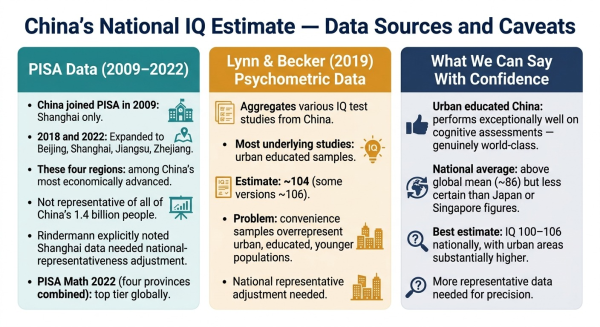
When China first participated in PISA in 2009, it entered only Shanghai — a city of approximately 24 million people in a country of 1.4 billion. Shanghai is China's most economically developed municipality, with per-capita income and educational quality far above the national average. Shanghai's first PISA scores were extraordinary: top of the world in mathematics, reading, and science. These scores were widely reported as "China's PISA scores" — which was factually incorrect and methodologically misleading.
The OECD subsequently worked with China to expand participation to additional provinces. In 2022, China's PISA data covered Beijing, Shanghai, Jiangsu, and Zhejiang — four provinces that are consistently among China's highest in educational quality and economic development. China's combined score of 591 in mathematics was the highest globally — but it represented approximately 200 million people in four top-tier provinces, not the 1.4 billion people of the full country.
What would nationally representative Chinese PISA data look like? Rindermann's methodology explicitly accounts for this, noting that "student data from countries with only regional data were adjusted to be (more) nationally representative (e.g., Shanghai for China)." This adjustment reduces China's estimated national cognitive average substantially below what Shanghai-only data would suggest.
The research on China's urban-rural educational gap provides a sense of the magnitude. Studies have discussed a 17% cognitive ability gap between average urban and rural students in China — driven not by innate differences but by dramatically unequal educational resources, the hukou system that restricts rural children's access to urban schools, and the particular vulnerability of left-behind children whose parents have migrated to cities.
China's urbanisation rate reached 65% in 2022, meaning approximately 35% of the population — roughly 490 million people — still lives in rural areas with substantially lower educational quality. A genuine national IQ average for China would need to include these populations, and the resulting figure would be lower than the urban-sample-based headline estimates suggest.
What Genuinely Drives China's Exceptional Urban Performance
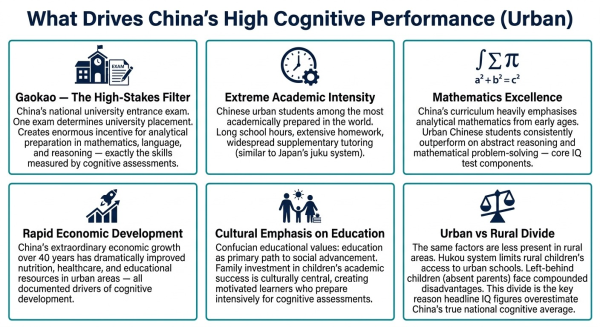
The caveat about data representativeness should not obscure a genuine finding: urban Chinese students, particularly from major cities and developed coastal provinces, really do perform at extraordinarily high levels on cognitive assessments. This performance is real, and it has real explanations:
The Gaokao examination system. China's national university entrance examination — the Gaokao — is the single most consequential academic test in the world by the number of people it affects. Each year, approximately 12 million students sit the Gaokao, and their score determines which university they can attend with almost no other factors considered. This creates enormous, multi-year preparation incentives. China excels in mathematics and science, outperforming the US in PISA scores, but students report a lack of creativity and independence due to Gaokao-centric education. The cognitive skills the Gaokao rewards — systematic mathematical reasoning, precise verbal comprehension, logical analysis — overlap substantially with what IQ tests and PISA assessments measure.
Academic intensity in urban settings. Urban Chinese students are among the most intensively academically prepared in the world. School hours are long, homework loads are heavy, and supplementary tutoring — including the widespread "shadow education" system of private tutoring academies — is nearly universal in urban areas. This preparation develops precisely the cognitive skills that cognitive assessments measure.
Rapid development improving cognitive conditions. China's extraordinary economic growth over the past four decades has dramatically improved urban nutrition, healthcare, and educational infrastructure — all documented drivers of population-level cognitive development. In cities, the nutritional and healthcare conditions that support optimal cognitive development are now largely in place. As covered in our guide on nutrition and IQ, iodine and iron sufficiency, prenatal care quality, and educational access are among the most powerful determinants of population cognitive performance.
Cultural emphasis on academic achievement. Confucian educational values — education as the primary mechanism of social advancement — create deep cultural motivation for academic preparation. This is not unique to China within East Asia (Japan, South Korea, and Singapore share similar cultural emphases), but it is a documented and powerful contributor to the region's consistent high performance on cognitive assessments.
China in the East Asian Context
| Country | IQ Estimate | PISA Math 2022 | Data Quality Note |
| Singapore | ~106 | 575 (#1 nationally representative) | ✅ City-state — nationally representative |
| Japan | ~106 | 536 (#3 nationally representative) | ✅ Nationally representative |
| South Korea | ~102 | 527 (#5 nationally representative) | ✅ Nationally representative |
| Taiwan | ~106 | Top tier | ✅ Generally representative |
| China | ~104–106 | 591 (#1) ⚠️ | ⚠️ Urban provinces only — not national |
China's position in East Asian rankings is complicated by the data quality issue. If the PISA data from Beijing, Shanghai, Jiangsu, and Zhejiang were representative of the whole country, China would rank as the world's highest-performing nation on cognitive assessments. But these four provinces are not representative, and the nationally adjusted estimates place China in the same general tier as Japan, Taiwan, and Singapore — all countries with genuine, well-documented educational excellence — but without the same confidence in the exact number.
For comparison, Singapore's PISA data is nationally representative because Singapore is a city-state — every student in Singapore is in the sample. Japan and South Korea both participate with nationally representative samples. China's expansion to four provinces was a significant improvement from Shanghai-only participation, but it remains incomplete for a country as large and diverse as China.
The comparison also illustrates the East Asian regional pattern discussed in our Japan IQ guide: shared cultural and educational emphases across the region produce consistently high cognitive assessment performance, regardless of which specific country is at the top of the ranking in a given year. The commonality is the educational culture, not anything specific to one nation's population.
What China's Data Means — and Doesn't Mean
Several important conclusions emerge from an honest reading of China's cognitive assessment data:
Urban China's educational performance is genuinely extraordinary. The PISA scores from Beijing, Shanghai, Jiangsu, and Zhejiang are not artefacts of test design or cultural familiarity with the format — they reflect genuine, high-level analytical and mathematical preparation that develops exactly the skills cognitive assessments measure.
The national average is more uncertain than the headline figures suggest. In China, the differences in estimates between datasets is due to a debate about representativeness — a debate that matters more for China than for almost any other country in the top-ranked group, because of the scale of the urban-rural educational gap and the size of the rural population.
The rural-urban gap is an environmental, not a genetic, issue. The approximately 17% cognitive performance gap between urban and rural Chinese students reflects educational resource inequality, not inherent cognitive differences. Research on educational reforms has shown a 21% reduction in the urban-rural education gap and a 78% reduction in the earning gap when computer-assisted learning was introduced to rural schools — demonstrating that the gap is responsive to environmental intervention. As China's urbanisation continues and rural educational quality improves, the national cognitive average will likely rise — just as Japan's did during its own development period.
China's estimated average IQ of ~104–106 places it among the top countries globally, and its PISA scores from selected urban provinces are genuinely among the highest ever recorded. But these figures carry more uncertainty than those for Japan, Singapore, or South Korea, because China's cognitive assessment data is disproportionately drawn from urban, high-income provinces rather than the full national population. The approximately 17% urban-rural cognitive performance gap documented in the research means that nationally representative estimates would likely be lower than headline figures suggest. What the data most clearly establishes is that urban China's educational system produces exceptional cognitive performance through an intensively demanding, analytically focused educational culture — and that this performance advantage is not evenly distributed across the country's 1.4 billion people.
For related guides, see our Japan IQ guide, our guide on average IQ by education level, and our discussion of nutrition and IQ. Take our free IQ test — no registration, results in under 20 minutes.
Frequently Asked Questions
What is the average IQ in China?
China's estimated average IQ is approximately 104–106 based on the most widely cited national intelligence datasets (Lynn & Becker, 2019; World Population Review). However, this estimate carries more uncertainty than figures for Japan or Singapore because it is primarily based on urban data. The true nationally representative average is likely somewhat lower, given the approximately 17% cognitive performance gap between urban and rural Chinese students.
Why does China score so high on PISA?
China's exceptional PISA scores reflect: an extremely demanding Gaokao-focused education system in urban areas, strong cultural emphasis on academic achievement, intensive supplementary tutoring, and the fact that China's PISA data comes only from its most educationally developed urban provinces. When broader, more rural samples are included, scores are substantially lower.
What is the Shanghai Problem?
The "Shanghai Problem" refers to China's PISA data being collected only from Shanghai (from 2009) and subsequently from three additional top-tier urban provinces — not from the full national population. These four provinces (Beijing, Shanghai, Jiangsu, Zhejiang) represent China's educational elite. Rindermann and other researchers explicitly noted that this data required adjustment for national representativeness.
How does China compare to Japan and Singapore?
In headline IQ estimates, China (~104–106) is comparable to Japan (~106) and Singapore (~106). However, Japan and Singapore's figures are based on nationally representative samples, while China's are primarily based on urban data. On methodology-adjusted comparisons, Japan and Singapore likely have more reliable national estimates than China at this time.
Does China's high IQ mean Chinese people are genetically smarter?
No. China's high urban cognitive scores reflect environmental factors — educational system intensity, cultural emphasis on academic preparation, improved nutrition and healthcare in urban areas. The 17% urban-rural cognitive gap within China itself demonstrates this: the gap cannot be genetic (same population), so it must be environmental. As China's rural educational quality continues to improve, the national average will likely rise further.

Comments
Share Your Thoughts