Japan consistently appears at or near the top of global national intelligence rankings. The most widely cited estimate, from Lynn and Becker's 2019 The Intelligence of Nations study, places Japan's average IQ at approximately 106.48 — the highest of any country in that dataset. Independently, Japan ranks in the top three in PISA (Programme for International Student Assessment) scores in mathematics, reading, and science — providing convergent evidence from a more methodologically consistent source.
These numbers raise several questions worth addressing directly: what do they actually mean? How reliable are national IQ estimates? What factors explain Japan's consistently high performance on cognitive assessments? And what does a population average tell us about individuals?
This guide covers all of these questions, with appropriate honesty about what the data shows and where its limitations lie.
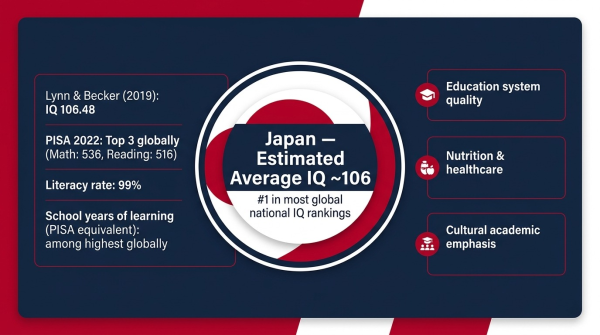
Japan's IQ Data: What the Sources Show
| Source | Japan Score | Japan Ranking | Notes |
| Lynn & Becker (2019) | IQ ~106.48 | #1 globally | Based on actual test data for Japan |
| PISA 2022 (Math) | Score 536 | #3 globally (after Singapore, Taiwan) | Most methodologically consistent source |
| PISA 2022 (Reading) | Score 516 | Top tier globally | Nationally representative 15-year-old sample |
| Literacy rate | ~99% | Among highest globally | Indirect cognitive capacity indicator |
| School years (quality-adjusted) | Among highest globally | Top tier | PISA "learning hours" metric |
The convergence across these different data sources — national IQ estimates, PISA academic assessments, literacy rates, and educational quality metrics — provides stronger evidence for Japan's high cognitive performance than any single source alone. When multiple independent measurement approaches point in the same direction, confidence in the underlying finding increases, even when each individual source has limitations.
How National IQ Estimates Are Produced — and Their Limits
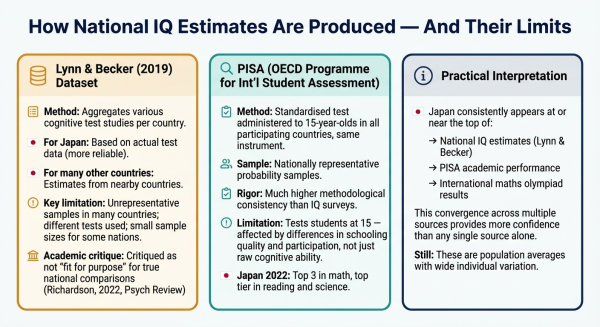
The primary source for Japan's IQ estimate — the Lynn and Becker (2019) dataset — requires context to interpret accurately.
Richard Lynn (1930–2023) spent decades compiling cognitive test data from countries around the world, producing what became the most widely cited source for national IQ comparisons. His 2019 collaboration with David Becker produced estimates for 203 countries. For some countries, including Japan, the estimates are based on actual standardised test data administered to representative samples. For many others, estimates are extrapolated from nearby countries or derived from small, unrepresentative samples.
The dataset has attracted substantial scientific criticism. A 2022 paper in Psychological Review concluded that the dataset "is not fit for purpose" for estimating national cognitive ability, citing: unrepresentative sampling in many countries; inconsistent test instruments across nations; and small sample sizes that could not support accurate national estimates. The authors noted that estimates for many countries were built on samples that "were deliberately chosen to be unrepresentative" — for example, only testing children from urban areas or selective schools.
Japan's estimate is more reliable than most within the dataset because it draws on actual test data from the country rather than extrapolation. But even for Japan, the national IQ figure should be understood as an order-of-magnitude estimate, not a precision measurement. It indicates that Japan's population-level cognitive assessment performance is substantially above the global average — it does not precisely pin that performance to the specific number 106.48.
PISA scores provide a more methodologically consistent basis for comparison. PISA uses the same test instrument, administered to nationally representative probability samples of 15-year-olds across all participating countries, with rigorous quality controls. Japan's consistent top-tier PISA performance — particularly in mathematics and scientific literacy — provides independent validation of its high cognitive assessment standing.
What Drives Japan's High Cognitive Performance
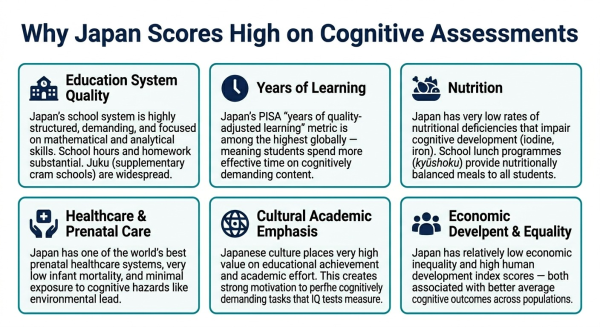
Japan's high cognitive assessment scores reflect a combination of environmental, educational, and cultural factors — not genetic differences. The scientific consensus is clear that national differences in cognitive assessment performance are primarily driven by environmental factors, and Japan's case provides several of the most important:
Educational system quality and intensity. Japan's school system is highly structured, rigorous, and demanding — particularly in mathematics and the analytical skills that IQ tests measure. School hours are long, homework is substantial, and a culture of academic discipline begins early. The juku system — supplementary cram schools attended by a large proportion of Japanese students outside regular school hours — provides additional cognitive practice beyond what formal schooling delivers. Japan's PISA "effective hours of learning" metric is among the highest in the world, reflecting not just time spent but the cognitive quality of that time.
Nutritional quality. Japan has consistently low rates of nutritional deficiencies that impair cognitive development, particularly iodine and iron deficiency. As covered in our guide on nutrition and IQ, iodine deficiency alone can reduce average population IQ by 12–13 points — its absence is a substantial cognitive advantage. Japan's school lunch programme (kyūshoku) provides nutritionally balanced meals to all students, further ensuring adequate micronutrient intake during critical developmental years.
Healthcare and prenatal care. Japan has one of the world's most effective prenatal and early childhood healthcare systems, with very low infant mortality rates and minimal exposure to environmental cognitive hazards such as lead. High-quality prenatal care during critical brain development windows (as discussed in our nutrition and IQ guide) protects the cognitive potential of each generation.
Cultural emphasis on academic achievement. Japanese culture places high value on educational effort and academic performance. This cultural emphasis creates strong intrinsic and social motivation to engage seriously with the cognitively demanding tasks that both IQ tests and PISA assessments measure. The attitude toward education as the primary mechanism for social advancement generates population-level preparation for exactly the skills that cognitive assessments measure.
Economic development and equality. Japan has a high Human Development Index score and relatively low economic inequality compared to many countries. Higher economic development is associated with better nutrition, healthcare, and educational quality — and lower inequality means these benefits are more widely distributed across the population rather than concentrated in a small elite.
The Flynn Effect: Japan's IQ Gains Are Proof That Environment Drives Performance
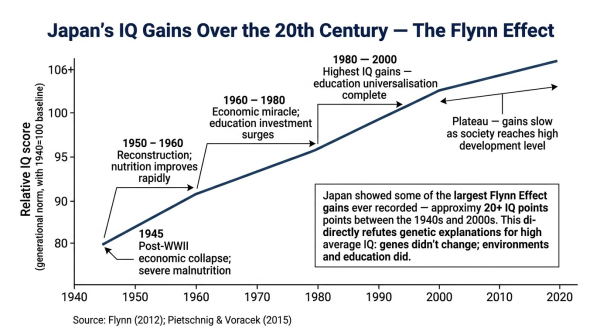
One of the most important pieces of evidence about what drives Japan's high cognitive assessment scores comes from history: Japan was not always near the top of international cognitive rankings. In the decades after World War II, Japan experienced catastrophic economic disruption, severe malnutrition, and dramatically reduced educational quality. The cognitive assessment scores of Japanese people during this period were substantially lower than they are today.
Over the second half of the 20th century, as Japan rebuilt its economy, radically expanded and improved its educational system, addressed nutritional deficiencies, and developed its healthcare infrastructure, measured cognitive ability rose dramatically. The Flynn Effect — the well-documented generational rise in raw IQ scores that has occurred across all studied populations in the 20th century — was particularly large in Japan. Research documents some of the largest Flynn Effect gains ever recorded for Japan: approximately 20+ IQ points between the post-WWII period and the modern era.
This history is critically important for interpreting Japan's current high scores. Genes did not change between the 1940s and the 2000s. The Japanese population's cognitive assessment performance improved dramatically because its environment — educational quality, nutrition, healthcare, economic conditions — improved dramatically. This is direct empirical evidence that Japan's high national IQ reflects environmental factors, not genetic superiority. For more on the Flynn Effect, see our guide on what IQ actually measures.
Japan in East Asian Context
Japan does not stand alone at the top of cognitive assessment rankings — it sits within a broader pattern of East Asian high performance that includes Singapore, Taiwan, South Korea, Hong Kong, and China. All of these countries share features of the profile described above: demanding educational systems, strong cultural emphasis on academic achievement, well-developed nutrition and healthcare infrastructure, and high human development indices.
This regional clustering further supports environmental explanations: multiple genetically diverse East Asian populations that share educational and cultural emphases consistently outperform populations from countries that lack these features. The commonality is not genetic heritage — the countries are genetically diverse — but the shared institutional and cultural emphasis on education and cognitive development. For comparison with other top-ranking countries, further guides in the IQ by Country series address Singapore, South Korea, and other high-performing nations.
What Japan's Average IQ Means — and Doesn't Mean
A population average IQ of approximately 106 means that Japanese people score, on average, 6 points above the global normalised mean. This is a meaningful difference in aggregate — it matters for population-level outcomes in education and economic productivity. But it does not mean that all or even most Japanese people have IQs of 106 or above. The individual distribution within Japan spans the same broad range as any population — from well below average to highly gifted — with an average shifted modestly upward compared to the global mean.
What it does not mean is that any individual Japanese person has a higher IQ than any individual from another country. A person in Japan with IQ 95 and a person in the US with IQ 125 are simply two individuals within the broad distributions of their respective populations. Population averages say nothing about individuals. For context on what specific IQ scores mean, see our IQ scale explained.
Japan's estimated average IQ of approximately 106 (Lynn & Becker, 2019) places it at or near the top of global national cognitive rankings, and this ranking is independently validated by Japan's consistent top-tier performance in PISA international assessments. This high average reflects a combination of exceptional educational system quality and intensity, excellent nutritional and healthcare infrastructure, strong cultural emphasis on academic achievement, and a high level of economic development — not genetic differences. Japan's dramatic Flynn Effect gains over the 20th century demonstrate directly that the country's high current scores are the product of environmental improvement, not fixed biological capacity.
Find out where your own cognitive profile sits with our free IQ test — no registration, results in under 20 minutes. For context on the IQ scale, see our IQ scale explained. For how nutrition and education affect IQ, see our nutrition and IQ guide and average IQ by education guide.
Frequently Asked Questions
What is the average IQ in Japan?
Japan's estimated average IQ is approximately 106–107, based on the Lynn and Becker (2019) Intelligence of Nations dataset. This places Japan at or near the top of global national IQ rankings. Japan also ranks consistently in the top 3 in PISA international student assessments, providing independent confirmation of high cognitive performance.
Why does Japan have such a high average IQ?
Japan's high cognitive performance reflects: exceptional educational system quality (demanding, analytical, with extensive supplementary schooling); excellent nutrition and healthcare (99% literacy, low nutritional deficiency rates, quality prenatal care); strong cultural emphasis on academic achievement; and high economic development with relatively low inequality. Japan's large Flynn Effect gains over the 20th century demonstrate that these are environmental, not genetic, factors.
Is Japan's IQ score accurate?
Japan's national IQ estimate is based on actual test data rather than extrapolation, making it more reliable than many countries in the Lynn & Becker dataset. However, all national IQ figures carry substantial methodological uncertainty. PISA scores, which use consistent methodology, provide more reliable comparative data and consistently place Japan in the global top tier.
How does Japan compare to other Asian countries?
East Asian countries consistently cluster at the top of both national IQ estimates and PISA rankings: Japan (~IQ 106), Taiwan (~IQ 106), Singapore (~IQ 106), Hong Kong (~IQ 105), China (~IQ 104), and South Korea (~IQ 102) all perform substantially above the global average. This East Asian clustering reflects shared educational and cultural emphases rather than genetic similarities.
Does Japan's high IQ mean Japanese people are genetically smarter?
No. The scientific consensus is that national differences in cognitive assessment scores are primarily driven by environmental factors — educational quality, nutrition, healthcare, and economic development. Japan's dramatic Flynn Effect gains (approximately 20+ IQ points) between the post-WWII period and modern day demonstrate directly that its high current scores reflect environmental improvement, not fixed genetic capacity.

Comments
Share Your Thoughts