IQ — Intelligence Quotient — is one of the most widely referenced but least well-understood concepts in psychology. People encounter IQ scores in school assessments, hiring processes, and online comparisons of famous figures. Yet the meaning of the number, what it actually measures, and what it predicts are consistently misunderstood. This guide covers the science: where IQ comes from, how modern tests work, what the WAIS-IV classification system actually says, and where the concept has meaningful limits. To take an IQ test and see your score, start with our International Standard IQ Test.
What IQ Measures — and What It Doesn't
IQ tests do not measure knowledge, education, or wisdom. They measure specific cognitive capacities: how efficiently your mind processes, analyzes, and responds to new or abstract problems. The domains most modern IQ tests assess are:
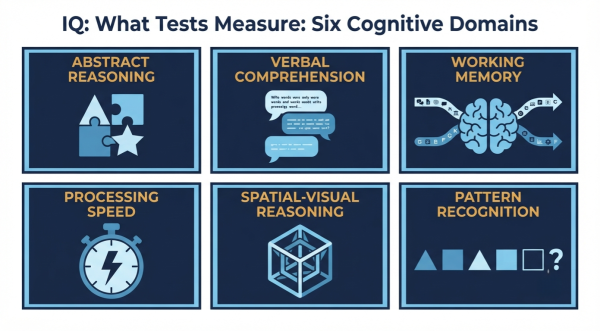
- Abstract Reasoning: Identifying patterns, relationships, and logical rules in new problem types without prior specific knowledge
- Verbal Comprehension: Understanding, analyzing, and using language — including vocabulary depth, reading comprehension, and verbal analogy
- Working Memory: Holding and manipulating multiple pieces of information in active memory simultaneously — directly relevant to multi-step reasoning and language processing
- Processing Speed: How quickly and accurately the brain can perform cognitive operations — relevant to timed tasks and fluid reasoning
- Spatial-Visual Reasoning: Understanding and mentally manipulating shapes, forms, and spatial relationships
- Pattern Recognition: Detecting structural rules and sequences in visual and numerical information — the basis of Raven's Progressive Matrices tests
The scores across these domains are combined into a composite IQ score. What is explicitly not measured by standard IQ tests:
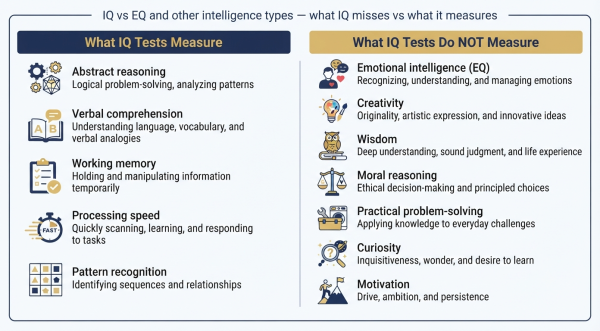
- Emotional intelligence (empathy, self-awareness, social judgment) — see the EQ Test and IQ vs EQ guide
- Creativity and divergent thinking — see IQ vs creativity
- Practical problem-solving in real-world contexts — see IQ vs problem-solving
- Wisdom, moral reasoning, and judgment under ambiguity
- Curiosity, motivation, and persistence — see whether IQ can be improved
- Musical, kinesthetic, interpersonal, and naturalistic intelligences — see Multiple Intelligences Theory
A Brief History of IQ Testing
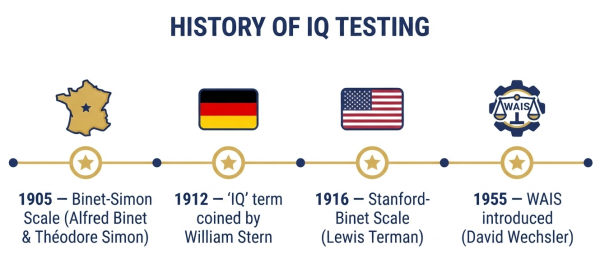
The concept of measuring intelligence developed rapidly in the early 20th century:
- 1905 — Alfred Binet and Théodore Simon (France): Developed the first practical intelligence test — the Binet-Simon Scale — to identify children who needed additional educational support. This is the origin of IQ testing. Binet himself was cautious about the test's limitations and warned against treating it as a fixed measure of innate ability. For more on this history, see the Binet IQ test guide.
- 1912 — William Stern (Germany): Coined the term "Intelligence Quotient" and proposed the original formula: IQ = (Mental Age / Chronological Age) × 100. A child performing at the mental level of someone two years older would score above 100.
- 1916 — Lewis Terman (Stanford University): Adapted the Binet-Simon for American use, creating the Stanford-Binet Intelligence Scale — the first widely used standardized IQ test in the United States.
- 1955 — David Wechsler: Introduced the Wechsler Adult Intelligence Scale (WAIS), which replaced the mental age formula with a statistical comparison approach and introduced the multi-domain structure still used today. The current version, WAIS-IV, remains the most widely used clinical IQ assessment for adults. Read the full WAIS-IV guide and Wechsler IQ test guide.
How Modern IQ Scores Are Calculated
The original ratio formula (Mental Age / Chronological Age × 100) was replaced in modern testing by deviation IQ — a statistical method that compares your performance to a large representative sample of people in your age group.
The key parameters of modern IQ scoring:
- Population mean is set to 100 by design
- Standard deviation (SD) is set to 15 on most tests (WAIS, Stanford-Binet)
- Approximately 68% of the population scores within one SD of the mean (IQ 85–115)
- Approximately 95% of the population scores within two SDs (IQ 70–130)
- Approximately 99.7% of the population scores within three SDs (IQ 55–145)
Your IQ score reflects how many standard deviations above or below the population mean you fall — not an absolute measure of cognitive ability, but a relative position within the normal distribution for your age group. For detailed percentile context, see the IQ Scale Explained guide.
WAIS-IV IQ Classification System
| IQ Score | WAIS-IV Classification | Percentile Range |
| 130 and above | Very Superior | 98th and above |
| 120–129 | Superior | 91st–97th |
| 110–119 | High Average | 75th–90th |
| 90–109 | Average | 25th–73rd |
| 80–89 | Low Average | 9th–23rd |
| 70–79 | Borderline | 2nd–8th |
| 69 and below | Extremely Low | Below 2nd |
Note: "Gifted" (IQ 130+) and "Genius" (IQ 140+) are informal cultural labels, not official WAIS-IV classifications. For individual score pages, see the IQ Scores guide.
Is IQ Inherited or Shaped by Environment?
Both — and in complex interaction. Research on twins, adopted children, and siblings consistently shows that somewhere between 50% and 80% of IQ variance across the population is attributable to genetic factors. Identical twins raised apart show more IQ similarity than fraternal twins raised together. Genetics influence brain structure, working memory capacity, processing efficiency, and other cognitive hardware.
But genetics set the potential range — environment determines how much of that potential is realized. The most significant environmental factors research has identified:
- Quality and duration of formal education
- Nutrition during prenatal development and early childhood — see nutrition and IQ
- Physical exercise — see exercise and the brain
- Sleep quality and duration — see sleep and IQ
- Socioeconomic access to cognitive stimulation and stability
- Cultural emphasis on reasoning and verbal complexity
For the full research on genetic versus environmental contributions to intelligence, see is intelligence inherited.
The Flynn Effect: Why IQ Scores Have Been Rising
One of the most important — and most underreported — facts about IQ is the Flynn Effect: the documented rise in average IQ scores of approximately 3 points per decade throughout most of the 20th century. Named after researcher James Flynn, the effect has been observed across dozens of countries and hundreds of samples.
The Flynn Effect is significant for several reasons:
- It demonstrates that measured IQ is substantially shaped by environmental factors — the gains are too rapid to be genetic
- It explains why IQ tests must be periodically re-normed — scores on tests with outdated normative samples appear systematically lower than they would on current samples
- It has particular importance at the lower end of the distribution — a score of 70 on a test normed in 1990 may correspond to approximately 73–76 on a test normed today, a difference that can matter for clinical diagnosis
- In some countries, the Flynn Effect has stalled or reversed in recent decades, prompting research on what environmental factors are changing
For the full research on this phenomenon, see the Flynn Effect guide.
What IQ Predicts — and What It Doesn't
IQ is one of the most thoroughly validated predictors in psychological research. High IQ is associated with:
- Academic performance — strong correlation across all educational levels
- Income and occupational complexity — see IQ and income and average IQ by profession
- Job performance, particularly in complex, information-dense roles
- Health outcomes — higher IQ is associated with better health literacy and decision-making
What IQ does not reliably predict on its own:
- Leadership effectiveness — emotional intelligence, communication, and situational judgment matter more
- Creative achievement — the correlation between IQ and creative output weakens significantly above IQ ~120
- Life satisfaction and wellbeing — research shows weak or no consistent correlation
- Moral character or ethical behavior — no relationship established
For context on how IQ compares to other predictors of success, see IQ vs EQ, IQ vs academic achievement, and IQ vs critical thinking.
Can IQ Be Improved?
IQ scores can change, particularly during childhood and adolescence when neuroplasticity is highest. A 2011 study from University College London found that adolescent IQ scores can shift by up to 20 points over several years based on educational engagement and cognitive challenge. The Flynn Effect demonstrates that population-level IQ has responded significantly to environmental improvements over generations. Research on neuroplasticity confirms that sustained cognitive challenge promotes brain development across the lifespan.
The most evidence-supported approaches to maintaining and strengthening the cognitive capacities IQ tests measure include quality education, physical exercise, adequate sleep, proper nutrition, sustained reading, and continued engagement with novel intellectual challenges. Brain training apps and targeted IQ-boosting programs show limited evidence of lasting transfer beyond the specific tasks practiced.
For more on this topic, see whether IQ can be improved.
IQ and Age: How It Changes Across the Lifespan
IQ scores are age-normed — your score reflects your performance relative to people in your age group, not compared to the entire population. This is important because fluid intelligence (abstract reasoning, processing speed) typically peaks in the mid-20s and gradually declines with age, while crystallized intelligence (accumulated knowledge, verbal comprehension) tends to remain stable or even improve into middle age and beyond. For more on how age affects cognitive ability, see average IQ by age.
Frequently Asked Questions
What does IQ stand for and what does it measure?
IQ stands for Intelligence Quotient. Modern IQ tests measure six primary cognitive domains: abstract reasoning, verbal comprehension, working memory, processing speed, spatial-visual reasoning, and pattern recognition. The average IQ is set at 100, with a standard deviation of 15. IQ does not measure creativity, emotional intelligence, wisdom, or practical life skills.
How is IQ calculated?
Modern IQ tests use deviation IQ — comparing your performance to a representative sample of your age group. The mean is set to 100 and the standard deviation to 15. The original mental age ratio formula was replaced by this statistical comparison method in modern assessments like the WAIS-IV.
What is a good IQ score?
By definition, 100 is the population average. About 68% of the population scores between 85 and 115. The WAIS-IV classifies 90–109 as Average, 110–119 as High Average, 120–129 as Superior, and 130+ as Very Superior. For specific scores, see the IQ Scores guide.
What is the Flynn Effect?
The Flynn Effect is the documented rise in average IQ scores of approximately 3 points per decade throughout the 20th century, observed across dozens of countries. It demonstrates that measured IQ is substantially shaped by environmental factors (nutrition, education, cognitive demands of daily life). It also means scores on outdated, un-renormed tests appear systematically lower than scores on current tests. See the Flynn Effect guide.
Can IQ be improved?
IQ scores can change, particularly during childhood and adolescence. Research confirms that quality education, physical exercise, adequate sleep, nutrition, and sustained intellectual engagement support cognitive development. Brain training apps show limited transfer effects. The Flynn Effect demonstrates that population IQ has responded to environmental improvements over generations. See the full guide: can IQ be improved.

Comments
Share Your Thoughts