Music does more than entertain — it shapes the way we think, feel, and learn. Musical intelligence, one of Howard Gardner’s multiple intelligences, refers to the ability to perceive, create, and express meaning through sound. People strong in this intelligence think in rhythms and melodies, and their brains are wired to respond deeply to musical patterns. In this guide, we’ll explore what musical intelligence is, how it works, and how you can develop it in everyday life.
What Is Musical Intelligence?
Musical intelligence is the capacity to recognize, differentiate, and manipulate sounds, rhythms, tones, and melodies. It involves sensitivity to pitch, rhythm, timbre, and tone — as well as the ability to express oneself musically. This concept complements traditional measures of intelligence, such as those found in our overview of what IQ is, by showing that intelligence extends far beyond logic and numbers. Howard Gardner first introduced this concept in his Theory of Multiple Intelligences (1983), emphasising that intelligence is also about creativity and emotional expression through music — a framework often compared to discussions about IQ vs. EQ when exploring different forms of human capability.
Characteristics of People with High Musical Intelligence
People with high musical intelligence experience the world through sound, rhythm, and vibration. Music is not just entertainment for them — it’s a language of thought, emotion, and connection. They often find meaning and memory in melodies, perceiving sound patterns with remarkable sensitivity and precision.
- Rhythmic Sensitivity: They can easily recognize tempo, rhythm, and beat — not only in music but also in speech, movement, and nature. This pattern-recognition ability often overlaps with cognitive skills evaluated in a problem-solving aptitude test.
- Strong Auditory Memory: They can recall melodies, lyrics, or even complex chord progressions after hearing them just once or twice, humming or reproducing sounds accurately without formal training.
- Emotional Connection to Sound: Music deeply moves them — a song can evoke vivid memories, inspire creativity, or change their emotional state instantly. This emotional resonance often leads them toward music therapy, counselling, or education.
- Creative Expression: They naturally gravitate toward composing, improvising, singing, or playing instruments, and innovate in how they use sound to communicate ideas, tell stories, or evoke moods.
- Enhanced Listening and Analytical Skills: They can detect subtle shifts in pitch, tone, and harmony that others might overlook, making them exceptional sound engineers, vocal coaches, or linguists.
Musical intelligence is not limited to professional musicians. Teachers who use rhythm in classroom lessons, therapists who use music to help patients recover emotional balance, or marketers who design jingles to influence behaviour — all demonstrate this type of intelligence.
The Brain and Musical Intelligence
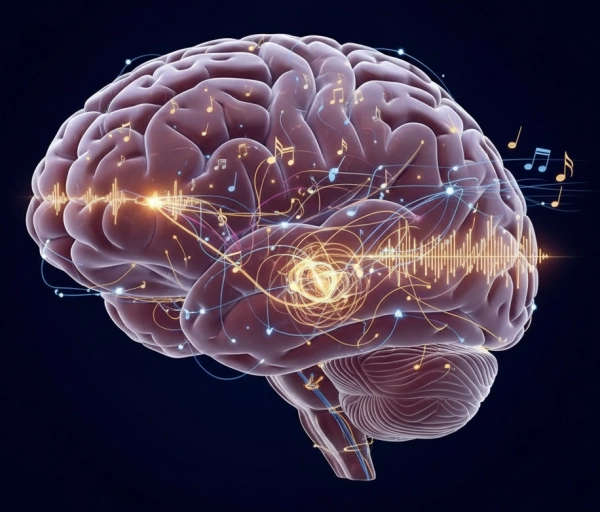
Music is one of the few human experiences that activates nearly every region of the brain simultaneously. The Auditory Cortex processes sound, tone, and pitch. The Cerebellum governs rhythm, balance, and timing. The Hippocampus connects music to long-term memory and emotion — explaining why hearing an old song can transport you back to a specific moment in time. The Prefrontal Cortex handles creativity, decision-making, composition, and improvisation. And the Corpus Callosum (the bridge between brain hemispheres) is often thicker in musicians, suggesting enhanced communication between analytical and creative thought processes.
A 2013 Nature Neuroscience study found that learning or playing an instrument strengthens connections between both hemispheres — similar to how mental training boosts neuroplasticity measured in various IQ tests. Music acts as a full-brain workout, combining artistic creativity with analytical precision — which explains why people with musical intelligence often excel in language learning, mathematics, and problem-solving.
Examples of Musical Intelligence in Daily Life
Musical intelligence manifests everywhere. Even people who don’t identify as “musical” often use this intelligence in subtle, everyday ways: instantly recognising the melody of a song after hearing just a few notes, using rhythm or jingles to remember information, tapping your foot or nodding along to a beat without realising it, feeling uplifted or focused when listening to specific genres, creating personalised playlists for studying or relaxing, and identifying instruments or harmonies in a complex piece. So whether you’re singing in the shower or using background music to stay productive, you’re already engaging your musical intelligence.
Benefits of Developing Musical Intelligence
1. Cognitive Benefits
Developing musical intelligence strengthens memory and attention span through repeated pattern recognition, enhances mathematical and spatial reasoning by understanding rhythm and structure, and boosts analytical thinking and sequencing skills used in problem-solving and programming.
2. Emotional and Social Benefits
Music promotes empathy (musicians learn to interpret emotional cues through sound), builds emotional regulation and resilience by channelling feelings into creative output, encourages teamwork and communication through group performances, and reduces anxiety while boosting mood through rhythmic synchronisation and self-expression.
3. Educational and Academic Benefits
Music enhances language learning, reading comprehension, and verbal memory. A 2019 study published in Frontiers in Psychology found that students engaged in consistent music education outperformed their peers in linguistic and cognitive tests — confirming that musical intelligence supports academic success and overall brain development.
How to Develop Musical Intelligence
You don’t have to be born with musical talent — musical intelligence can be developed and refined at any age. Just like physical fitness, the brain’s auditory and rhythmic centres strengthen through consistent exposure, deliberate practice, and emotional engagement with sound.
1. Listen Actively — Train Your Ear to Hear More
Instead of playing music as background noise, start listening with intention. Pay attention to the rhythm and tempo, the melody and harmony, how different instruments interact, and the emotional journey the music takes you through. Active listening stimulates both the auditory cortex and the prefrontal cortex, improving your ability to recognise sounds and your analytical thinking. Try closing your eyes when you listen and mentally visualising the instruments or rhythm patterns to strengthen auditory-visual integration.
2. Learn an Instrument — Build Neural Pathways Through Practice
Playing an instrument is one of the most effective ways to grow musical intelligence. When you play piano, guitar, violin, or drums, your brain coordinates hearing, sight, and fine motor skills simultaneously — creating strong neural connections between sensory and motor regions. Neuroscientists at Harvard Medical School found that musicians have denser grey matter in the auditory and motor cortices than non-musicians. Even 15–30 minutes of daily instrument practice can significantly boost memory, attention, and hand-eye coordination.
3. Sing or Hum Regularly — Strengthen Memory Through Sound
Singing activates both hemispheres of the brain — the left for language and structure, and the right for emotion and melody. When you sing or hum, you train pitch accuracy, improve breathing control, and engage your auditory feedback loop. Studies show that people who sing regularly exhibit better verbal memory and emotional regulation. Whether in a choir, car, or shower, you’re exercising your musical intelligence and emotional well-being.
4. Explore Music Theory — Understand the Language of Sound
Learning music theory deepens your appreciation for how melodies and harmonies work. Understanding scales, chords, intervals, and time signatures allows you to predict musical patterns, recognise compositions, and create your own. Music theory is to musicians what grammar is to writers — it provides structure, rules, and creative freedom. It also strengthens logical and mathematical thinking, since rhythm and harmony are deeply rooted in ratios and numerical relationships.
5. Create or Remix Music — Stimulate the Creative Brain
Composing, remixing, or experimenting with sounds engages multiple brain regions simultaneously — from the auditory cortex (listening) to the prefrontal cortex (decision-making and creativity). Digital music tools like GarageBand, Ableton Live, or FL Studio allow anyone to compose music easily regardless of experience level. Creating your own rhythm or melody enhances pattern recognition, sequencing skills, and emotional intelligence, while also activating dopamine — the brain’s “pleasure chemical” — which enhances learning and motivation.
6. Connect Music with Emotion — Bridge Feeling and Thought
When you consciously connect songs to feelings or life experiences, you engage both the limbic system (emotion) and the hippocampus (memory). Try creating playlists for specific moods — focus, joy, calm, nostalgia, or confidence. Associating melodies with emotions strengthens self-awareness and emotional regulation. As music psychologist Dr. Daniel Levitin explains, “Music uniquely unites the emotional and cognitive systems of the brain — allowing us to feel and think simultaneously.”
Musical Intelligence in Education and Therapy
1. In Education
Teachers integrate rhythm, melody, and rhyme to make learning more memorable. Students remember historical facts through songs, multiplication tables become easier with rhythm patterns, and language learners improve pronunciation through musical repetition. Research from the Journal of Educational Psychology (2020) shows that children exposed to structured music lessons demonstrate higher academic achievement and better attention control than peers without musical training.
2. In Therapy and Mental Health
Music therapy is a clinically recognised field used to help individuals recover speech, movement, or emotional stability. For stroke survivors, rhythmic cueing helps retrain the brain for speech and coordination. For patients with depression or anxiety, creating and listening to music reduces cortisol levels and fosters emotional release. For those with PTSD, certain harmonic frequencies can trigger calmness and safety responses.
3. In Special Education
Children with autism spectrum disorder (ASD) or ADHD often respond strongly to rhythmic and melodic patterns. Music helps them regulate attention, express themselves non-verbally, and improve coordination. As noted by the American Psychological Association, music “bridges the gap between emotion and cognition,” making it one of the most powerful and inclusive tools for human development.
Famous Examples of Musical Intelligence
Throughout history, some of humanity’s most creative minds have embodied extraordinary musical intelligence. Wolfgang Amadeus Mozart composed complex symphonies by age five. Ludwig van Beethoven, despite losing his hearing, continued to compose masterpieces by “hearing” music internally — a powerful testament to neuroplasticity and imagination. Stevie Wonder transformed his heightened sense of hearing into soulful, emotionally rich music that transcended genres. Hans Zimmer masterfully combines classical orchestration with modern sound design to shape the emotional storytelling of today’s films. These examples prove that musical intelligence goes beyond sound — it is a deep form of creativity, intuition, and resilience.
Final Thoughts: Everyone Has Musical Potential
Musical intelligence is not a rare gift — it is a universal human ability waiting to be nurtured. Every time you sing, move to a rhythm, or use sound to express emotion, you engage powerful neural pathways that shape your creativity and consciousness. By intentionally developing this intelligence through active listening, learning instruments, or composing, you enhance not only your musicality but also your memory, emotional depth, and cognitive performance.
As Howard Gardner, the creator of the Multiple Intelligences Theory, wrote:
“Music is the most unique expression of human intelligence — where logic meets emotion.”
Music is not just what we hear; it’s how we think, feel, and connect. Developing your musical intelligence isn’t merely about playing notes — it’s about unlocking the symphony within your mind. Explore more in our IQ Guides collection.
References
- Patel, A. D. (2010) – Music, Language, and the Brain. Oxford University Press.
- Herholz, S. C., & Zatorre, R. J. (2012) – Musical Training as a Framework for Brain Plasticity. Nature Reviews Neuroscience.

Comments
Share Your Thoughts