The relationship between sleep and cognitive performance is one of the most robust findings in neuroscience: sleep deprivation reliably impairs the cognitive abilities that IQ tests measure, and adequate sleep is essential for the brain to perform at its best. But the science of sleep and intelligence is more nuanced — and more surprising — than popular coverage usually conveys.
The most striking finding in recent research comes from a 2023 study by Balter and colleagues at the Karolinska Institutet: people with higher fluid intelligence are not more resistant to sleep deprivation — they are more vulnerable. Their cognitive advantage at baseline largely disappears after a night without sleep. If you are reading this because you want to understand how sleep affects your cognitive performance, this finding matters directly for you.
This guide covers what happens to the brain during sleep deprivation, which cognitive domains are most affected, what the research says about how many IQ points are lost with chronic short sleep, and the practical implications for anyone who wants to protect or maximise their cognitive output.

Sleep is not cognitive downtime. It is cognitively essential — the period during which the brain performs maintenance and consolidation functions that cannot happen during wakefulness. Understanding what these functions are makes it clear why sleep deprivation is so cognitively costly:
Memory consolidation. During slow-wave (non-REM) sleep, the hippocampus replays experiences from the day and transfers them into longer-term cortical storage. This is why learning is more effective when followed by sleep: the material is literally being consolidated into long-term memory while you sleep. Multiple studies have demonstrated that sleep-deprived learners retain significantly less new material than those who sleep normally after learning — not because they learned less, but because the consolidation process was disrupted.
Synaptic homeostasis. The synaptic homeostasis hypothesis (Tononi and Cirelli) proposes that wakefulness is associated with net synaptic strengthening, and sleep performs synaptic downscaling — pruning weak connections and renormalising synaptic strength. This maintains the signal-to-noise ratio in neural networks that efficient cognition requires. Without adequate sleep, neural noise increases and cognitive processing becomes less efficient.
Glymphatic clearance. During sleep, the brain's glymphatic system flushes metabolic waste products — including amyloid-beta, the protein associated with Alzheimer's disease — from brain tissue at a substantially higher rate than during wakefulness. Chronic sleep deprivation allows these metabolites to accumulate, with documented associations with long-term cognitive decline in older adults.
Prefrontal cortex restoration. The prefrontal cortex — responsible for executive function, working memory, planning, and top-down cognitive control — is particularly sensitive to sleep deprivation and is the first region to show functional impairment with sleep loss. This is consequential for IQ because fluid intelligence, executive function, and working memory (all measured by IQ tests) are substantially dependent on prefrontal cortex function.

Sleep deprivation does not affect all cognitive abilities equally. The research identifies a clear hierarchy of sensitivity:
Sustained attention — most affected. The ability to maintain focused attention over time is the cognitive function most consistently and substantially impaired by sleep deprivation. Even modest sleep restriction (restricting to 6 hours per night for two weeks) produces sustained attention impairments equivalent to two nights of total sleep deprivation. This has direct implications for any extended cognitive task — including IQ testing, academic examinations, and any work requiring sustained concentration.
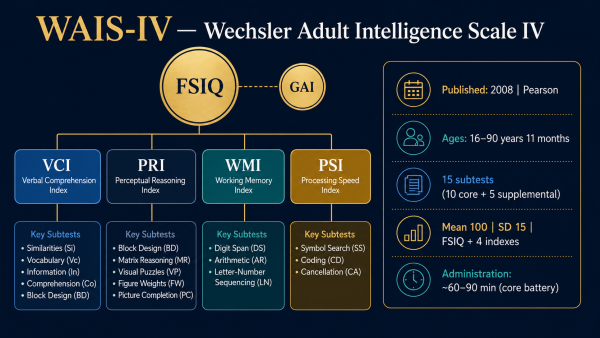
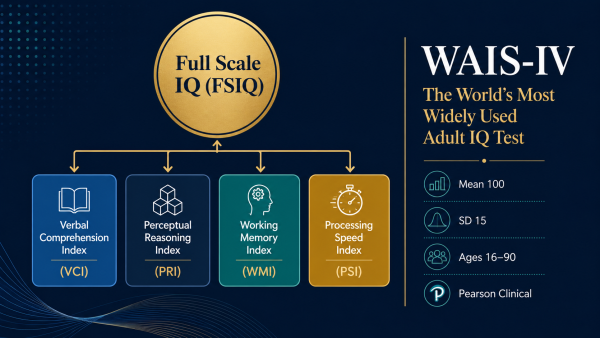
Processing speed — highly affected. How quickly simple cognitive information is processed declines significantly with sleep deprivation. The Processing Speed Index (PSI) of the WAIS-IV — measured by Symbol Search and Coding subtests — is expected to be among the indexes most sensitive to sleep status. Sleep-deprived individuals complete these tasks more slowly and with more errors. The 2025 research confirms that reaction time slows and auditory P300 latency increases after total sleep deprivation.
Working memory — highly affected. The ability to hold and manipulate information in short-term memory is substantially compromised by sleep deprivation, consistent with the prefrontal cortex sensitivity described above. The Working Memory Index (WMI) of the WAIS-IV is therefore expected to decline significantly under sleep-deprived conditions. Research on partial sleep restriction over multiple nights finds cumulative working memory deficits that worsen over successive nights of restricted sleep.
Executive function and decision-making — moderately to highly affected. Sleep deprivation impairs impulse control, risk assessment, planning, and cognitive flexibility — the higher-order regulatory functions dependent on prefrontal cortex integrity. Crucially, sleep-deprived individuals consistently underestimate their own cognitive impairment — they feel less impaired than they are, which makes sleep deprivation particularly insidious in contexts requiring accurate self-assessment.
Fluid reasoning — moderately affected. Abstract reasoning and novel problem-solving are affected by sleep deprivation, though the research is somewhat less consistent here than for attention and working memory. A meta-analysis by Lowe et al. (2017) found that "sleep deprivation effects were less consistent for traditional IQ measures (reasoning and intelligence) than for attention and working memory tasks." This suggests that fluid reasoning is more robust to acute sleep loss than attentional functions, though chronic sleep restriction does impair it.
Crystallised verbal knowledge — least affected. Accumulated verbal knowledge — vocabulary, general information, verbal analogies — is the most robust cognitive domain under sleep deprivation. The Verbal Comprehension Index (VCI) of the WAIS-IV is expected to be the least affected by acute sleep deprivation. This makes intuitive sense: crystallised knowledge is stored in long-term cortical memory and does not require the same moment-to-moment executive processing that fluid tasks demand.
For context on how these specific cognitive domains map onto IQ test scores, see our WAIS-IV guide.
Several research studies have attempted to quantify the cognitive cost of sleep deprivation in IQ-equivalent terms:
A 2023 study published in the Journal of Neuroscience (Cheng et al.) examined cognitive performance in short sleepers (below 6 hours per night) and found that they scored approximately 2.4 to 2.9 IQ points lower on general cognitive ability tests compared to adequate sleepers, even without reporting sleep problems or daytime sleepiness. This suggests that habitual short sleep produces measurable cognitive impairment even when the person subjectively feels adapted to it.
For acute total sleep deprivation (one night without sleep), effects on sustained attention are particularly large — some studies report performance drops on the Psychomotor Vigilance Task equivalent to the level seen after moderate alcohol intoxication (blood alcohol approximately 0.05–0.08%). For cognitive tasks requiring sustained focus over extended periods — including full IQ test administration (60–90 minutes) — sleep deprivation effects can be substantial.
Chronic partial sleep restriction (sleeping 6 hours per night for 14 days) produces cognitive impairments that eventually match those of 24–48 hours of total sleep deprivation, while subjective sleepiness levels off much earlier. This is the "adaptation illusion" — people feel less sleepy but continue to perform worse cognitively with each successive night of insufficient sleep.

The most counterintuitive finding in recent sleep-IQ research comes from a 2023 study by Balter, Sundelin, Holding, Petrovic, and Axelsson at the Karolinska Institutet, published in the Journal of Sleep Research.
The study randomised 182 healthy adults to either total sleep deprivation or a normal night of sleep. Participants completed Raven's Progressive Matrices (a standard fluid intelligence test) at baseline and cognitive tests — arithmetic ability, episodic memory, spatial working memory, and simple attention — at both baseline and post-sleep manipulation.
The baseline finding was expected: people with higher fluid intelligence performed significantly better on arithmetic calculations and episodic memory at baseline. This is consistent with the established validity of IQ tests as predictors of cognitive performance.
The post-deprivation finding was not expected: those with higher fluid intelligence showed larger performance decrements after total sleep deprivation, not smaller. Their cognitive advantage at baseline largely disappeared after one night without sleep. Lower-IQ participants declined less because they had less to lose from the starting point.
The researchers propose a mechanism: "The superior cognitive performance in those with higher fluid intelligence is dependent on a prefrontal cortex network that requires optimal sleep." High fluid intelligence relies on efficient prefrontal top-down control of working memory, executive function, and reasoning. Since the prefrontal cortex is the brain region most sensitive to sleep deprivation, high-IQ performance — which depends more on this network — is more disrupted when it is compromised.
The practical implication is significant: if you have high cognitive ability and are accustomed to performing at a high level, you may have more to lose from sleep deprivation than you expect. The cognitive advantage that comes with high fluid intelligence appears to be more fragile under sleep-deprived conditions than lower-baseline performance is.

The relationship between sleep duration and cognitive performance follows an inverted-U curve: too little impairs performance, and — perhaps surprisingly — too much is also associated with reduced cognitive performance relative to the optimal range.
| Sleep Duration | Cognitive Impact | Notes |
| 4–5 hours | Severe impairment | Sustained attention, working memory, speed all substantially reduced |
| 6 hours | Moderate impairment | ~2.4–2.9 IQ-point performance decrement; adaptation illusion likely |
| 7–9 hours | Optimal range | NSF recommendation for adults 18–64; peak cognitive output |
| 9–11 hours | Modest decline | Often reflects underlying health conditions rather than oversleep per se |
The National Sleep Foundation recommends 7–9 hours for adults aged 18–64 and 7–8 hours for adults 65+. Individual variation exists — a minority of adults appear to function well on 6 hours due to genetic variants (particularly a mutation in the DEC2 gene associated with short sleep efficiency), and a minority need 9+ hours. But the research consistently suggests that most adults chronically underestimate their sleep need and overestimate their adaptation to short sleep.
One underappreciated implication of the sleep-cognition research is that IQ test performance is meaningfully affected by sleep status at the time of testing. This has implications for how to interpret IQ scores and for how to prepare for cognitive assessment:
A 2020 review in Current Opinion in Behavioral Sciences noted that IQ test performance may be higher when assessed at an individual's preferred time of day, and that there is a documented association between chronotype (morning vs evening preference) and intellectual ability — people with evening chronotypes tend to score higher on intelligence tests, but may be tested at disadvantageous times in standardised school settings. Research raises the possibility that the cognitive advantage of higher intelligence may be offset by sleep deprivation effects if all children are tested at the same early hour in school.
For anyone preparing for a formal IQ assessment, the practical implication is clear: adequate sleep in the nights before testing is one of the most effective optimisations available. The evidence suggests this is particularly important for people with higher fluid intelligence, whose test performance may be more sensitive to sleep quality.
Sleep is not a passive break from cognitive activity — it is the period during which the brain consolidates memory, restores prefrontal function, clears metabolic waste, and prepares for the next day's cognitive demands. Sleep deprivation impairs attention, working memory, and processing speed most severely — the cognitive domains most sensitive to executive function. Fluid reasoning is somewhat more robust but is also compromised with chronic sleep restriction. And the 2023 Karolinska research introduces a finding that deserves wide attention: people with higher fluid intelligence appear to be more vulnerable to sleep deprivation than people with lower baseline performance, not less — because their superior performance depends on prefrontal networks that sleep loss preferentially disrupts. Sleep may be the single most accessible and powerful tool for maintaining and protecting cognitive performance.
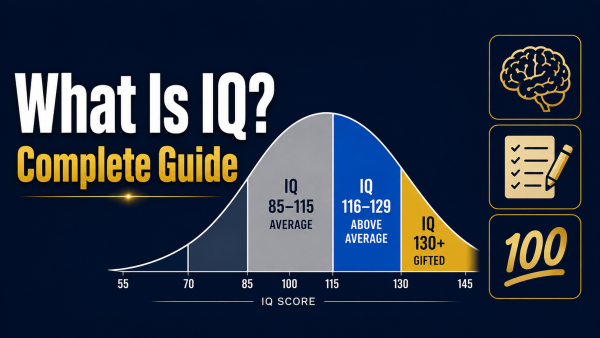
For more on how the cognitive abilities affected by sleep map onto IQ test structure, see our WAIS-IV guide and our Wechsler IQ test guide. For context on what specific IQ scores mean, see our IQ scale explained. Take our free IQ test when well-rested for your best result.
Yes. Sleep deprivation reliably impairs the cognitive abilities measured by IQ tests, particularly attention, working memory, and processing speed. A 2023 Journal of Neuroscience study found short sleepers scored approximately 2.4–2.9 IQ points lower on general cognitive ability tests. Effects on fluid reasoning are somewhat less consistent than effects on attention tasks, but chronic sleep restriction impairs all cognitive domains over time.
Estimates suggest chronic short sleep (below 6 hours) is associated with cognitive decrements equivalent to approximately 2–8 IQ points depending on the measure and duration. Acute total sleep deprivation produces larger impairments on sustained attention and processing speed — comparable to mild intoxication on some measures — but has less consistent effects on fluid reasoning.
No — and the research suggests the opposite. A 2023 Karolinska Institutet study found that people with higher fluid intelligence showed larger performance decrements after sleep deprivation, not smaller. Their baseline advantage largely disappeared after one sleepless night, likely because high fluid intelligence depends on prefrontal cortex networks that are particularly sensitive to sleep loss.
7–9 hours per night for adults aged 18–64 is the range most consistently associated with peak cognitive performance, per National Sleep Foundation guidelines and the broader research literature. Both too little and too much sleep are associated with reduced cognitive performance relative to this range.
From most to least affected: sustained attention (most sensitive), processing speed, working memory, executive function, fluid reasoning, verbal comprehension, and crystallised knowledge (least sensitive). On the WAIS-IV, Processing Speed Index (PSI) and Working Memory Index (WMI) are most affected; Verbal Comprehension Index (VCI) is most robust.
Comments
Share Your Thoughts