The Wechsler Adult Intelligence Scale — known clinically as the WAIS — is the most widely administered individual intelligence test for adults in the world. Developed by psychologist David Wechsler and published by Pearson Clinical, it has been the clinical standard for adult cognitive assessment in North America and much of the English-speaking world since its first edition in 1955. The current version is the WAIS-5, published in 2024, succeeding the WAIS-IV (2008) which was itself in active clinical use for over a decade.
When a licensed clinical psychologist, neuropsychologist, or school psychologist gives someone an IQ test, the WAIS is the instrument they are most likely to use. When a clinical report states an IQ score, it is most likely derived from a Wechsler instrument. When IQ scores are referenced in disability assessments, forensic evaluations, educational planning documents, or neurological diagnoses, the Wechsler scale is the most common source.
This guide covers everything you need to understand the Wechsler IQ test: its history, structure, what each component measures, how scores are built from subtests to index scores to Full Scale IQ, what the WAIS-IV and WAIS-5 look like, the broader Wechsler family of tests, and how to interpret a Wechsler score report.
David Wechsler and the Origins of the WAIS
David Wechsler published his first intelligence scale — the Wechsler-Bellevue Intelligence Scale — in 1939. It was a deliberate departure from the Stanford-Binet scale that had dominated intelligence testing since Lewis Terman's 1916 adaptation (covered in our Binet IQ test guide). Wechsler had two primary criticisms of the Stanford-Binet as it existed at the time:
Age coverage. The Stanford-Binet was designed primarily for children and adolescents. Its ratio IQ formula (mental age ÷ chronological age × 100) breaks down for adults, since mental age does not continue to increase into adulthood in the same way it does during childhood. Wechsler wanted a test designed from the ground up for adult populations.
Single-score limitation. Wechsler believed intelligence was not a single entity that could be adequately described by one number. He designed his test to produce both a verbal score and a performance (nonverbal) score in addition to a full-scale composite — acknowledging that cognitive ability has multiple relatively distinct dimensions.
The Wechsler-Bellevue was revised and renamed the Wechsler Adult Intelligence Scale (WAIS) in 1955. It has been revised four times since: WAIS-R (1981), WAIS-III (1997), WAIS-IV (2008), and WAIS-5 (2024). Each revision updated the normative sample to correct for the Flynn Effect and refined the test structure based on advances in cognitive science. The WAIS-IV's 2008 elimination of the traditional Verbal IQ / Performance IQ dichotomy — replaced by a four-index model — was the most significant structural change in the test's history.
The WAIS-IV Structure: Four Indexes, 15 Subtests, One FSIQ
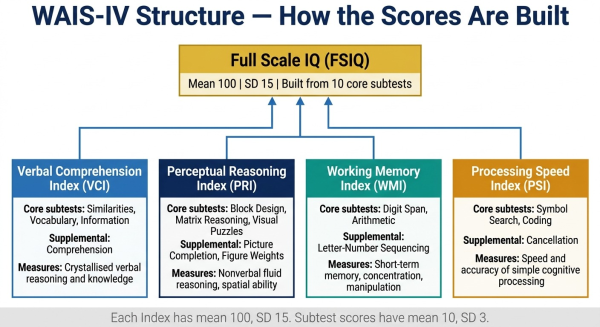
The WAIS-IV (2008) organises its assessment around a hierarchical structure: 15 subtests (10 core, 5 supplemental) combine into four Index Scores, which in turn combine into a single Full Scale IQ (FSIQ). All scores use the same scale: mean 100, SD 15. All four Index Scores are on this scale independently, meaning an Index Score of 115 means the same thing in any domain — better than approximately 84% of the normed adult population on that specific cognitive domain.
The Four Index Scores
Verbal Comprehension Index (VCI). The VCI measures crystallised verbal intelligence — language-based reasoning and knowledge that has been built through education and experience. Core subtests: Similarities (how are two things alike — tests verbal abstract reasoning and concept formation), Vocabulary (define words — tests breadth of vocabulary and verbal knowledge), and Information (general knowledge questions — tests range of accumulated knowledge). Supplemental: Comprehension (practical social judgment questions). A high VCI indicates strong verbal reasoning, broad vocabulary, and the ability to understand and use language precisely. It is the index most predictive of academic performance in verbally intensive fields and the most stable over time.
Perceptual Reasoning Index (PRI). The PRI measures fluid nonverbal intelligence — the ability to reason about visual-spatial problems that cannot be solved through accumulated verbal knowledge. Core subtests: Block Design (assemble coloured blocks to match a pattern — tests spatial analysis and visual construction), Matrix Reasoning (identify the missing piece in a visual pattern — tests inductive nonverbal reasoning), and Visual Puzzles (identify which three pieces assemble into a given design). Supplemental: Picture Completion, Figure Weights (quantitative visual reasoning). A high PRI indicates strong spatial reasoning, visual problem-solving, and the ability to reason in the moment without relying on stored knowledge. It is particularly relevant for engineering, design, surgical, and visual-creative fields.
Working Memory Index (WMI). The WMI measures the ability to hold information in short-term memory while performing mental operations on it — what cognitive scientists call executive working memory. Core subtests: Digit Span (repeat a sequence of numbers forwards, backwards, and in ascending order — tests auditory attention and memory), and Arithmetic (mentally solve numerical problems without writing — tests numerical working memory under time pressure). Supplemental: Letter-Number Sequencing. The WMI is particularly sensitive to attention difficulties, anxiety, and the cognitive effects of neurological conditions. People with ADHD often show lower WMI scores regardless of their verbal or perceptual reasoning level. A high WMI indicates strong mental multitasking, concentration, and the ability to track multiple pieces of information simultaneously.
Processing Speed Index (PSI). The PSI measures the speed and accuracy of simple cognitive processing — the ability to process routine information quickly and accurately. Core subtests: Symbol Search (scan rows to determine whether a target symbol appears — tests visual scanning speed and attention) and Coding (copy symbols paired with numbers according to a key — tests processing speed, visual-motor coordination, and short-term visual memory). Supplemental: Cancellation. The PSI is the most sensitive index to normal ageing — processing speed declines most reliably with age compared to other cognitive domains. A low PSI with high other indexes is common in people with certain neurological conditions, ADHD, or in older adults. A high PSI indicates cognitive efficiency and rapid information processing in routine tasks.
What Each Index Measures in Everyday Terms
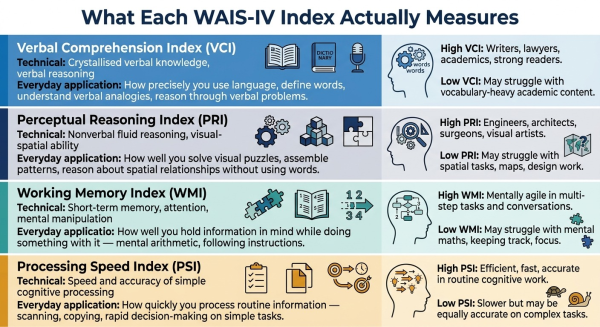
The four Index Scores translate into recognisable patterns of cognitive strength and challenge in everyday life. Understanding what each measures in practical terms helps interpret a WAIS score report much more usefully than the FSIQ alone.
A person with a high VCI and low PRI typically demonstrates strong verbal and linguistic ability but struggles with spatial and nonverbal tasks — a profile common in certain learning profiles and associated with strong performance in humanities and law but relative difficulty in engineering and spatial design. A person with a high PRI and low VCI shows the mirror pattern — strong visual-spatial reasoning with relative weakness in verbal domains, a profile associated with strong performance in technical and visual fields but potential difficulty with linguistically demanding academic content. A person with low WMI often reports subjective difficulties with focus, concentration, and mental tracking — difficulties that do not reflect their verbal or spatial reasoning capability but do affect the efficiency with which that capability is deployed. A person with disproportionately low PSI compared to other indexes may be intellectually capable but slow in time-pressured cognitive tasks — a pattern that can be especially problematic in standardised testing environments and some high-speed professional contexts.
This is why clinical psychologists consistently emphasise that the FSIQ alone is often the least informative number in a Wechsler report. The index profile — how the four indexes compare to each other — frequently reveals clinically important patterns that the composite conceals. An FSIQ of 100 might reflect four index scores all near 100 (a relatively flat profile suggesting consistently average ability across domains), or it might reflect a VCI of 130 and a PSI of 72 (a clinically significant discrepancy suggesting strong verbal ability with extremely slow processing speed, a pattern common in some learning disabilities and neurological conditions).
The Full Scale IQ (FSIQ): What It Is and What It Isn't
The Full Scale IQ (FSIQ) on the WAIS-IV is derived from the 10 core subtests. It has a mean of 100 and a standard deviation of 15. It is the single composite score most commonly reported as "the IQ score." The classification bands used by the Wechsler scale are:
| IQ Range | Wechsler Classification | Percentile Range |
| 130 and above | Very Superior | 98th+ |
| 120–129 | Superior | 91st–97th |
| 110–119 | High Average | 75th–90th |
| 90–109 | Average | 25th–73rd |
| 80–89 | Low Average | 9th–23rd |
| 70–79 | Borderline | 2nd–8th |
| 69 and below | Extremely Low | Below 2nd |
For context on what specific scores in these ranges mean for career access, cognitive profile, and daily life, see our dedicated guides across the IQ score series — from our IQ 73 guide (Borderline range) through our IQ 160 guide (clinical ceiling). For an overview of the full scale, see our IQ scale explained.
The FSIQ is a powerful predictor of academic achievement, occupational performance in complex roles, and learning efficiency — the research evidence for its predictive validity is among the strongest in all of psychology. What it is not is a complete description of a person's cognitive life. It does not measure emotional intelligence, creativity, practical intelligence, musical or athletic ability, moral character, or any of the many other human capacities that are not captured by time-pressured performance on specific cognitive tasks. For more on this, see our guide on IQ vs EQ.
The WAIS-5 (2024): What Changed
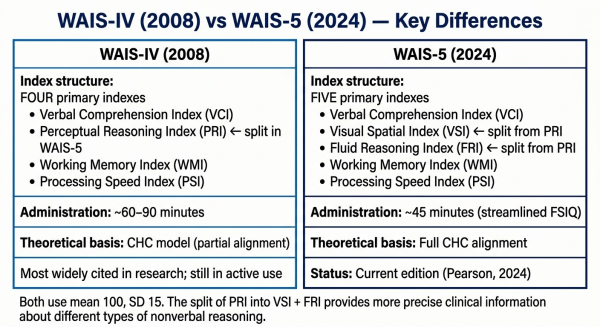
Pearson published the WAIS-5 in 2024, succeeding the WAIS-IV after 16 years. The most significant structural change is the splitting of the Perceptual Reasoning Index (PRI) into two separate indexes:
- Visual Spatial Index (VSI) — measuring spatial assembly and pattern recognition (Block Design, Visual Puzzles)
- Fluid Reasoning Index (FRI) — measuring novel abstract problem-solving through inductive and quantitative reasoning (Figure Weights, Matrix Reasoning)
This creates a five-index structure aligned with the Cattell-Horn-Carroll (CHC) theoretical model of cognitive abilities — the dominant theoretical framework in psychometric research. The WAIS-5 also streamlines the FSIQ to seven core subtests, reducing administration time to approximately 45 minutes for the standard battery (compared to 60–90 minutes for the full WAIS-IV). The underlying scoring standard (mean 100, SD 15) is retained.
In practice, the WAIS-IV remains widely used — many psychologists trained on it, large research databases reference WAIS-IV norms, and the two instruments are substantially comparable. Understanding which edition produced a specific score report matters for accurate interpretation, particularly when comparing scores from different testing occasions.
The Wechsler Family: WAIS, WISC, and WPPSI
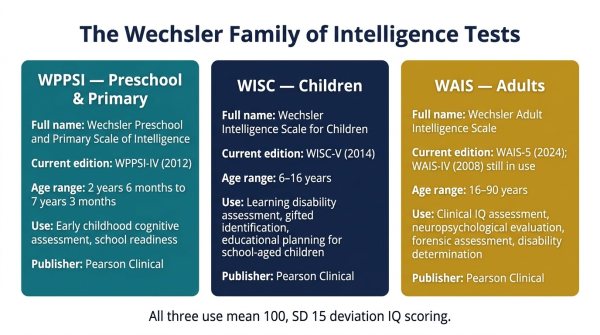
The WAIS is the adult member of a broader family of Wechsler intelligence tests, all published by Pearson and all using the same mean 100 / SD 15 scoring system:
WPPSI (Wechsler Preschool and Primary Scale of Intelligence). Current edition: WPPSI-IV (2012). Age range: 2 years 6 months to 7 years 3 months. Used for early childhood cognitive assessment, developmental screening, and school readiness evaluation. Appropriate for assessing very young children before the WISC age range begins.
WISC (Wechsler Intelligence Scale for Children). Current edition: WISC-V (2014). Age range: 6–16 years. The most widely used intelligence test for school-aged children, used for learning disability assessment, gifted identification, educational planning, and cognitive evaluation in clinical and school psychology settings. The WISC-V uses five primary index scores: Verbal Comprehension, Visual Spatial, Fluid Reasoning, Working Memory, and Processing Speed — the same five-index structure that the WAIS-5 has now adopted for adults.
WAIS (Wechsler Adult Intelligence Scale). Current edition: WAIS-5 (2024). Age range: 16–90 years. The gold standard for adult cognitive assessment in clinical, neuropsychological, forensic, and disability evaluation contexts.
Scores on all three instruments are directly comparable — they use the same norming standard, the same mean and SD, and closely related classification labels. This means a WISC score from childhood can be meaningfully compared to a later WAIS score from adulthood, within the limits of measurement error and developmental change.
How to Read a Wechsler Score Report
A full Wechsler score report typically includes:
- Full Scale IQ (FSIQ) — the single composite, with confidence interval
- Index Scores — each Index Score with its classification, percentile, and confidence interval
- Subtest Scaled Scores — each of the 10+ subtests scaled to mean 10, SD 3
- Index comparisons — whether differences between index scores are statistically significant and clinically meaningful
- Strengths and weaknesses — which subtests and indexes are significantly above or below the person's own average (ipsative interpretation)
The most important interpretive principle: read the profile, not just the number. A FSIQ of 95 (Average) with a VCI of 130 (Very Superior) and a PSI of 68 (Extremely Low) is a dramatically different cognitive profile from a FSIQ of 95 with all four index scores between 90 and 100. Both produce the same FSIQ. Only the index profile tells the complete story.
The Wechsler IQ test — in its WAIS form for adults — is the clinical gold standard for measuring adult cognitive ability. The WAIS-IV's four-index structure (Verbal Comprehension, Perceptual Reasoning, Working Memory, Processing Speed) and the WAIS-5's five-index extension provide a detailed cognitive profile beyond the single Full Scale IQ. Understanding what each index measures, how the subtests build into indexes, and why the profile matters more than the FSIQ alone is essential for anyone interpreting a Wechsler score report — whether for their own results, a child's educational evaluation, or a clinical or forensic context.
For more on how IQ tests work and what they measure, see our guides on the Binet IQ test and what IQ actually measures. For context on specific scores on the Wechsler scale, see our full IQ scale explained. Take our free IQ test to find out where your own cognitive profile sits.
Frequently Asked Questions
What is the Wechsler IQ test?
The Wechsler IQ test refers to a family of individually administered intelligence tests published by Pearson. The adult version — the Wechsler Adult Intelligence Scale (WAIS) — is the most widely used adult intelligence test in the world. Current edition: WAIS-5 (2024); the WAIS-IV (2008) is still widely cited and used. All versions use mean 100, SD 15 deviation IQ scoring.
What does the WAIS measure?
The WAIS-IV measures four cognitive domains: Verbal Comprehension (language-based reasoning and knowledge), Perceptual Reasoning (nonverbal visual-spatial problem-solving), Working Memory (short-term attention and mental manipulation), and Processing Speed (speed and accuracy of simple cognitive tasks). The WAIS-5 splits Perceptual Reasoning into Visual Spatial and Fluid Reasoning, creating five indexes.
How is the WAIS scored?
WAIS scores use deviation IQ with mean 100 and SD 15. Subtest scaled scores have mean 10 and SD 3. The four Index Scores and the Full Scale IQ (FSIQ) all have mean 100 and SD 15. A score of 100 is exactly average. Scores 90–109 are classified Average; 110–119 High Average; 120–129 Superior; 130+ Very Superior.
What is the difference between WAIS-IV and WAIS-5?
The WAIS-IV (2008) uses four index scores; the WAIS-5 (2024) splits the Perceptual Reasoning Index into Visual Spatial and Fluid Reasoning, creating five index scores aligned with the CHC theoretical model. The WAIS-5 also streamlines FSIQ administration to approximately 45 minutes. Both use mean 100, SD 15 scoring.
What is the Full Scale IQ on the Wechsler?
The Full Scale IQ (FSIQ) is a composite score with mean 100 and SD 15, derived from the core subtests. It is the single number most commonly reported as "the IQ score." However, clinical psychologists emphasise that the index profile is often more informative than the FSIQ — large discrepancies between index scores can make the FSIQ misleading as a summary of cognitive ability.

Comments
Share Your Thoughts