The WAIS-IV (Wechsler Adult Intelligence Scale – Fourth Edition) is the most widely cited adult intelligence test in the world. Published by Pearson in 2008, it is the clinical gold standard for adult cognitive assessment — the instrument found on the desk of virtually every clinical psychologist, neuropsychologist, and school psychologist who works with adults aged 16 and older. When a clinical report references an adult IQ score, it is most likely derived from the WAIS-IV.
This guide provides a complete reference to the WAIS-IV: all 15 subtests and what each measures, the four index scores and what each represents, the Full Scale IQ and the supplemental General Ability Index, how to read a WAIS-IV report, and the most common interpretive patterns that clinical reports document.
WAIS-IV at a Glance: Key Facts
| Feature | Detail |
| Full name | Wechsler Adult Intelligence Scale – Fourth Edition |
| Publisher | Pearson (PsychCorp) |
| Year published | 2008 |
| Age range | 16:0 to 90:11 (years:months) |
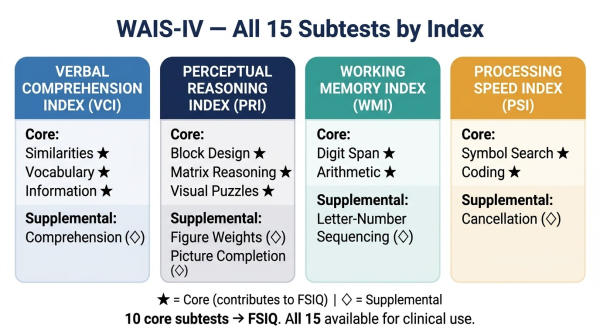
| Number of subtests | 15 total (10 core + 5 supplemental) |
| Primary composite scores | FSIQ + four Index Scores (VCI, PRI, WMI, PSI) |
| Supplemental composites | General Ability Index (GAI), Cognitive Proficiency Index (CPI) |
| Scoring standard | Deviation IQ: mean 100, SD 15 |
| Normative sample | 2,200 adults (collected 2006–2007) |
| Administration time | ~60–90 minutes for core battery |
| Administration method | Individually administered by trained examiner |
| Major change from WAIS-III | Removed Verbal IQ/Performance IQ; introduced four-index structure |
The Four Index Scores: What Each Measures
The WAIS-IV organises cognitive assessment around four primary Index Scores, each measuring a distinct cognitive domain. Every Index Score has a mean of 100 and a standard deviation of 15, using the same scale as the Full Scale IQ. This means the same classification bands apply to Index Scores and the FSIQ alike — a VCI of 125 means the same thing (Superior, 95th percentile) as an FSIQ of 125.
Verbal Comprehension Index (VCI)
The VCI measures crystallised verbal intelligence — the accumulated product of education and experience expressed through language. It is the most stable of the four indexes over time and the least sensitive to the effects of normal ageing. Core subtests: Similarities, Vocabulary, and Information. Supplemental: Comprehension.
A high VCI indicates strong verbal reasoning, broad vocabulary, and the ability to use language precisely. It predicts performance in verbally demanding academic and professional contexts — law, literature, management, academia. A low VCI relative to PRI may indicate a language-based learning difficulty, limited educational opportunity, or a profile where nonverbal reasoning is stronger than verbal. For context on how VCI performance relates to real-world outcomes, see our guide on what IQ actually measures.
Perceptual Reasoning Index (PRI)
The PRI measures fluid nonverbal intelligence — the ability to reason about visual-spatial problems without relying on accumulated verbal knowledge. It is more sensitive to the effects of normal ageing than the VCI. Core subtests: Block Design, Matrix Reasoning, and Visual Puzzles. Supplemental: Figure Weights, Picture Completion.
A high PRI indicates strong spatial reasoning, visual problem-solving, and fluid intelligence — the ability to think clearly about novel problems in the moment. It predicts performance in engineering, architecture, surgery, and visual-creative fields. In the WAIS-5 (2024), the PRI was split into two separate indexes — Visual Spatial and Fluid Reasoning — reflecting the clinical and theoretical recognition that these two aspects of nonverbal intelligence are distinguishable. For more, see our Wechsler IQ test guide.
Working Memory Index (WMI)
The WMI measures the ability to hold information in short-term memory while performing mental operations on it. It is particularly sensitive to attentional difficulties, anxiety, and the early cognitive effects of neurological conditions. Core subtests: Digit Span and Arithmetic. Supplemental: Letter-Number Sequencing.
Digit Span is administered in three parts: forward (repeat digits in order — tests simple auditory attention and short-term memory), backward (repeat digits in reverse — tests working memory), and ascending (reorder digits from lowest to highest — tests executive working memory). The pattern of performance across these three conditions provides diagnostic information beyond the subtest total. A person whose forward span is normal but backward and ascending are substantially lower is showing a specific executive working memory deficit, not just a memory deficit.
Low WMI with otherwise strong indexes is a common pattern in ADHD (attention-deficit/hyperactivity disorder) and some learning disabilities. It can also reflect test anxiety, since Arithmetic specifically requires holding a numerical problem in working memory under time pressure. A low WMI does not indicate low intelligence — it indicates difficulty with the specific cognitive operations of mental manipulation and sustained attention.
Processing Speed Index (PSI)
The PSI measures the speed and accuracy of simple cognitive processing — rapid visual scanning, accurate copying of symbol-digit pairings, and focused attention. Core subtests: Symbol Search and Coding. Supplemental: Cancellation.
The PSI is the index most sensitive to normal ageing — processing speed declines reliably with age from the mid-20s onward, while verbal comprehension remains stable or even increases until late middle age. In older adults, a low PSI in the context of normal VCI and PRI is a normal ageing pattern, not a sign of pathology. In younger adults, a disproportionately low PSI relative to other indexes may indicate neurological conditions, ADHD, depression, motor difficulties (particularly relevant for Coding, which involves handwriting), or specific processing speed deficits.
All 15 Subtests: What Each One Measures
Verbal Comprehension Subtests
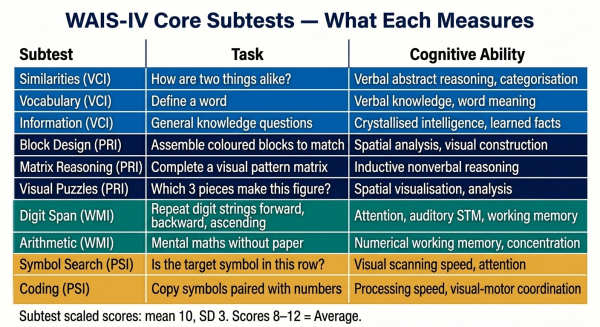
Similarities (Core — VCI). The examiner names two objects or concepts and the examinee must explain what they have in common (e.g., "In what way are a triangle and a rectangle alike?"). This is a measure of verbal abstract reasoning and concept formation — the ability to identify the abstract category that links two apparently different things. Higher-level responses that identify the more abstract, essential similarity score more highly than responses that identify only surface features.
Vocabulary (Core — VCI). The examiner presents words either orally or visually and the examinee must define them. This is a measure of crystallised verbal knowledge — the breadth and depth of verbal knowledge accumulated through education and reading. It is one of the most reliable subtests on the WAIS-IV and the most predictive of academic performance in verbally intensive fields.
Information (Core — VCI). The examiner asks factual questions covering a broad range of general knowledge topics (history, science, geography, culture). This measures crystallised intelligence in the form of accumulated factual knowledge. It is sensitive to educational opportunity and cultural exposure.
Comprehension (Supplemental — VCI). The examiner asks questions about practical social situations and conventions (e.g., "Why are laws necessary?" or "What should you do if you find someone's wallet?"). This measures practical social reasoning and judgment rather than verbal knowledge per se.
Perceptual Reasoning Subtests
Block Design (Core — PRI). The examinee uses red-and-white patterned blocks to recreate a geometric design shown in a picture, working against time limits. This measures spatial analysis, visual construction, and the ability to decompose a complex whole into its component parts. It is one of the most sensitive subtests to spatial learning disabilities and neurological conditions affecting spatial processing. A Block Design No Time Bonus process score is available — comparing performance with and without time pressure provides diagnostic information about whether slow performance is due to spatial difficulty or processing speed difficulty.
Matrix Reasoning (Core — PRI). The examinee examines a series of abstract figures arranged in a matrix pattern and selects the missing element from five options. This is a pure measure of inductive nonverbal reasoning and fluid intelligence, largely free from cultural and educational influences. It is considered one of the purest measures of Gf (fluid intelligence) in the WAIS-IV.
Visual Puzzles (Core — PRI). The examinee looks at a completed geometric figure and selects from six options the three component pieces that would combine to make it. New to the WAIS-IV (not present in WAIS-III), this measures spatial synthesis and visual-spatial reasoning without the time pressure and motor demands of Block Design.
Figure Weights (Supplemental — PRI). The examinee views a picture of a scale with weights and must identify which of five options would balance the scale. This measures quantitative visual reasoning — a bridge between perceptual reasoning and numerical reasoning.
Picture Completion (Supplemental — PRI). The examinee looks at coloured pictures of common objects or scenes with one important element missing and must identify what is missing. This measures visual attention and knowledge of meaningful visual details.
Working Memory Subtests
Digit Span (Core — WMI). The examiner reads number sequences aloud and the examinee must repeat them: first in the same order (Digit Span Forward — tests auditory attention and short-term memory), then in reverse order (Digit Span Backward — tests working memory), then in ascending order (Digit Span Sequencing — tests executive working memory). The three conditions provide diagnostic differentiation beyond the composite score.
Arithmetic (Core — WMI). Mentally solve arithmetic word problems presented orally without writing, working against time limits. This measures numerical working memory — the ability to hold a numerical problem in mind, track the relevant quantities, and calculate mentally. It is particularly sensitive to anxiety and attentional difficulties, and is one of the most likely subtests to show below-expectation performance in people with ADHD or math anxiety.
Letter-Number Sequencing (Supplemental — WMI). The examiner reads a mixed sequence of letters and numbers; the examinee must report the numbers in ascending order and then the letters in alphabetical order. This measures the ability to organise and resequence auditory information simultaneously.
Processing Speed Subtests
Symbol Search (Core — PSI). Timed: the examinee scans rows of symbols and marks whether a target symbol appears in each row. Measures visual scanning speed and sustained visual attention without requiring fine motor writing skill.
Coding (Core — PSI). Timed: the examinee is given a key pairing numbers with symbols and must write the corresponding symbol under each number in a long sequence. Measures processing speed, visual-motor coordination, short-term visual memory, and the ability to learn a new visual code quickly. Motor difficulties affect Coding more than Symbol Search; a large Coding-Symbol Search discrepancy may indicate motor rather than cognitive speed limitation.
Cancellation (Supplemental — PSI). Timed: the examinee marks target animals within rows of animal and non-animal pictures. Assesses visual selective attention and processing speed with a different response format than Coding and Symbol Search.
The Full Scale IQ (FSIQ) and the General Ability Index (GAI)
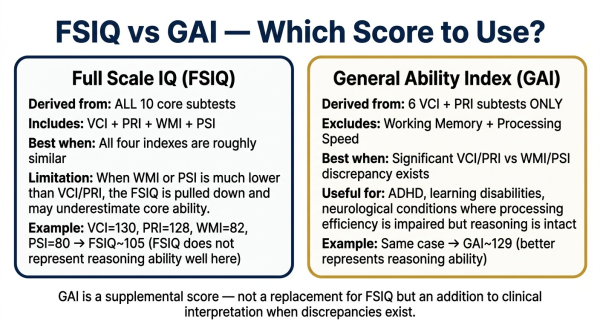
The Full Scale IQ (FSIQ) is derived from all 10 core subtests and represents overall cognitive ability. It is the most commonly reported IQ score and the composite with the strongest predictive validity for academic and occupational outcomes. However, the FSIQ is not always the most clinically informative score in a WAIS-IV report.
The General Ability Index (GAI) is a supplemental composite derived from the six VCI and PRI subtests only, excluding Working Memory and Processing Speed. It provides a measure of general reasoning and problem-solving ability without the influence of cognitive efficiency factors. The GAI is particularly useful in two clinical situations:
- When VCI/PRI and WMI/PSI are significantly discrepant. A person with VCI 130, PRI 125, WMI 80, PSI 78 has an FSIQ of approximately 105 — but this number misrepresents their verbal and perceptual reasoning ability (which is well above average) because the FSIQ is substantially reduced by the low WMI and PSI. The GAI in this case would be approximately 129, which more accurately represents their core reasoning and problem-solving capability. This pattern is common in ADHD, some specific learning disabilities, and certain neurological conditions.
- When FSIQ appears unrepresentative of observed functioning. When clinical observation suggests significantly stronger reasoning than the FSIQ indicates, checking whether WMI/PSI are pulling the composite down provides valuable interpretive clarity.
The Cognitive Proficiency Index (CPI) is the mirror composite to the GAI — derived from WMI and PSI subtests only, measuring cognitive efficiency. The GAI–CPI discrepancy provides a direct measure of the gap between reasoning ability and processing efficiency, which is clinically meaningful in many diagnostic contexts.
How to Interpret a WAIS-IV Report
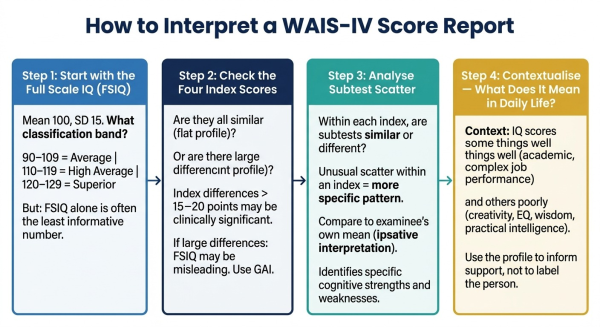
The most important principle in reading any WAIS-IV report: start with the index scores before the FSIQ. A single FSIQ tells you remarkably little about cognitive profile — it is an average that may mask enormous variation across the four domains. The following interpretive sequence is consistent with clinical best practice:
Step 1: Is the FSIQ interpretable? Check whether the four Index Scores are sufficiently similar to make the FSIQ a meaningful composite. As a general clinical guideline, if Index Scores differ by more than 20–25 points, the FSIQ should be interpreted cautiously and the GAI and CPI examined. A significant index discrepancy does not invalidate the assessment — it enriches it by revealing a specific cognitive profile.
Step 2: Interpret each Index Score independently. Each Index Score can be interpreted as a measure of its domain independent of the FSIQ. VCI of 95, PRI of 92, WMI of 88, PSI of 85 represents a flat profile — consistently below-average to average across all domains. VCI of 130, PRI of 128, WMI of 82, PSI of 80 represents a strongly split profile requiring GAI interpretation.
Step 3: Examine subtest scatter within indexes. Within each index, are subtests similar or substantially different? A VCI where Similarities = 14, Vocabulary = 13, and Information = 8 (substantially lower) suggests specific weakness in accumulated factual knowledge relative to verbal reasoning — a pattern that may reflect limited educational opportunity or cultural exposure, or specific domain-related difficulty.
Step 4: Contextualise the scores. WAIS-IV scores provide valuable clinical information — they predict academic and occupational performance in demanding roles, guide educational planning, and support diagnostic clarification. They do not define a person's potential or worth. Scores should always be interpreted in context: the person's history, presenting concerns, observed functioning, cultural and linguistic background, and the specific questions driving the assessment. For more on what IQ tests can and cannot tell us, see our guide on what IQ actually measures.
The WAIS-IV is the most comprehensive and most validated measure of adult cognitive ability available. Its 15 subtests feed into four Index Scores and a Full Scale IQ that together provide a rich cognitive profile. The clinical art of WAIS-IV interpretation lies in understanding how the indexes relate to each other, when the FSIQ misleads, when the GAI clarifies, and how the subtest pattern within each index reveals specific cognitive strengths and challenges. The number is the beginning of understanding, not the end.
For more context on the Wechsler family of tests, see our Wechsler IQ test guide. For what specific scores on the Wechsler scale mean in population terms, see our full IQ scale explained. For the Binet line of tests alongside the Wechsler, see our Binet IQ test guide.
Frequently Asked Questions
What is the WAIS-IV?
The WAIS-IV (Wechsler Adult Intelligence Scale – Fourth Edition) is a comprehensive individually administered intelligence test for adults aged 16 to 90, published by Pearson in 2008. It is the most widely cited adult IQ test in the world. It produces a Full Scale IQ (FSIQ) and four Index Scores — Verbal Comprehension (VCI), Perceptual Reasoning (PRI), Working Memory (WMI), and Processing Speed (PSI) — across 15 subtests (10 core, 5 supplemental).
How many subtests does the WAIS-IV have?
The WAIS-IV has 15 subtests: 10 core subtests contributing to the FSIQ and four Index Scores, plus 5 supplemental subtests providing additional clinical information. Core subtests: Similarities, Vocabulary, Information (VCI); Block Design, Matrix Reasoning, Visual Puzzles (PRI); Digit Span, Arithmetic (WMI); Symbol Search, Coding (PSI). Supplemental: Comprehension (VCI); Figure Weights, Picture Completion (PRI); Letter-Number Sequencing (WMI); Cancellation (PSI).
What is the General Ability Index (GAI)?
The GAI is a supplemental composite score derived from the 6 VCI and PRI subtests only, excluding Working Memory and Processing Speed. It is used when a significant discrepancy exists between VCI/PRI and WMI/PSI — a common pattern in ADHD and learning disabilities — because the FSIQ in these cases may underestimate core reasoning ability. The GAI provides a purer measure of reasoning and problem-solving ability uncontaminated by cognitive efficiency factors.
How long does the WAIS-IV take?
The 10 core WAIS-IV subtests take approximately 60–90 minutes for most adults. Including supplemental subtests extends administration time. The test must be individually administered by a trained licensed examiner — it cannot be self-administered or given in groups.
What is the difference between FSIQ and GAI?
The FSIQ is derived from all 10 core subtests (all four domains). The GAI is derived from only the 6 VCI and PRI subtests, excluding WMI and PSI. When WMI and PSI are substantially lower than VCI and PRI, the FSIQ is pulled down and may not accurately represent core reasoning ability — the GAI provides a better estimate in these cases. When indexes are similar, FSIQ and GAI are approximately equal.

Comments
Share Your Thoughts