Many students, parents, and educators wonder whether IQ scores and SAT scores measure the same thing. If someone has a high IQ, does that mean they will automatically score well on the SAT? And if a student performs poorly on the SAT, does it reflect lower intelligence?
The short answer is: IQ and SAT scores are related, but they are not the same—and neither fully defines intelligence or potential. This distinction is explored in detail in IQ vs SAT score.
This article explains how IQ and SAT scores differ, where they overlap, and what research actually says about their relationship.
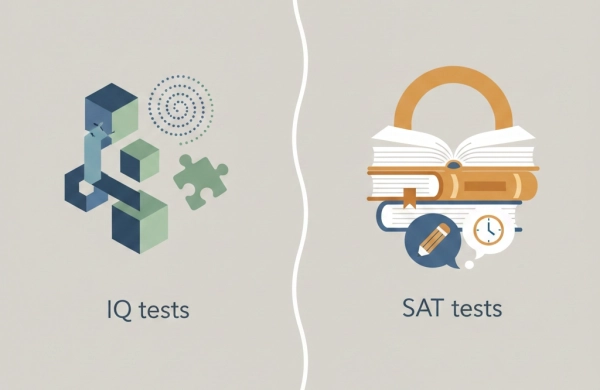
What Is an IQ Score?
An IQ (Intelligence Quotient) score is designed to measure general cognitive ability, often referred to as g (general intelligence). Rather than testing memorized knowledge, IQ assessments focus on how efficiently a person can reason, identify patterns, and solve unfamiliar problems. For a foundational overview, see what IQ is and how intelligence quotient works.
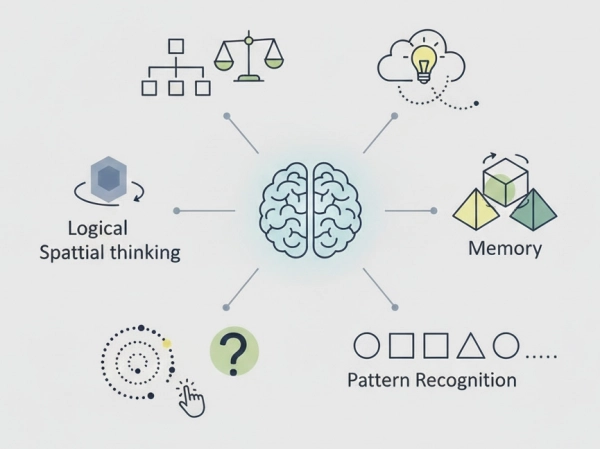
Most modern IQ tests evaluate a combination of cognitive skills, including:
- Logical reasoning – the ability to analyze relationships and draw valid conclusions
- Pattern recognition – identifying visual or numerical sequences and rules
- Working memory – holding and manipulating information over short periods
- Spatial reasoning – understanding shapes, rotations, and visual relationships
- Abstract problem-solving – solving novel problems without relying on prior knowledge
Well-known frameworks include Raven’s Progressive Matrices and the Wechsler scales. Many of these rely on verbal and nonverbal tests of intelligence to reduce the influence of language and education.
IQ scores are standardized across populations using a bell-curve distribution, where:
- Average IQ = 100
- Standard deviation = 15
This means most people score between 85 and 115, as explained in the IQ scale explained from low to genius.
What Does the SAT Measure?
The SAT (Scholastic Assessment Test) is a standardized academic exam primarily used for college admissions in the United States. Its purpose is not to measure raw intelligence, but to assess how well a student is prepared for college-level coursework.
The SAT focuses on skills such as:
- Reading comprehension – understanding and analyzing written passages
- Writing and language skills – grammar, clarity, and sentence structure
- Mathematical reasoning – algebra, problem-solving, and data interpretation
- Performance under time pressure – applying knowledge efficiently within strict limits
Unlike IQ tests, SAT performance is strongly shaped by external factors. SAT scores are:
- Closely aligned with school curricula
- Highly responsive to test preparation and coaching
- Language-heavy and culturally specific
Because of this, the SAT is better understood as a measure of academic achievement rather than innate intelligence—a distinction also discussed in IQ vs academic achievement.
Are IQ and SAT Scores Correlated?
Yes. Multiple studies show a moderate to strong correlation between IQ and SAT scores, meaning the two measures are related—but not interchangeable.
Most research places the correlation coefficient in the range of:
- 0.5 to 0.7, depending on population, age group, and test versions
This indicates that:
- Individuals with higher IQs tend to achieve higher SAT scores
- However, a large amount of variation remains unexplained
In practical terms, a high IQ does not guarantee a high SAT score, and a lower SAT score does not automatically indicate lower intelligence.
Why IQ and SAT Scores Are Not the Same
1. Test Preparation Has a Major Impact on SAT Scores
SAT performance can improve substantially through:
- Targeted coaching
- Repeated practice tests
- Familiarity with question formats and timing strategies
IQ scores, by contrast, are far less affected by short-term preparation. While some strategies can help, core reasoning ability remains relatively stable—especially on abstract tests. This is why factors that affect IQ test results differ greatly from factors affecting SAT performance.

2. Language and Educational Bias
The SAT relies heavily on:
- English language proficiency
- Reading speed and comprehension
- Formal exposure to mathematics and academic instruction
IQ tests—especially visual or abstract ones—are structured to reduce linguistic and educational bias, making them more suitable for cross-cultural comparisons.
3. Different Cognitive Skills Are Emphasized
- IQ tests focus on raw reasoning, pattern detection, and abstract thinking
- SAT tests emphasize the academic application of learned knowledge
As a result, it is common to see students who possess:
- High IQ
- Average or below-average SAT scores
This often occurs when strong reasoning ability is paired with limited academic preparation or test-taking experience.
Can the SAT Be Considered an IQ Test?
Historically, early versions of the SAT were more closely linked to intelligence testing concepts. Over time, however, the SAT evolved to prioritize:
- Alignment with school curricula
- Standardized academic benchmarks
- College readiness assessment
Today, psychologists do not classify the SAT as an IQ test, even though it still reflects certain cognitive abilities related to reasoning and problem-solving.
What About High IQ but Low SAT Scores?
This pattern is more common than many people assume.
Possible explanations include:
- Test anxiety or stress under time limits
- Weak time-management strategies
- Limited access to SAT preparation resources
- Low motivation for standardized testing despite strong reasoning ability
On the other hand, students with average IQ scores can often achieve excellent SAT results through disciplined preparation, structured study plans, and repeated practice.
Which One Is a Better Predictor of Success?
Neither IQ nor SAT scores alone are reliable predictors of long-term success.
Research consistently shows that success depends on a combination of factors, including:
- Cognitive ability (IQ)
- Emotional intelligence (EQ)
- Motivation, persistence and discipline
- Quality of education and learning environment
- Access to opportunities and support systems
This broader perspective is explored in IQ vs EQ and emotional intelligence and self-awareness, both of which highlight skills that standardized tests do not capture.
Key Takeaways
IQ and SAT scores are related but not equivalent
IQ measures general cognitive ability; SAT measures academic readiness
SAT scores are more influenced by education, language, and preparation
High intelligence does not always translate into high SAT performance
Neither score defines a person’s potential, ability, or future success
Final Thoughts
Understanding the difference between IQ and SAT scores can help reduce unnecessary stress and misconceptions. Intelligence is multi-dimensional, and no single test can fully capture human potential.
If you are curious about your cognitive strengths beyond academic testing, a well-designed IQ test can offer valuable insights—especially when combined with assessments of emotional intelligence and personality.

Comments
Share Your Thoughts