IQ tests are often used to better understand how children think, learn, and solve problems. For parents, these tests can raise important questions about accuracy, meaning, and whether the results truly reflect a child’s abilities. To evaluate how accurate IQ tests are for children, it is essential to understand what these tests measure, their limitations, and how results should be interpreted responsibly.
What Do IQ Tests Measure in Children?
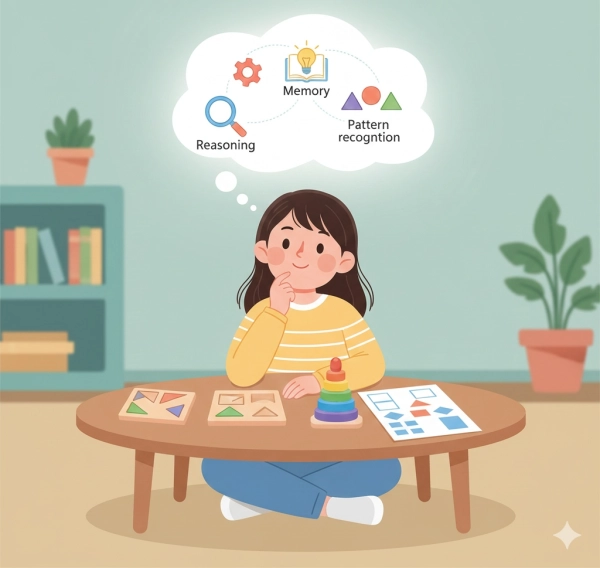
IQ, or Intelligence Quotient, tests are designed to assess specific cognitive skills involved in how children think, learn, and solve problems, including logical reasoning, pattern recognition, verbal understanding, working memory, and processing speed. These skills are connected to academic learning, but they represent only one part of a child’s overall development, as explained in what is IQ: a complete guide to intelligence quotient.
Modern IQ tests for children are carefully standardised and age-adjusted — a child’s score is compared only to others in the same age group, not to older or younger children. A score reflects how a child performs relative to peers at a specific point in time, not an absolute level of intelligence.
How Accuracy Is Defined in Child IQ Testing
In psychology, accuracy does not mean that a test perfectly captures everything about a child’s intelligence. Instead, it refers to whether a test reliably measures certain cognitive skills under standardised conditions. Well-developed and professionally administered IQ tests are generally considered reasonably accurate at assessing current cognitive functioning, relative strengths and weaknesses across different skill areas, and performance on structured, time-limited problem-solving tasks. However, accuracy decreases when IQ scores are treated as permanent traits, since children’s intelligence is flexible and shaped by development and experience.
Why IQ Test Results Can Change Over Time
Children’s brains are still developing, which means cognitive abilities are more flexible and responsive to experience than in adulthood. As a result, IQ scores in childhood can fluctuate over time.

Changes in scores may occur due to natural cognitive and neurological development, increased educational exposure and learning opportunities, practice effects and familiarity with test formats, and emotional state, stress level, or physical health on the day of testing. This developmental variability is why experts caution parents against viewing a single score as a permanent indicator.
Factors That Can Affect Test Accuracy
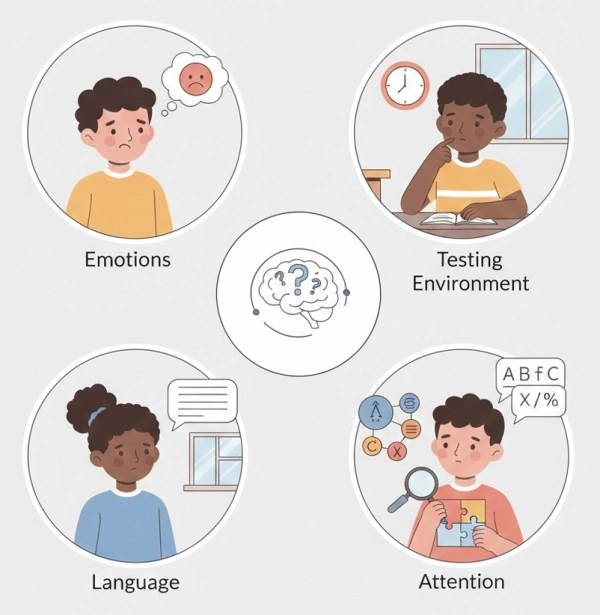
Several non-cognitive factors can significantly affect how accurately an IQ test reflects a child’s true abilities. Attention and focus may be reduced by fatigue, stress, or anxiety. Motivation is influenced by interest, confidence, and comfort with testing situations. Verbal subtests may be affected by vocabulary exposure and language background. And the testing environment — noise, unfamiliar settings, time pressure, or discomfort — can interfere with performance. These are factors that reflect the test context, not the child’s underlying intelligence.
What IQ Tests Do Well
When used appropriately, IQ tests can be valuable tools for understanding certain aspects of a child’s learning profile. They are most accurate and helpful for identifying patterns in how a child processes information, highlighting relative cognitive strengths and challenges, supporting educational planning and individualised instruction, and guiding conversations between parents, teachers, and specialists. IQ tests are most effective when combined with classroom observations, academic performance, and developmental history.
What IQ Tests Do Not Measure
Despite their usefulness, IQ tests do not capture many important dimensions of a child’s development. They do not assess creativity or imagination, emotional intelligence or self-regulation, social skills or communication ability, motivation, curiosity, or resilience, or artistic, musical, athletic, or practical talents. Children may show high potential in areas far beyond what IQ testing measures, and parents should be careful not to reduce a child’s value to a single number.
Are IQ Tests Predictive of Future Success?
IQ scores alone are weak predictors of long-term academic achievement and life success. While cognitive skills play a role in learning, research consistently shows that other factors are equally or more important: supportive and stimulating learning environments, emotional well-being and confidence, quality education and effective teaching, and personal interests, motivation, and effort. This perspective aligns with broader discussions such as can someone with a low IQ be successful, which emphasise growth and opportunity over test scores.
How Parents Should View IQ Test Results
For parents, the healthiest way to interpret an IQ score is to view it as one piece of information, not a judgement or prediction. A balanced approach includes looking for patterns across different skills rather than focusing on a single number, emphasising growth, learning, and development over comparison, using results to guide support and learning strategies rather than to limit expectations, and avoiding comparisons with siblings or other children. The most important thing parents can do is ensure their child feels supported, capable, and encouraged — regardless of any test result.
The Bottom Line
IQ tests can provide reasonably accurate insights into certain cognitive skills at a specific moment in development. However, they do not define a child’s intelligence, potential, or worth. Because children grow and change rapidly, IQ scores should always be interpreted thoughtfully and within a broader developmental and educational context. When used responsibly, IQ tests can support learning and understanding. When overemphasised, they risk overlooking the many strengths and abilities that make each child unique. Explore more in our Parents & Kids section.

Comments
Share Your Thoughts