One of the most common misconceptions in education is that the child getting the best grades is the gifted child. It is intuitive — if a child is very smart, shouldn't they be performing at the top of their class? In many cases, yes. But in many others, the relationship is the reverse: the child getting straight A's is a high achiever — working diligently, responding brilliantly to the educational system, and outperforming peers through effort, organisation, and conscientiousness. Meanwhile, the gifted child may be bored, disengaged, underachieving, or struggling in ways that no one has correctly identified.
Understanding the difference between a high achiever and a gifted learner matters enormously — because each child needs something fundamentally different from the educational system, and what works beautifully for one can be completely inadequate or even harmful for the other.
The Core Distinction: System Response vs Brain Difference
The most fundamental difference between a high achiever and a gifted learner is not about how much they know or what grades they get. It is about the underlying source of their performance — and more importantly, about what challenges them.
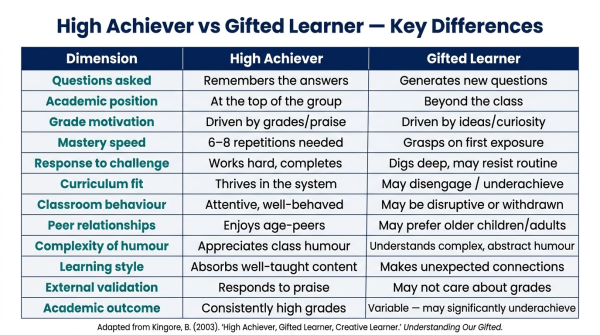
A high achiever is a child who responds brilliantly to the educational system. They absorb instruction efficiently, complete work carefully and on time, earn high grades, and are typically well-behaved and socially adjusted. They are externally motivated — they respond well to praise, grades, and recognition. They need approximately 6–8 repetitions to master new material, which is within the normal learning curve but at the fast end. They genuinely enjoy learning and are genuinely capable. There is nothing wrong with being a high achiever — it is a wonderful profile that predicts good educational outcomes and career success. But it is a different profile from giftedness.
A gifted learner has what researchers describe as a "brain-based difference in how they learn and process information." They do not just learn faster — they process information at a qualitatively different level. They ask original questions that the curriculum has not raised. They make unexpected conceptual connections. They grasp complex abstract ideas on the first exposure and are immediately ready to go further, deeper, or in a completely different direction. They are typically intrinsically driven — motivated by ideas and curiosity, often indifferent to grades or external validation. As Dr. Jim Delisle describes it: "Giftedness is an innate ability to both detect and comprehend the world in complex ways that differ significantly from age-expected norms."
The comparison framework developed by Bertie Kingore (2003) captures this distinction with precision: the high achiever remembers the answers; the gifted learner generates new questions. The high achiever performs at the top of the group; the gifted learner is beyond the group entirely. What the high achiever can learn easily, the gifted learner already knows.
The Gifted Underachiever: The Most Commonly Missed Child
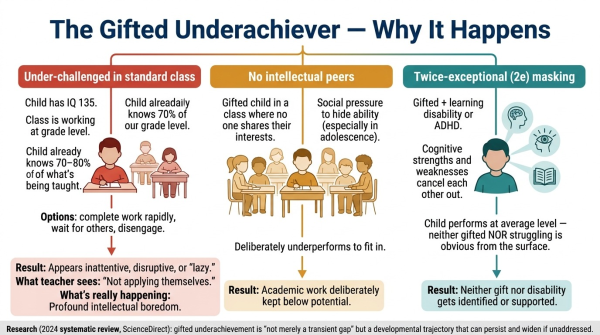
If the gifted child is "beyond the group entirely," what happens when the group is not appropriately challenged? In many cases: the gifted child disengages, underachieves, and appears to be a problem child rather than an exceptional one.
Gifted underachievement is extensively documented in the research literature. A 2024 systematic review published in ScienceDirect found that gifted underachievement is "not merely a transient gap between potential and performance; rather, it manifests as a developmental trajectory that can be challenging to identify." In other words, gifted underachievement is not just a phase — it can persist and worsen over time if the underlying mismatch between the child's cognitive needs and their educational environment is not identified and addressed.
The mechanisms are understandable once the gifted-achiever distinction is clear:
Under-challenge produces disengagement. A child with IQ 135 placed in a standard classroom typically already knows 70–80% of what is being taught at grade level. The experience is not "easier school" — it is more analogous to an adult being asked to sit through a class on material they mastered years ago. Boredom, inattention, or low-level disruption are rational responses to an environment that provides no cognitive stimulation. When a teacher reports that a child "isn't applying themselves" or "could do the work if they tried," the possibility that the child has already done the work mentally — and finds it unstimulating — should be explored.
Social pressure to mask ability. Particularly in adolescence, gifted children may deliberately underperform to avoid social differentiation. In class environments where academic success is not socially valued, a gifted child may achieve at the average level to maintain peer relationships — and this masking can persist for years before anyone recognises it.
Twice-exceptionality. Gifted children with co-occurring learning disabilities (dyslexia, dyscalculia) or ADHD — referred to as twice-exceptional or 2e — represent a particularly high-risk group for missed identification. Their cognitive strengths and learning challenges may cancel each other out, producing a child who performs at average level while experiencing both intellectual frustration and learning difficulty. Neither their gift nor their challenge receives appropriate identification or support. For more on formal assessment of this population, see our IQ testing for children guide.
IQ Thresholds and Categories of Giftedness
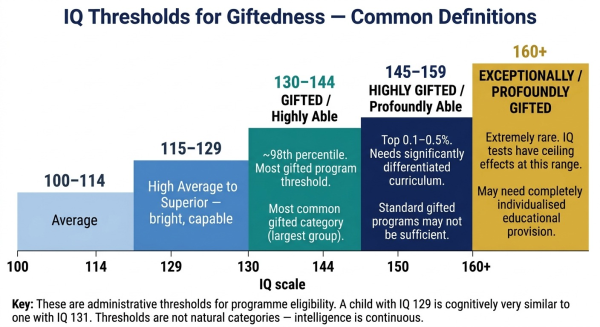
For educational identification purposes, giftedness is typically defined by IQ score thresholds, though these vary by jurisdiction and programme:
| IQ Range | Category | Approximate Frequency | Educational Implication |
| 115–129 | High Ability / Bright | ~16% of population | Enrichment within standard curriculum |
| 130–144 | Gifted / Highly Able | ~2–3% of population | Gifted programme eligibility (most) |
| 145–159 | Highly Gifted / Profoundly Able | Top 0.1–0.5% | Standard gifted programs may be insufficient |
| 160+ | Exceptionally / Profoundly Gifted | Extremely rare (~1 in 10,000+) | Highly individualised provision needed |
Important to note: these are administrative thresholds for programme eligibility, not natural cognitive categories. Intelligence is a continuous dimension. A child with IQ 129 is cognitively very similar to a child with IQ 131 — the threshold simply determines programme access, not cognitive reality. Additionally, IQ testing is one component of gifted identification, not the only one — behavioural observation, teacher and parent input, and portfolio evidence all contribute to comprehensive identification.
For more on what these IQ ranges mean and how they are measured, see our IQ scale explained and our IQ testing for children guide.
What Each Child Actually Needs
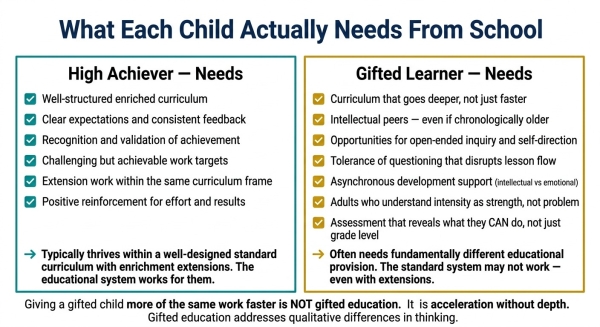
Understanding the distinction matters practically because it determines what kind of educational support a child needs:
High achievers typically thrive within a well-designed standard curriculum with enrichment extensions. They respond well to clear feedback, recognition of achievement, and challenging but attainable targets within the existing curriculum framework. Extension work — more advanced problems, additional reading, deeper projects within the same subject area — is typically effective. The educational system works for them.
Gifted learners often need something qualitatively different: curriculum that goes deeper rather than just faster; intellectual peers, even if that means working with older children or adults; opportunities for open-ended inquiry and self-directed learning; and adults who understand that their intensity, questioning, and nonconformity are cognitive strengths rather than behavioural problems. A critical insight from gifted education research: giving a gifted child more of the same work faster is not gifted education. It is acceleration without depth. Gifted education addresses qualitative differences in thinking — the need for conceptual complexity, original thinking, and intellectual challenge at a level that matches the child's actual cognitive level.
A 2024 systematic review in Frontiers in Psychology found that gifted children outperform peers in verbal working memory, inhibition, attention-switching, and elemental information processing — and show higher intrinsic motivation, self-efficacy, and openness to experience. These are profile characteristics that require specific types of educational challenge to develop and sustain — not simply more homework or faster progression through the same curriculum.
Asynchronous Development: The Hidden Challenge of Giftedness
One of the most important and least-discussed characteristics of gifted children is asynchronous development — the gap between their intellectual maturity and their social-emotional maturity. A gifted 8-year-old may reason like a 14-year-old intellectually but have the emotional regulation of a typical 8-year-old. This creates specific challenges: frustration when peers cannot follow their thinking; social difficulty because their intellectual interests are at odds with their chronological peers; intense emotional reactions that confuse adults who expect intellectual maturity to translate into emotional maturity.
Gifted children also commonly show what gifted education researchers describe as "overexcitabilities" — heightened responsiveness in intellectual, psychomotor, sensory, imaginational, and emotional domains. High sensitivity to injustice, intense aesthetic responses to art or music, vivid imagination that can produce both creative work and anxiety, and strong emotional reactions to situations that peers take in stride are all common profiles in gifted children. These characteristics are sometimes misdiagnosed as ADHD, anxiety disorder, or sensory processing difficulties — particularly when they appear without the expected academic achievement.
The child getting straight A's may be a high achiever — working brilliantly within the educational system through diligence, organisation, and responsiveness to instruction. The gifted child may be the one who is bored, disruptive, or underachieving — cognitively far beyond what the curriculum offers, with nowhere to go with their questions. Both children deserve recognition and support appropriate to who they are. But they need different things: the high achiever needs enrichment within the system; the gifted learner often needs a fundamentally different kind of challenge. Mistaking one for the other means that high achievers receive gifted programming they may not need, while genuinely gifted children remain invisible — their potential untapped, their intensity unrecognised, their disengagement unexplained.
For related guides, see our IQ testing for children ages 6–12, our how to raise child IQ, and our IQ scale explained. For context on high-IQ profiles in adults, see our highest IQ in history guide.
Frequently Asked Questions
What is the difference between a gifted child and a high achiever?
A high achiever performs at the top of their class through diligence and responsiveness to instruction. A gifted child has a brain-based difference in how they process information — characterised by unusually deep thinking, original questions, and cognitive engagement beyond standard curriculum. Gifted children are often NOT the top academic performers — they may disengage or underachieve if the curriculum doesn't challenge them.
How do you know if your child is gifted or just a high achiever?
High achievers are externally motivated (grades, praise) and perform well within the system. Gifted children are intrinsically driven, ask original questions, make unexpected connections, and may show asynchronous development (advanced intellectual ability with age-typical social-emotional maturity). Formal identification requires individual IQ testing (WISC-V). Behavioural observation provides important early signals.
Can a gifted child be a poor student?
Yes — gifted underachievement is well-documented. Gifted children may disengage, appear lazy, or underperform when the curriculum doesn't challenge them. A 2024 ScienceDirect systematic review found gifted underachievement is a developmental trajectory that can persist and widen. Twice-exceptional children (gifted + learning disability/ADHD) are particularly at risk of being missed.
What IQ score is considered gifted?
Most educational programmes use IQ 130+ (98th percentile, WISC-V) as the standard threshold. Some use 120–125. Children scoring 145+ are considered highly gifted; 160+ as exceptionally gifted. These are administrative thresholds — intelligence is continuous, and IQ alone is not the only identification criterion.
What does a gifted child need that a high achiever doesn't?
Gifted children typically need: curriculum that goes deeper, not just faster; intellectual peers (even older); open-ended inquiry opportunities; asynchronous development support; and adults who understand their intensity as strength. High achievers thrive within a well-enriched standard curriculum. Giving a gifted child more of the same work faster is not gifted education.

Comments
Share Your Thoughts