Few questions generate more confident-sounding but factually dubious answers than "who has the highest IQ in history?" Search online and you'll find rankings featuring numbers like 250, 300, even 400 — presented with the same confidence as other factual claims. Most of these numbers are wrong, and the remainder are almost impossible to verify with the reliability that any serious claim about measurement requires.
This guide provides the complete picture: what reliable IQ measurement can actually tell us about extreme cognitive ability, why standard IQ tests effectively cap out around IQ 160, the three distinct tiers of evidence behind high-IQ claims, and a clear-eyed assessment of the most commonly cited figures — from Terence Tao and Marilyn vos Savant to William James Sidis and the great historical geniuses.
The Fundamental Problem: Why Extreme IQ Claims Are Unreliable
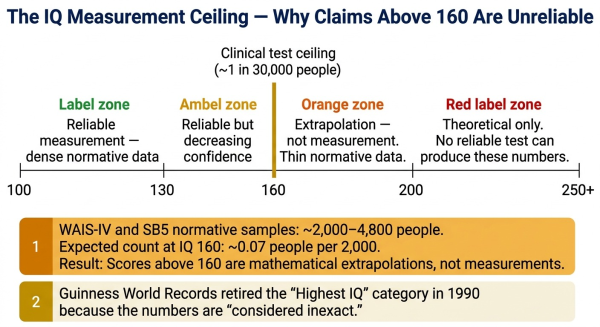
Before addressing any specific IQ claims, it is essential to understand the fundamental measurement constraint that makes all extreme IQ numbers inherently uncertain: standard clinical IQ tests cannot reliably measure above approximately IQ 160.
The reason is statistical. IQ tests are calibrated against normative samples — groups of people who take the test under standardised conditions and whose scores establish the reference distribution. The WAIS-IV was normed on a sample of 2,200 adults. The Stanford-Binet 5 on approximately 4,800 people. At IQ 160, the expected frequency in a randomly sampled population is approximately 1 in 31,000. A normative sample of 2,200 people would be expected to contain, on average, approximately 0.07 people at IQ 160 or above — essentially none.
Without adequate representation at the extreme upper tail of the distribution, there is no statistical basis for discriminating between, say, IQ 165 and IQ 175. The test simply runs out of sufficiently difficult items, and scores beyond the measurement range are mathematical extrapolations rather than measurements. This is not a limitation of specific tests — it is a fundamental constraint of any norm-referenced measurement instrument.
This is why the Guinness World Records retired its "Highest IQ" category in 1990, stating that the numbers were "considered inexact." As one comprehensive review of high-IQ claims notes: "Most psychologists consider scores above 160 unreliable."
For more on how this measurement ceiling affects IQ 160 specifically, see our IQ 160 guide. For how IQ tests work in general, see our guides on the WAIS-IV and the Binet IQ test.
A Framework for Evaluating High-IQ Claims: Three Tiers
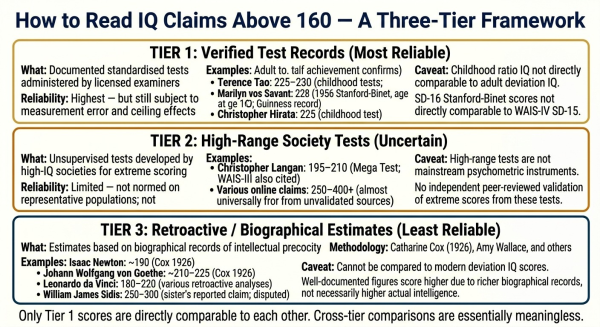
All high-IQ claims can be categorised into three evidence tiers. These tiers are not equally reliable, and cross-tier comparisons are essentially meaningless.
Tier 1: Verified Test Records
Standardised tests administered by trained examiners — the most reliable evidence tier, though still subject to the measurement ceiling described above. For childhood scores: childhood ratio IQ (mental age ÷ chronological age × 100) is not directly comparable to adult deviation IQ. For Stanford-Binet scores before the 4th edition (1986): SD=16 rather than SD=15, requiring conversion before comparison to WAIS-IV scores. For more on this SD difference, see our Binet IQ test guide.
Tier 2: High-Range Test Scores and Disputed Claims
High-range tests are instruments developed by high-IQ societies specifically to assess people who have already exceeded the ceiling of standard tests. These tests — including the Mega Test, LAIT, and others — are not normed on representative population samples, have not been independently validated through peer-reviewed psychometric research, and produce scores that cannot be directly compared to WAIS-IV or Stanford-Binet scores. They are useful as relative ranking instruments within the community of people who take them, but their absolute score claims (IQ 195, IQ 210, IQ 250+) carry very wide uncertainty intervals.
Tier 3: Retroactive and Biographical Estimates
Historical figures who lived before IQ testing was invented cannot have measured IQ scores. Estimates for historical geniuses are produced through historiometric methodology — examining biographical records of childhood intellectual development and extrapolating IQ using the ratio formula. The most systematic application was Catharine Cox's 1926 study of 300 historical geniuses. Critically, this methodology produces estimates that are influenced by the richness of the biographical record as much as by the person's actual intellectual level — well-documented figures score higher regardless of underlying intelligence. These estimates cannot be compared to modern deviation IQ scores.
The Highest Verified and Best-Supported IQ Scores
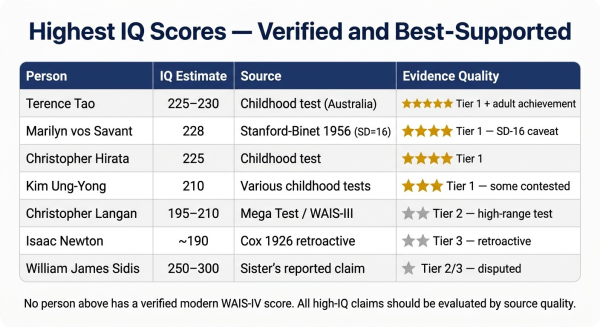
Terence Tao — IQ 225–230 (Tier 1)
Terence Tao is widely regarded as the most credible claimant for the highest IQ among living people. Born in Adelaide, Australia in 1975, he began university-level mathematics at age 9, received his PhD at 21 from Princeton, and joined the UCLA faculty at age 24, becoming a full professor at 25. In 2006 he won the Fields Medal — mathematics' highest honour, often called the Nobel Prize of mathematics. In 2015 he received the Breakthrough Prize in Mathematics ($3 million). Unlike many child prodigies, Tao has sustained extraordinary mathematical productivity into middle age, working across number theory, harmonic analysis, and partial differential equations. His childhood IQ was reported as 225–230 on tests administered in Australia. The combination of extraordinary childhood score and sustained, verified adult achievement makes his the most credible extreme IQ claim on record. For more on Tao, see our full profile: Terence Tao IQ.
Marilyn vos Savant — IQ 228 (Tier 1, with caveat)
Marilyn vos Savant's score of 228 was recorded in September 1956 when she was 10 years old, on an adult-level Stanford-Binet administered by a psychologist. The test gave her a mental age of 22 years 11 months, from which the ratio IQ of 228 was calculated. She was listed in the Guinness Book of World Records under "Highest IQ" from 1986 until Guinness retired the category in 1990. Two important caveats: (1) this is a childhood ratio IQ, not an adult deviation IQ; and (2) the Stanford-Binet at the time used a standard deviation of 16 rather than the 15 used by the WAIS-IV, making direct comparison to modern scores unreliable. For more on vos Savant, see our profile: Marilyn vos Savant IQ.
Christopher Hirata — IQ 225 (Tier 1)
Christopher Hirata is an American astrophysicist who reportedly scored 225 on an IQ test as a child. He won the International Physics Olympiad gold medal at 16, earned his PhD from Princeton at 22, and joined NASA's space exploration team while still a teenager. He is currently a professor at Ohio State University. His adult scientific achievement, while distinguished, has not reached the level of Fields Medal or comparable recognition — but his childhood score is among the most credible extreme claims on record.
Kim Ung-Yong — IQ 210 (Tier 1, contested)
South Korean civil engineer Kim Ung-Yong was once listed in the Guinness Book of World Records as having an IQ of 210. He was a child prodigy — reading and writing Korean and German as a toddler, appearing on Japanese television, and attending university at age 4. As an adult he became a civil engineer and professor in South Korea. His case is notable as an example of extraordinary childhood prodigy who chose an ordinary adult professional life by choice, later stating that happiness and fulfilment mattered more to him than maximising his intellectual output.
William James Sidis — IQ 250–300 (Tier 2/3, disputed)
William James Sidis is one of the most fascinating and most misrepresented figures in the IQ discourse. Born in 1898, he entered Harvard at 11, gave a lecture on four-dimensional bodies to the Harvard Mathematical Club at 11, and reportedly spoke over 40 languages and dialects. He spent most of his adult life in menial jobs and died at 46 after a cerebral haemorrhage.
The 250–300 IQ estimate is not based on a standardised test. It reportedly derives from a psychologist's assessment shortly before his death, with his sister telling biographer Amy Wallace that the psychologist had never seen scores that high and estimated them "between 250 and 300." No test record survives. The ratio IQ formula applied to childhood prodigies systematically inflates estimates. The claim has not been independently verified. Most modern psychometricians consider the 250–300 estimate to be unverifiable and almost certainly inflated.
What Sidis' case does illustrate clearly — and this is worth more than the disputed number — is that extraordinary childhood IQ does not guarantee extraordinary adult achievement. The non-cognitive factors (emotional regulation, motivation, social functioning) that Sidis arguably lacked explain at least as much about his adult trajectory as any cognitive measure. For more, see our profile: William James Sidis IQ.
Christopher Langan — IQ 195–210 (Tier 2)
Christopher Langan scored a perfect 800 on the Scholastic Aptitude Test reportedly while taking a nap during part of the exam. His IQ has been reported as 195–210 based on the Mega Test and other high-range instruments, as well as a WAIS-III administration. He worked as a construction worker, bouncer, and cowboy before developing his Cognitive-Theoretic Model of the Universe (CTMU), which has not been accepted by mainstream science. His case was made famous by Malcolm Gladwell in Outliers, where Gladwell argued that Langan's failure to achieve academic distinction despite extraordinary IQ demonstrated the importance of social capital and family background in translating intelligence into achievement. For more on Langan, see our profile: Christopher Langan IQ.
Historical Geniuses: The Retroactive Estimate Tier
Several historical figures are frequently cited in high-IQ lists with estimates ranging from 180 to 300. These are all Tier 3 estimates — retroactive analyses that cannot be directly compared to modern deviation IQ scores:
| Person | Retroactive IQ Estimate | Primary Source | Known for |
| Isaac Newton | ~190 (Cox 1926) | Historiometric — Catharine Cox 1926 | Calculus, gravity, optics, Principia |
| Johann Wolfgang von Goethe | ~210–225 (Cox 1926) | Historiometric — highest in Cox sample | Faust, comparative anatomy, colour theory |
| Leonardo da Vinci | ~180–220 | Multiple retroactive analyses | Art, anatomy, engineering, polymath |
| Marie Curie | ~180–200 | Historiometric | Two Nobel Prizes, radioactivity, polonium, radium |
| Carl Friedrich Gauss | ~250–300 (disputed) | Popular estimate — no rigorous source | Number theory, statistics, physics |
Goethe's score of 210–225 in Cox's 1926 study is noteworthy because it is the highest in her systematic sample of 300 historical geniuses — exceeding Newton, Voltaire, and other canonical geniuses. Cox's methodology is the most academically rigorous available for historical IQ estimation, though all historiometric estimates carry substantial uncertainty. As noted in our highest IQ of all time celebrity guide, estimates above 180 for historical figures should be treated as order-of-magnitude indications rather than precise measurements.
Why High IQ Doesn't Guarantee the Highest Achievement
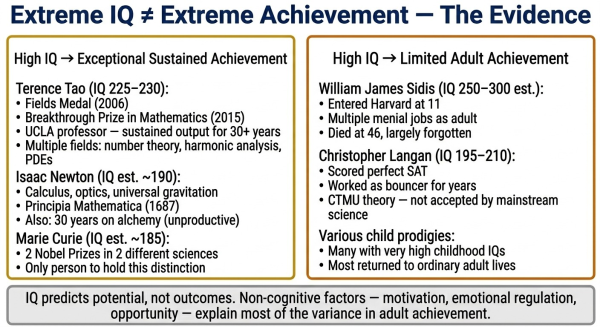
One of the most consistent findings in the high-IQ literature is the enormous variation in adult outcomes among people with apparently similar extreme childhood IQ. Terence Tao (IQ 225–230) won the Fields Medal and is generally considered one of the greatest living mathematicians. William James Sidis (IQ 250–300, disputed) worked in menial jobs and died largely forgotten. Christopher Langan (IQ 195–210) spent years as a bouncer and developed an unvalidated cosmological theory.
This pattern — which repeats across the high-IQ literature — reflects the central finding about IQ and achievement: above approximately IQ 130, additional IQ points explain diminishing variance in real-world outcomes. As Warren Buffett (IQ ~155) has argued explicitly, above a cognitive threshold, temperament matters more than intelligence. Charles Darwin (~IQ 165) attributed his achievement to habits — patience, observation, honest self-assessment — not raw cognitive firepower. The people who convert extraordinary IQ into extraordinary achievement are those who also bring the motivation, emotional regulation, domain focus, and sustained effort that no IQ test measures.
For more on what IQ predicts and doesn't predict, see our guides on IQ vs EQ and IQ and income.
The highest IQ in history is a question without a reliable answer — not because intelligence doesn't exist at extreme levels, but because the measurement tools available become unreliable above approximately IQ 160, historical figures cannot be tested, and claimed scores above 200 consistently come from sources that lack the methodological rigour needed to support such specific claims. What the evidence does support: Terence Tao holds the most credible combination of extreme childhood score and sustained extraordinary adult achievement. Marilyn vos Savant holds the only formally recognised record. And William James Sidis — the figure most often cited as having the highest IQ ever — has a claim that rests on a single disputed report with no surviving test record. The number matters less than what was done with it.
For in-depth profiles of the figures mentioned here, see our Celebrity IQ guides: Terence Tao, Marilyn vos Savant, William James Sidis, Christopher Langan, Isaac Newton, and Leonardo da Vinci. Take our free IQ test to find out where your own profile sits.
Frequently Asked Questions
Who has the highest IQ in history?
The honest answer depends on evidence tier. Terence Tao (IQ 225–230) has the most credible combination of extreme childhood test score and sustained extraordinary adult scientific achievement. Marilyn vos Savant (IQ 228) held the only formally recognised Guinness record. William James Sidis (IQ 250–300) is most frequently cited as the highest ever, but the estimate is disputed and unverifiable. Historical figures (Newton, Goethe, da Vinci) have retroactive estimates that cannot be compared to modern test scores.
What is the highest IQ ever recorded?
Marilyn vos Savant's score of 228 (1956 Stanford-Binet, age 10) is the highest formally recognised record — held by the Guinness Book of World Records until they retired the category in 1990. Important caveat: this was a childhood ratio IQ on a Stanford-Binet with SD=16, not directly comparable to modern WAIS-IV deviation IQ (SD=15).
Why don't IQ tests go above 160?
Standard clinical IQ tests cannot reliably measure above approximately IQ 160 because normative samples (typically 2,000–5,000 people) contain too few individuals at this extreme to anchor the scale statistically. Above IQ 160, scores are mathematical extrapolations rather than measurements. This is why Guinness retired its "Highest IQ" category in 1990.
Is William James Sidis really the smartest person ever?
Almost certainly not by the claimed 250–300 figure. The estimate is not based on a surviving standardised test — it derives from a report by his sister that a psychologist estimated scores "between 250 and 300." No test record survives. The ratio IQ method applied to childhood prodigies inflates estimates. Most psychometricians consider claims above 200 essentially unmeasurable.
What is Terence Tao's IQ?
Terence Tao's IQ is reported as approximately 225–230, based on childhood tests. He is widely considered the most cognitively capable living person by conventional measures — combining an extreme childhood score with sustained extraordinary adult achievement including the Fields Medal (2006) and the Breakthrough Prize in Mathematics (2015).

Comments
Share Your Thoughts