If your child has been referred for cognitive testing — whether for gifted program placement, a learning disability evaluation, an ADHD assessment, or simply because their teacher or you have noticed something unexpected about how they learn — this guide covers everything you need to know: which test is used, what it measures, when testing makes sense, how to prepare your child, and how to interpret and use the results.
The central test for school-age children is the WISC-V (Wechsler Intelligence Scale for Children, Fifth Edition) — the gold standard for individual cognitive assessment of children ages 6:0 through 16:11. It is individually administered by a licensed psychologist, takes approximately 45–90 minutes, and produces a Full Scale IQ plus five index scores that together paint a detailed picture of a child's cognitive strengths and challenges.
When Does IQ Testing Make Sense for a Child?
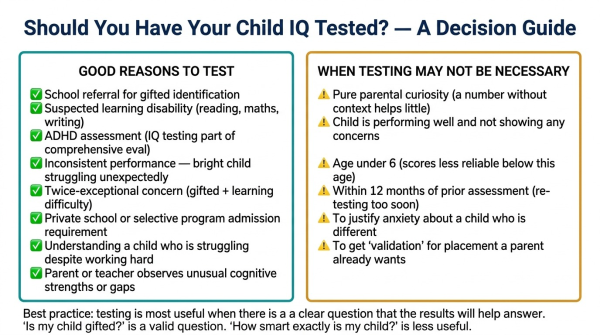
IQ testing is most useful when there is a clear question that the results will help answer. The most common and well-justified reasons to pursue formal assessment:
Gifted identification. Most gifted education programmes in the US and many other countries use WISC-V Full Scale IQ as one criterion for programme eligibility — typically requiring FSIQ 130 or above (98th percentile) for the most selective programmes, though some use lower thresholds of IQ 120–125. If a child's teacher or parent suspects exceptional cognitive ability and gifted programming would provide better educational fit, formal testing provides the information needed to access that provision.
Learning disability concerns. A bright child who struggles unexpectedly with reading (despite strong verbal skills), maths (despite strong reasoning), or writing (despite adequate intelligence) may have a specific learning disability. The WISC-V cognitive profile — particularly the pattern of high and low index scores — is a core component of psychoeducational evaluation for learning disabilities like dyslexia, dyscalculia, or dysgraphia. The IQ profile helps distinguish between a global cognitive delay and a specific learning difficulty in a child who is otherwise capable.
ADHD assessment. A comprehensive ADHD evaluation typically includes cognitive testing, because IQ measurement helps distinguish attention and processing speed difficulties from intellectual disability, and because ADHD has characteristic profiles on the WISC-V (typically lower Working Memory Index and Processing Speed Index relative to Verbal Comprehension and Fluid Reasoning). Cognitive testing is not alone sufficient for an ADHD diagnosis — it requires clinical interview, behavioural rating scales, and history — but it provides important diagnostic context.
Twice-exceptional (2e) identification. Children who are both gifted and have a learning difficulty or disability can be particularly hard to identify without formal assessment — their gifts can mask their difficulties, and their difficulties can mask their gifts, resulting in a child performing at the average level but experiencing both frustration (because the work is too easy in some dimensions) and struggle (because of the learning challenge). WISC-V assessment is particularly important for this population.
Testing is less clearly warranted for pure parental curiosity (a number without educational context typically helps less than it appears), when a child is performing well with no concerns, for children under age 6 (scores are less stable and less predictive below this age), or within 12 months of a prior assessment.
The WISC-V: What It Measures
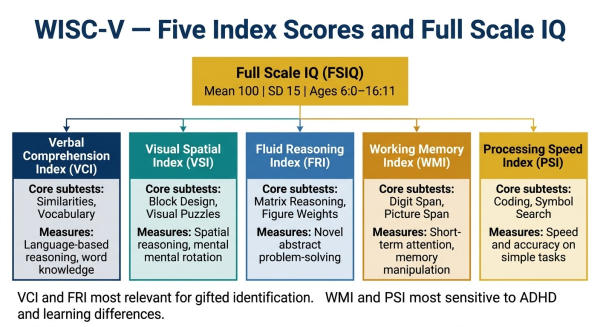
The WISC-V (published by Pearson in 2014) is the fifth edition of a test first developed by David Wechsler in the 1940s. It is the most widely administered individual intelligence test for school-age children worldwide. The WISC-V organises cognitive assessment into five primary indexes:
Verbal Comprehension Index (VCI). Measures language-based reasoning — how a child thinks using words, understands concepts, explains relationships, and builds on accumulated verbal knowledge. Core subtests: Similarities (how are two things alike?), Vocabulary (define words). A high VCI indicates strong verbal reasoning and language ability. A low VCI relative to other indexes may indicate limited language exposure, a language-based learning difficulty, or an English language learner effect in non-native speakers.
Visual Spatial Index (VSI). Measures spatial reasoning — the ability to analyse visual information, construct patterns, and reason about relationships in space. Core subtests: Block Design (assemble blocks to match a pattern), Visual Puzzles (identify pieces that make a figure). The VSI was separated from the Fluid Reasoning Index in the WISC-V to provide more diagnostic precision — a distinction that also appears in the WAIS-5 (2024) for adults. For more on how this separation works, see our WAIS-IV guide.
Fluid Reasoning Index (FRI). Measures the ability to reason about novel problems that cannot be solved through accumulated knowledge — the core of fluid intelligence (Gf). Core subtests: Matrix Reasoning (complete a visual pattern), Figure Weights (balance a scale — quantitative visual reasoning). FRI is one of the most theoretically important indexes for understanding a child's potential for academic learning, as it most directly measures the capacity to figure out new things.
Working Memory Index (WMI). Measures the ability to hold information in short-term memory while using it — the cognitive scratchpad that supports multi-step problem solving and sustained attention. Core subtests: Digit Span (repeat and reorder number sequences), Picture Span. The WMI is particularly sensitive to ADHD and anxiety; a low WMI relative to VCI or FRI is a common clinical pattern in children with attention difficulties. For more on working memory and its cognitive role, see our IQ and memory guide.
Processing Speed Index (PSI). Measures the speed and accuracy with which a child processes simple cognitive information. Core subtests: Coding, Symbol Search. The PSI is the index most sensitive to fatigue, anxiety, and the processing speed difficulties associated with ADHD and some learning disabilities. A child with dyslexia may have a low PSI independent of their reasoning ability. Like the WMI, a low PSI with high VCI and FRI suggests a discrepancy between reasoning ability and processing efficiency that warrants careful educational support planning.
All five indexes and the Full Scale IQ (FSIQ) use the standard scale: mean 100, SD 15. The WISC-V classification bands are identical to adult IQ scales.
How to Read Your Child's WISC-V Report
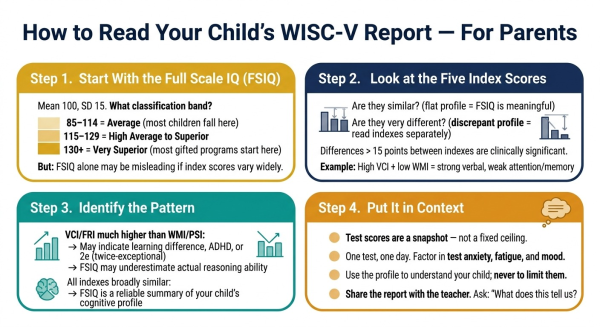
When you receive a WISC-V report, it will typically include the Full Scale IQ, five index scores, subtest-level scaled scores, confidence intervals, percentile ranks, and a written interpretation by the psychologist. Here is how to navigate the core elements:
Step 1: Check the Full Scale IQ. The FSIQ is derived from seven core subtests (one from each domain). It is the single number most commonly reported. The classification bands: 130+ = Very Superior (gifted program threshold for most programmes); 120–129 = Superior; 110–119 = High Average; 90–109 = Average; 80–89 = Low Average; 70–79 = Borderline; below 70 = Extremely Low. For context on what these ranges mean, see our IQ scale explained.
Step 2: Look at the five index scores separately. If the five index scores are all broadly similar (within about 15 points of each other), the FSIQ is a reliable summary of your child's cognitive profile. If there are large differences between indexes — particularly if VCI and FRI are substantially higher than WMI and PSI — the FSIQ may underestimate your child's core reasoning ability, which is typically better reflected by the General Ability Index (GAI, a supplemental composite of VCI and FRI only).
Step 3: Identify clinically significant discrepancies. A discrepancy of 15+ points between any two index scores is clinically significant — it indicates your child has meaningfully stronger cognitive ability in some domains than others. The most common clinically important patterns: high VCI/FRI with low WMI/PSI is common in ADHD and anxiety; high VCI with low FRI may indicate a specific learning profile; very high FRI with average VCI may suggest a child who is highly capable analytically but whose verbal abilities have not kept pace with their reasoning ability.
Step 4: Use the report, don't file it. The report is a tool for educational planning — share it with your child's teacher, the school's special education coordinator, or the gifted education teacher. Ask: "Given this profile, what adjustments in how we teach this child would be most helpful?" A high WMI/PSI child who struggles in timed tasks needs different accommodations than a child whose difficulty is primarily in VCI.
Preparing Your Child for IQ Testing
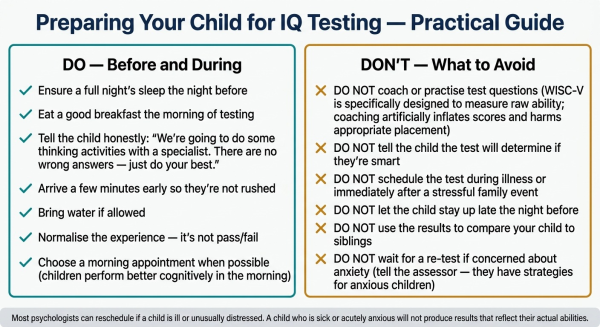
The quality of a child's WISC-V performance is meaningfully affected by how they feel on the day — their sleep, nutrition, anxiety, and understanding of what they're doing. Preparation that addresses these factors is both ethical and important; preparation that involves coaching specific test content is not.
What to tell your child: "We're going to do some thinking activities with a specialist. There are puzzles, some memory games, some questions about words and pictures. There are no right or wrong answers — you just do your best at each one. It's not pass or fail." Children who understand that the test is simply about showing what they know and can do, without stakes attached to any specific answer, perform closer to their actual ability than children who are anxious about "getting it wrong." Most professional assessors are skilled at rapport-building with children — the one-on-one format, with a trained examiner who adjusts their approach, typically produces better results than children expect.
The night before: Full sleep is the single most important preparation factor. As our sleep and IQ guide covers, sleep deprivation substantially reduces performance on working memory and processing speed tasks — exactly the areas where anxiety children may already be vulnerable. A tired child will not produce scores that reflect their actual cognitive ability.
Do not coach test content. The WISC-V is designed to measure native cognitive ability, not learned responses to specific question types. Coaching — practising sample test questions, drilling vocabulary or pattern-recognition tasks — can artificially inflate scores and lead to inappropriate placement. If a child is placed in a setting that exceeds their actual ability because of inflated scores, the outcome is worse for the child, not better. The WISC-V's adaptive, individually administered format is specifically designed to be resistant to coaching.
What the Results Mean — and Don't Mean
A few principles for using IQ test results responsibly as a parent:
An IQ score is a snapshot, not a verdict. The WISC-V measures your child's cognitive performance on one particular day, at one particular age. IQ scores in middle childhood are more stable than in early childhood, but they can still change meaningfully — particularly for children who receive targeted support for identified challenges. A child with a working memory difficulty who receives appropriate support may show meaningful WMI improvement over years.
The profile matters more than the number. Two children with FSIQ 115 may have very different cognitive profiles — one with high VCI and average FRI, one with average VCI and high FRI — and these different profiles have meaningfully different educational implications. The index scores are the most useful part of the report for educational planning.
IQ does not determine potential. As discussed in our guide on how to raise child IQ, early cognitive assessments are influenced by environmental factors that can change. A child with a lower score who receives cognitively enriched education, adequate nutrition, and warm responsive parenting may develop their cognitive potential substantially over the years following assessment. The score describes where a child is — it does not define where they can go.
IQ testing for children ages 6–12 is most valuable when there is a clear purpose: gifted identification, learning disability evaluation, ADHD assessment, or understanding a child whose inconsistent performance is confusing parents and teachers. The WISC-V is the gold standard instrument, measuring five cognitive domains (VCI, VSI, FRI, WMI, PSI) alongside a Full Scale IQ. Scores become more reliable from age 7 onward, with middle childhood (8–12) results being most predictive of adult cognitive ability. Preparing a child means prioritising sleep and explaining honestly — not coaching content. Reading results means understanding the index profile, not just the FSIQ number. Using results means translating them into educational support, not into labels.
For related guides, see our how to raise child IQ guide, our IQ scale explained, and our WAIS-IV guide for context on how the adult version compares. Take our free IQ test for adults — no registration, results in under 20 minutes.
Frequently Asked Questions
At what age should a child have an IQ test?
Ages 6–16 is the optimal window for the WISC-V — the gold standard children's IQ test. The WISC-V requires a minimum age of 6:0. Scores stabilise from age 7 onward, with middle childhood (8–12) results being most predictive of adult cognitive ability. Most psychologists recommend waiting until at least age 6 unless there is a specific earlier concern.
What IQ test do schools use for children?
The most widely used clinical IQ test for school-age children is the WISC-V (ages 6:0–16:11). Schools may also use the Stanford-Binet 5 or Woodcock-Johnson IV. Online tests are not appropriate for educational or clinical decisions — only individually administered tests by licensed psychologists produce valid results for gifted identification, learning disability assessment, or ADHD evaluation.
What does the WISC-V measure?
The WISC-V measures five primary indexes: Verbal Comprehension (VCI), Visual Spatial (VSI), Fluid Reasoning (FRI), Working Memory (WMI), and Processing Speed (PSI), combining into a Full Scale IQ (FSIQ). All scores use mean 100, SD 15.
What IQ score is needed for gifted programs?
Most US gifted programs use FSIQ 130 or above (98th percentile) as a threshold, though some use 120–125. Some consider individual index scores rather than FSIQ alone. These are administrative thresholds — a child with IQ 129 is cognitively very similar to one with IQ 131.
How much does a children's IQ test cost?
Private WISC-V assessment costs approximately $300–$800 depending on location and scope. Testing is provided free by schools under IDEA (US) when there is a concern about learning disability or special education need. Some school districts also offer gifted identification testing at no charge.

Comments
Share Your Thoughts