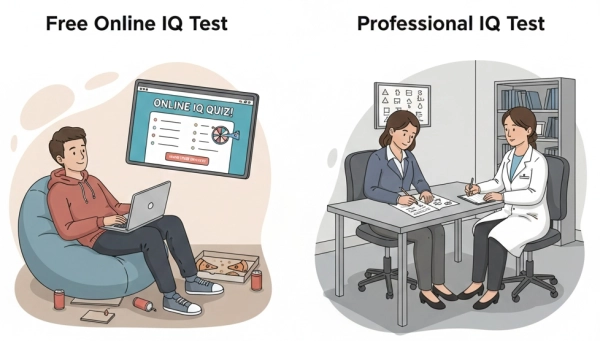
Free online IQ tests are everywhere. They promise quick results, instant feedback, and insight into your intelligence — all without cost. But how accurate are free online IQ tests, really? The short answer is: they can be interesting and sometimes informative, but they are not fully accurate or reliable measures of true IQ. To understand why, it’s important to know how real IQ testing works — and where most online tests fall short.
What Makes an IQ Test “Accurate”?
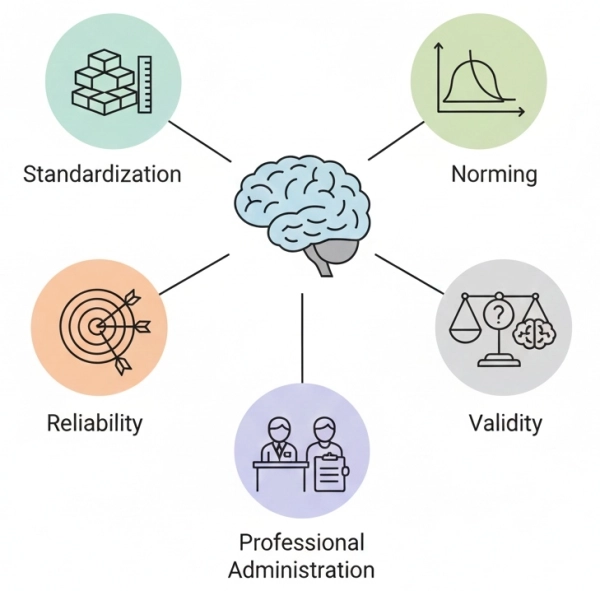
An accurate IQ test is not just a collection of puzzles. It is a carefully designed psychological instrument grounded in decades of research. To be considered scientifically valid, an IQ test must meet several strict criteria, as explained in what is IQ – a complete guide to intelligence quotient.
Standardisation
Standardisation means the test is administered the same way to everyone. Instructions, time limits, scoring rules, and testing conditions are consistent, ensuring score differences reflect cognitive performance rather than situational variables.
Norming
Norming compares an individual’s score to a large, representative population. Without proper norms, numbers like “IQ 120” are meaningless. Understanding where a score fits is essential (see the IQ scale explained from low to genius).
Reliability
Reliability refers to score stability over time. If you take the same test under similar conditions, results should be reasonably consistent. Large swings often indicate measurement error, not real changes in intelligence — an issue common in poorly designed online tests.
Validity
Validity ensures the test measures intelligence-related abilities such as reasoning, memory, and processing efficiency — not tricks or unrelated skills. Validity is established through extensive research, not marketing claims.
Professional Development and Administration
Clinically used IQ tests such as the WAIS and Stanford-Binet are developed and interpreted by trained psychologists. Most free online tests lack professional oversight and psychometric transparency, and fail to meet several — if not all — of the criteria above.
What Free Online IQ Tests Usually Measure
Free online IQ tests tend to focus on a narrow slice of cognitive ability, most commonly pattern recognition and matrix-style puzzles, basic logical reasoning, and simple numerical or visual sequences. While related to intelligence, these skills represent only part of what real IQ tests assess. Full-scale assessments also evaluate working memory, processing speed, verbal comprehension, deeper spatial reasoning, and sustained attention. Differences between verbal and nonverbal intelligence testing further highlight what online tests often miss (see verbal and nonverbal tests of intelligence). Because online tests frequently omit or poorly measure these components, their results offer an incomplete — and sometimes distorted — picture of cognitive ability.
Why Free Online IQ Tests Are Often Inaccurate
1. Lack of Proper Norms
Many free online tests do not clearly explain how scores are calculated or what population they are compared against. Without transparent norming, a reported IQ score has no scientific foundation. Some websites inflate scores to boost user satisfaction or social sharing, while others intentionally lower scores to create anxiety and encourage paid upgrades. In both cases, the numbers are driven by design choices rather than psychometric accuracy.
2. Poor Test Design
Professional IQ tests are refined over years of pilot testing and statistical analysis. In contrast, free online tests often suffer from too few questions to ensure reliability, poorly balanced difficulty levels, overuse of similar or predictable patterns, and ambiguous questions with unclear logic. These issues are among the most common factors that reduce IQ score accuracy (see common mistakes that lower IQ test scores).
3. No Control Over Test Conditions
Online tests are taken under uncontrolled circumstances: background noise or interruptions, fatigue or stress, multitasking or distractions, differences in screen size or display quality, and internet lag. In clinical settings, testing conditions are carefully controlled because environment has a measurable impact on cognitive performance. Online tests cannot account for these variables.

4. Practice and Familiarity Effects
Repeated exposure to similar question formats can artificially raise scores. Improvements may reflect familiarity rather than increased intelligence, especially when users take multiple online tests without adequate time between them. If you do test repeatedly, allowing sufficient recovery between sessions is important to avoid distorted results.
5. Self-Selection Bias
People who choose to take online IQ tests are not representative of the general population. This self-selection distorts score distributions and makes comparisons unreliable, further weakening accuracy.
When Free Online IQ Tests Can Be Somewhat Useful
Despite their limitations, free online IQ tests can still have limited value when used appropriately. They may offer a rough indication of strengths in pattern-based or logical reasoning, increase awareness of how IQ-style questions are structured, encourage interest in cognitive abilities and psychology, or serve as entertainment or casual self-reflection. The key is to treat them as informal estimates or puzzles, not as definitive measurements.
When You Should Not Trust the Results
Be especially sceptical if the test reports a very precise score without explaining its methodology, your results vary dramatically across different websites, the test claims to measure “full IQ” in just a few minutes, the site pressures you to pay to reveal or “fix” your score, or you feel discouraged or overly proud based on a single result. Legitimate IQ assessments do not work this way.
How to Get a More Accurate IQ Assessment
If you want a meaningful evaluation of IQ, take a professionally administered test with a licensed psychologist, use the results to understand cognitive strengths and weaknesses, and avoid treating the score as a label or life verdict. Even then, IQ should be viewed as one data point — not a complete portrait of intelligence or potential.
What IQ Tests — Online or Not — Do Not Measure
Regardless of format, IQ tests do not assess many critical human qualities, including creativity (see IQ vs creativity), emotional intelligence and empathy (see IQ vs EQ), motivation, resilience, and discipline, social skills and communication, and ethical judgement or life satisfaction. Many people with average IQs thrive academically and professionally because success depends on far more than a test score.
Final Verdict: Are Free Online IQ Tests Accurate?
Free online IQ tests are not accurate measures of true IQ. At best, they provide a rough, informal glimpse into certain reasoning skills. At worst, they are misleading and emotionally discouraging. If you choose to take them, treat the results lightly. Intelligence is complex, multifaceted, and shaped by far more than a score on a screen. Explore more in our Blog.

Comments
Share Your Thoughts