Many parents and educators wonder whether a child’s IQ, or intelligence quotient, can be improved through practice, learning, or specific training. While IQ measures certain cognitive abilities, it is not a fixed number, and research shows that some skills can indeed be strengthened over time. To understand this properly, it helps to first clarify what IQ actually measures and what it does not.
Understanding what IQ tests measure and how a child’s brain develops is key to knowing what training can—and cannot—do.
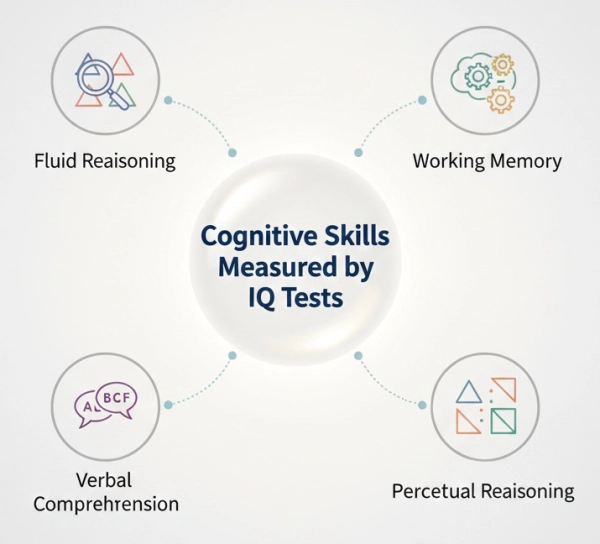
What IQ Tests Measure
IQ tests are standardized assessments that evaluate a specific set of cognitive abilities, including:
- Logical reasoning – the ability to analyze problems and find solutions using logic and structured thinking.
- Pattern recognition – identifying trends, sequences, and relationships between objects or concepts.
- Verbal comprehension – understanding language, vocabulary, and the meaning behind words.
- Working memory – holding, manipulating, and recalling information in short-term memory.
- Processing speed – the ability to complete tasks efficiently and accurately within a given timeframe.
It is important to remember that IQ tests measure only a narrow slice of intelligence. Skills such as creativity, emotional intelligence, social awareness, motivation, and practical problem-solving are not reflected in an IQ score. This distinction is explored further in IQ vs creativity: what intelligence tests don’t measure.
Brain Development and Plasticity in Children

Children’s brains are highly adaptable, a concept known as neuroplasticity. Neuroplasticity refers to the brain’s ability to form new neural connections in response to learning, practice, and experience. This adaptability explains why IQ scores in childhood are more flexible than many parents assume, as discussed in how accurate are IQ tests for children.
Targeted learning and practice can strengthen certain skills, particularly those assessed by IQ tests. However, the degree of improvement varies widely and depends on factors such as age, learning environment, interest, motivation, and consistency.
Types of Training That Can Support Cognitive Growth
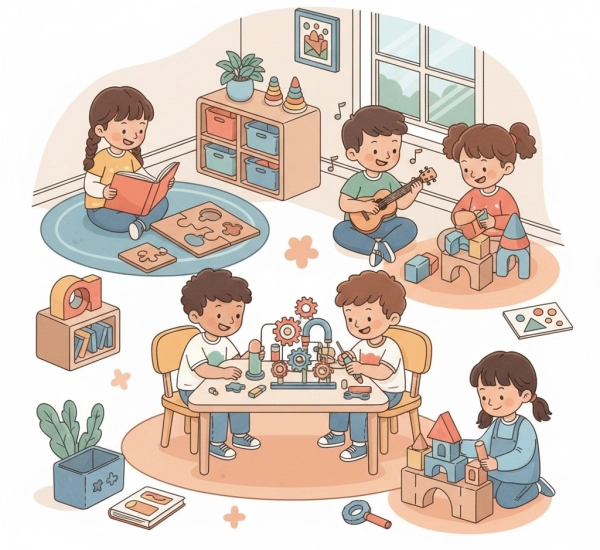
Research indicates several approaches to supporting children’s cognitive development:
1. Educational Practice
- Regular exposure to math, logic, and problem-solving tasks.
- Reading exercises and vocabulary building to strengthen verbal comprehension.
- Structured puzzles, brain teasers, and logic games that challenge reasoning skills.
These activities often improve performance on tasks similar to those found in IQ tests, especially when paired with supportive instruction, as outlined in IQ testing for kids: what parents should know.
2. Working Memory and Attention Training
- Memory games, sequencing tasks, and strategy-based board games.
- Activities that require planning, multitasking, and following multiple steps.
Strengthening working memory and attention can enhance fluid intelligence, which underlies problem-solving and learning efficiency.
3. Enrichment Activities
- Music lessons, arts, creative writing, and hands-on STEM projects.
- Activities that encourage creativity, critical thinking, and flexible problem-solving.
While these may not directly raise an IQ score, they promote cognitive flexibility and adaptive thinking—skills strongly linked to long-term success and highlighted in emotional intelligence and self-awareness.
4. Healthy Lifestyle Factors
- Adequate sleep to support memory consolidation and attention.
- Balanced nutrition to provide essential nutrients for brain development.
- Physical exercise, which boosts attention, memory, and overall cognitive performance.
A healthy lifestyle complements learning and creates the optimal environment for cognitive growth.
What IQ Training Cannot Do
It’s essential to have realistic expectations. IQ training or brain games cannot:
- Permanently increase a child’s innate reasoning potential.
- Guarantee a higher IQ score across all standardized tests.
- Replace quality education, supportive parenting, or stimulating learning experiences.
Training can improve specific skills measured by IQ tests, but it does not define a child’s intelligence or potential. This perspective aligns with research discussed in can someone with a low IQ be successful.
How Parents Can Support Cognitive Development
Parents play a critical role in fostering intellectual growth. Practical strategies include:
- Encourage curiosity and exploration in everyday activities.
- Offer diverse, challenging, yet achievable tasks to stretch thinking.
- Celebrate effort and progress, not just test results.
- Provide a structured and supportive learning environment.
- Collaborate with teachers and educators to identify effective learning strategies.
As emphasized in should parents be concerned about their child’s IQ, long-term development depends far more on environment and encouragement than on test scores alone.
The Bottom Line
Can a child’s IQ improve with training? The answer is partially yes. While IQ tests measure specific cognitive skills, children’s brains are adaptable, and targeted learning can enhance abilities such as reasoning, memory and problem-solving.
However, IQ scores are not fixed measures of intelligence and they do not capture all of a child’s potential.
The most effective approach is to focus on learning, skill development and overall growth, rather than striving solely to raise an IQ score. Children thrive when supported emotionally, socially and academically, which ultimately contributes more to long-term success than any single number on a test.

Comments
Share Your Thoughts