Parents naturally want to understand their child’s abilities and support their development in the best way possible. When an IQ score enters the conversation, it can raise questions, uncertainty, or concern. But is an IQ number something parents should truly worry about?
In most cases, the answer is no. A child’s IQ score is only one small piece of information and should never be viewed as a definitive measure of intelligence, potential, or future success. This perspective is explored in more detail in should parents be concerned about their child’s IQ.
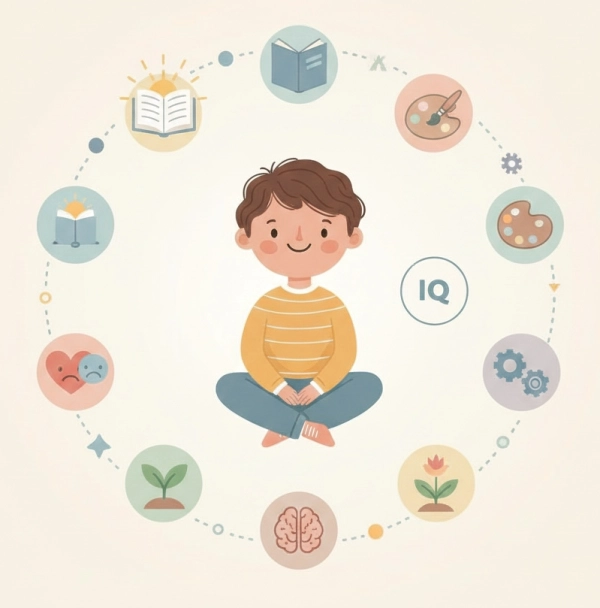
What an IQ Score Actually Represents
An IQ (Intelligence Quotient) score reflects how a child performs on a set of standardized cognitive tasks compared with other children of the same age. These tasks are designed to assess specific mental processes, such as:
- Logical reasoning
- Pattern recognition
- Verbal understanding
- Working memory
- Processing speed
IQ tests are carefully developed using large samples and statistical methods to ensure consistency and reliability. Their purpose is not to label children, but to provide a snapshot of performance on certain structured problem-solving tasks at a particular point in time. Parents who want a clearer foundation may find it helpful to review what is IQ – a complete guide to intelligence quotient.
It is important to understand that IQ tests measure how a child thinks in specific situations, not how intelligent, creative, or capable they are overall. Many essential abilities—such as curiosity, imagination, emotional awareness, and practical problem-solving—fall outside the scope of IQ testing. As a result, an IQ score should be viewed as limited information rather than a complete picture of a child’s abilities.
Why IQ Scores Can Be Misleading in Children
Children’s brains are still developing, and cognitive skills do not grow at the same pace for every child. Because of this ongoing development, IQ scores in childhood are more flexible and changeable than they are in adulthood.
Unlike adults, children often show noticeable fluctuations in test performance over time. Scores may change as children grow, learn, and gain new experiences—an issue discussed in how accurate are IQ tests for children.
IQ scores in childhood may vary due to factors such as:
- Natural brain growth and developmental timing
- Increased exposure to education and structured learning
- Emotional state, motivation, or fatigue on the day of testing
- Familiarity with test formats or similar tasks
- Comfort level with the testing environment and examiner
These influences mean that a single score represents a moment, not a permanent trait. For this reason, professionals caution against treating childhood IQ results as fixed labels or long-term predictions.
When Parents Typically Become Concerned
Parents may begin to worry about an IQ score for several understandable reasons. Concern often arises when:
- The number seems lower or higher than expected
- The score is compared to siblings, classmates, or peers
- The result is misunderstood as a prediction of future success
- The score is presented without explanation or proper context
In many cases, anxiety comes not from the score itself, but from misunderstanding what it does—and does not—mean. Articles like IQ testing for kids: what parents should know help clarify these common concerns.
What IQ Scores Do—and Do Not—Tell Parents
When used responsibly, IQ scores can sometimes help identify:
- How a child approaches certain types of structured problem-solving
- Relative cognitive strengths and areas that may need support
- Learning patterns that can inform educational strategies
- Situations where enrichment or additional assistance may be helpful
However, it is equally important to understand what IQ scores do not measure. IQ tests do not assess:
- Creativity or imaginative thinking (IQ vs creativity).
- Emotional intelligence, empathy, or self-awareness (emotional intelligence and self-awareness).
- Motivation, effort or persistence
- Social skills and communication ability
- Artistic, athletic, mechanical or hands-on talents
Many children demonstrate high potential in areas that standardized tests are not designed to measure, including those described in signs of high intellectual potential in children.
IQ Is Not a Measure of a Child’s Future
Research consistently shows that IQ alone is a weak predictor of long-term outcomes. While cognitive skills matter, they are only one part of a much larger picture.
Factors that tend to have a greater influence on a child’s future include:
- Supportive and stable family relationships
- Quality and consistency of education
- Emotional well-being and self-confidence
- Encouragement and positive expectations
- Opportunities to explore interests and talents
- Persistence, adaptability, and problem-solving skills
Many successful people follow paths that would not have been predicted by IQ scores alone, as discussed in can someone with a low IQ be successful.
How Parents Can Respond in a Healthy Way
Rather than focusing on an IQ number, parents can take practical steps to support their child’s overall development.

Healthy and constructive responses include:
- Viewing IQ results as information, not judgment or limitation
- Focusing on effort, progress, and learning habits
- Encouraging curiosity, play, and exploration
- Recognizing and nurturing individual strengths
- Avoiding comparisons with other children
- Communicating openly with teachers or educators when needed
Practical strategies for support are also outlined in how to support a child with below-average IQ.
When Professional Guidance Can Help
In some situations, IQ testing is part of a broader educational or psychological evaluation. When this occurs, results should always be reviewed with qualified professionals who can:
- Explain scores clearly and responsibly
- Place results within a broader developmental and educational context
- Identify supportive strategies tailored to the child’s needs
Professional interpretation helps ensure that IQ results are used as tools for understanding and support—not as labels that limit expectations.
The Bottom Line
So, should parents be concerned about their child’s IQ?
In most situations, no.
An IQ score reflects performance on a limited set of cognitive tasks at a specific moment in time. It does not define a child’s intelligence, worth or future. Children grow, learn, and develop in many different ways and their potential cannot be captured by a single number.
When parents focus on encouragement, opportunity, and understanding rather than test scores, children are far more likely to thrive—academically, socially and emotionally.

Comments
Share Your Thoughts