William James Sidis is one of the most fascinating and most misrepresented figures in the history of intelligence. He entered Harvard University at age 11 — the youngest person ever enrolled — delivered a lecture on four-dimensional bodies to the Harvard Mathematical Club at the same age, and is widely claimed to have had an IQ of 250 to 300. He died at 46, alone in a Boston rooming house, working as a clerk and collecting streetcar transfers for a hobby.
The gap between these two facts — Harvard at 11, clerk at 39 — has made him a permanent cautionary tale, a symbol of wasted genius, a broken prodigy. But the real story is more complicated, more human, and ultimately more interesting than either the myth of his intellect or the myth of his failure. This article examines what we actually know about Sidis's intelligence, what the 250–300 IQ claim is actually based on, and what his life really teaches us about the limits of cognitive potential.
What Was William James Sidis's IQ?
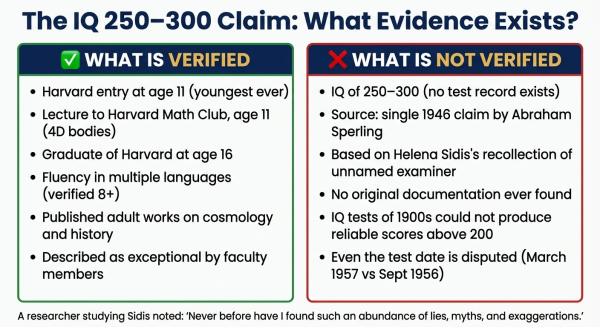
The IQ of 250–300 most commonly attributed to William James Sidis is not based on any verified test record. No documentation of any standardised IQ test administered to Sidis has ever been found. The figure originates from a single source: psychologist Abraham Sperling's 1946 book Psychology for the Millions, in which Sperling claimed that Sidis's sister Helena told him that an unnamed examiner had once estimated Sidis's intelligence in this range.
This is a third-hand account — Sperling reporting what Helena said an unnamed third party had estimated — published two years after Sidis's death, in a popular psychology book, with no original documentation cited. Modern psychologists and historians of intelligence testing have identified multiple problems with the figure:
- IQ tests in the early 1900s were not standardised or reliable enough to produce meaningful scores above 200 — the psychometric infrastructure to anchor such claims did not exist
- No original test record, no examiner's identity, no methodology has ever been documented or verified
- The ratio IQ formula — which could theoretically produce extreme numbers for young children — was not reliably validated beyond mental ages of 15 even for the tests of that era
- A researcher who spent 28 years studying primary sources on Sidis reported: "Never before have I found such an abundance of lies, myths, half-truths, exaggerations, and misinformation than in William Sidis's history"
What is not in dispute is that Sidis's cognitive ability was genuinely exceptional. The verified facts of his childhood — reading at 18 months, mastering multiple languages before age 8, entering Harvard at 11, lecturing on advanced mathematics at the same age — provide overwhelming evidence of extraordinary intelligence regardless of any specific number. The figure 250–300 is mythology layered on top of a reality that is extraordinary enough without it. For context on why extreme IQ claims above 200 are unreliable, see our guide on the highest IQ of all time and the IQ scale explained.
The Verified Facts: A Childhood That Was Genuinely Extraordinary
Whatever the precise number, the documented facts of Sidis's early development are extraordinary by any measure and require no embellishment.
| Age | Verified Achievement |
| 18 months | Reading the New York Times |
| ~3 | Teaching himself to type |
| 5 | Writing French poetry; learning Latin and Greek |
| 6 | Fluent in English, Latin, French, German, Russian, Hebrew, Turkish, and Armenian |
| 8 | Washington Post profile as "Boy Wonder" |
| 9 | Accepted to Harvard; required to wait until age 11 |
| 11 | Enrolled at Harvard — youngest ever; lectured Harvard Mathematical Club on four-dimensional bodies |
| 16 | Graduated Harvard — class of 1914 |
William James Sidis was born on 1 April 1898 in Manhattan, New York, to Boris Sidis — a Ukrainian-born psychologist who had fled persecution and earned his PhD under William James at Harvard — and Sarah Mandelbaum, who had given up her own medical studies to focus on raising their son. Both parents were extraordinarily well-educated. Boris deliberately applied his psychological research to the question of how to accelerate a child's intellectual development, treating young William as an experiment in what maximum early stimulation could produce.
The results were remarkable. But as Sidis himself would later make clear, the experiment had a significant human cost.
Why the IQ Claim Cannot Be Verified
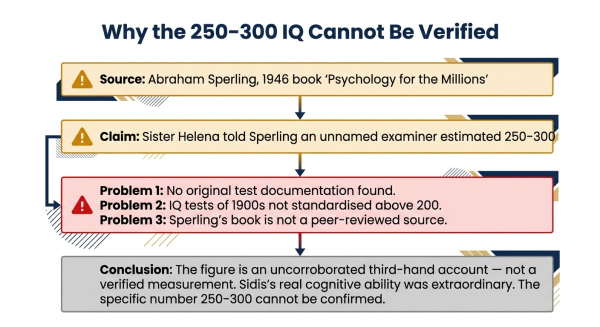
The specific figure of 250–300 has been repeated across the internet so many times that it has acquired the status of fact. It is not. The chain of evidence is:
- Sidis dies in 1944
- In 1946, Abraham Sperling publishes Psychology for the Millions
- Sperling writes that Sidis's sister Helena told him an examiner had estimated Sidis's IQ at this level
- No examiner's name is given. No test record is cited. No methodology is described
- The figure is repeated in subsequent popular accounts, each time acquiring more certainty than the source warrants
Modern psychometricians have noted that even if such a test had been administered, the IQ tests available in Sidis's lifetime could not reliably produce scores above approximately 160–170 for adults, and any childhood ratio score extrapolated to 250–300 would violate the validated range of the test instruments available at the time.
The more honest assessment: Sidis's cognitive ability was in a range that standard tests could not adequately measure. His verified childhood achievements — the languages, the mathematics, the Harvard admission and performance — suggest cognitive ability well above the 130–140 range associated with giftedness. The specific figures 250 or 300 are mythology, not measurement. For comparison, the highest verified childhood IQ score in the modern record belongs to Terence Tao at 225–230 — and even that is a childhood ratio score not directly comparable to adult assessments.
Harvard, Rice, and the Beginning of the Retreat
Sidis's time at Harvard was both a triumph and a harbinger. Faculty members were initially sceptical about teaching an 11-year-old, but most were quickly impressed by his mathematical abilities and serious approach to learning. On 5 January 1910, he delivered a lecture on four-dimensional bodies to the Harvard Mathematical Club that drew the attention of prominent American physicists and mathematicians.
He graduated in 1914 at age 16 and immediately took a teaching position at Rice University in Houston. The experience was a disaster. Rice students — most of them significantly older — responded to their 16-year-old instructor with hostility, mockery, and open contempt. Sidis endured it for eight months before resigning and returning to Harvard to study law.
He abandoned law as well, before graduating. In 1918, he was arrested while participating in an anti-war May Day rally in Boston — one of several encounters with the police related to his socialist political activities. He was sentenced to 18 months in prison, a sentence that was ultimately suspended after his parents arranged for him to receive psychiatric care.
By his early twenties, Sidis had effectively retreated from the public world that had defined his childhood. He began working a series of low-level clerical jobs — accounting, adding-machine operation — and cultivated obscurity as deliberately as his parents had once cultivated his fame.
The Adult Life He Actually Chose
The narrative of Sidis as a broken genius, wasting his gifts in shame and failure, is largely a press creation — and he resented it deeply. When journalists found him working as an adding-machine operator in his late twenties, he told them: "The mere sight of a mathematical formula makes me physically sick." He once said he boasted of his ability to operate an adding machine with great precision — deliberately inverting the expectation that a man with his intellectual history should be doing something grander.
What the failure narrative misses is that Sidis continued producing intellectual work throughout his adult life — quietly, under pseudonyms, with no interest in recognition. His verified adult output includes:
- The Animate and the Inanimate (1925) — a self-published work exploring entropy, the second law of thermodynamics, and speculations about the universe that some later scholars found prescient in their anticipation of ideas about black holes and cosmic reversibility
- Notes on the Collection of Transfers (1926) — a book about streetcar transfer systems, published under the pseudonym Frank Folupa, that reflected his genuine passion for the mechanics of public transit systems
- An extensive unpublished manuscript on American Indigenous history — discovered after his death and later recognised as containing genuine historical scholarship
None of this is the output of a man whose intellect had collapsed. It is the output of a man who had decided to use his intellect on his own terms, for his own purposes, without the weight of the world's expectations.
The New Yorker Profile and the Privacy Law Legacy
In August 1937, The New Yorker published a profile titled "Where Are They Now? April Fool!" — a mocking portrait of Sidis as an eccentric recluse, collecting streetcar transfers, living in a shabby rooming house, a pathetic remnant of his childhood promise. The article caused Sidis severe distress and prompted a lawsuit for invasion of privacy.
The case — Sidis v. F-R Publishing Corporation (1940) — established an important precedent in American privacy law: that a person who was once a public figure remains a public figure, and that truthful reporting about their life, however intrusive, does not constitute actionable invasion of privacy. This legal legacy is one of the most concrete contributions William James Sidis made to American society — an irony he almost certainly would have appreciated and resented in equal measure.
He ultimately won a modest settlement from The New Yorker for factual inaccuracies in the article. He died on 17 July 1944 — his father's cause of death, cerebral haemorrhage — at age 46, in his Boston rooming house, with a small group of family members in attendance.
The Comparison That Matters: Sidis vs Tao
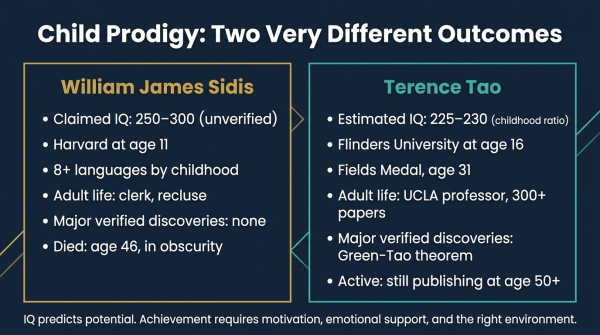
The most illuminating comparison in understanding Sidis's story is with Terence Tao — the Australian-American mathematician whose childhood IQ estimate of 225–230 is comparable to the range attributed to Sidis, and whose adult output includes the Fields Medal, the Green-Tao theorem, and more than 300 peer-reviewed research papers.
Both were childhood prodigies. Both demonstrated extraordinary mathematical ability before age 12. The outcomes could not be more different. Tao's parents — both educators — were careful to balance his mathematical acceleration with ordinary childhood development, social engagement, and emotional support. His father later wrote about the importance of not forcing the pace, of allowing him to develop as a whole person rather than just as a cognitive instrument.
Boris and Sarah Sidis made the opposite choice. They treated their son as an experiment, isolated him from ordinary childhood peer relationships, and pushed his intellectual development at a pace that left no room for the emotional and social development that sustains adult functioning. The results illustrate one of the most robust findings in developmental psychology: cognitive potential is necessary but not sufficient for adult achievement — and the environment in which it develops shapes the outcome as much as the capacity itself.
For more on this relationship, see our guide on can IQ improve in children and signs of a gifted child.
What William James Sidis Actually Teaches Us
The mythology around Sidis tends in two directions: either he was the smartest person who ever lived and died a tragic waste, or he was a brilliant man who simply chose a different kind of life. Both framings miss the point.
The more useful reading of his story is as evidence about the conditions that allow exceptional cognitive ability to develop into exceptional adult contribution — and the conditions that prevent it:
- Cognitive potential is not destiny. Extraordinary childhood ability does not automatically produce extraordinary adult achievement. The gap between what Sidis could do at 11 and what he produced at 40 was not primarily about intelligence. It was about emotional development, social belonging, and the psychological cost of a childhood spent as a public spectacle
- The IQ number is the least important part of his story. Whether Sidis's IQ was 200, 250, or 300 is essentially irrelevant. What matters is that a genuinely exceptional mind was placed under conditions that made it impossible to develop the motivation, stability, and direction that converts raw cognitive capacity into meaningful work
- The "wasted genius" narrative is itself a form of harm. The press coverage that dogged Sidis throughout his adult life — treating him as public property, mocking his choices, reducing him to a symbol of failure — was a continuation of the same exploitation that had defined his childhood. His retreat was not failure. It was a reasonable response to conditions that most people would find intolerable
For more on how intelligence interacts with emotional development and life outcomes, see our guides on IQ vs EQ and what matters more than IQ for success.
William James Sidis had an extraordinary mind — that much is beyond reasonable doubt. The IQ of 250–300 has no reliable evidence behind it. What does have evidence is the story of a child who was never allowed to be a child, and what that cost him. His life is not a lesson about wasted genius. It is a lesson about what cognitive potential actually requires to become human flourishing.
Take our free IQ test — no registration, results in under 20 minutes. Explore our full Celebrity IQ database, or see how Sidis compares to other extreme IQ cases in our guide on the highest IQ of all time.
Frequently Asked Questions
What was William James Sidis's IQ?
William James Sidis's IQ is most commonly cited as 250–300. However, no verified test record exists. The figure originates from a single 1946 claim by psychologist Abraham Sperling, who reported that Sidis's sister Helena described an estimate by an unnamed examiner. No documentation has ever been found, and IQ tests of the early 1900s could not produce reliable scores above 200. His cognitive ability was genuinely extraordinary — the specific numbers are not verified.
How young was William Sidis when he entered Harvard?
William James Sidis entered Harvard at age 11 in September 1909, becoming the youngest person ever enrolled. Harvard had accepted him at age 9 but required him to wait. He delivered a lecture on four-dimensional bodies to the Harvard Mathematical Club on January 5, 1910, at age 11.
Why did William James Sidis become a clerk?
After failed attempts at teaching at Rice University and studying law, Sidis deliberately retreated from public life. He stated that mathematics made him physically sick. His adult choices reflected a conscious rejection of the pressure and public attention his prodigy status had imposed. His retreat was a choice — not a collapse. He continued writing and publishing under pseudonyms throughout his adult life.
What did William James Sidis actually achieve as an adult?
Sidis published The Animate and the Inanimate (1925) — a work on cosmology and entropy considered prescient by some scholars — and Notes on the Collection of Transfers (1926) on streetcar systems. He also wrote an extensive unpublished manuscript on American Indigenous history. His privacy lawsuit against The New Yorker established important precedents in American privacy law that remain relevant today.
How did William James Sidis die?
William James Sidis died on July 17, 1944, at age 46, from a cerebral haemorrhage — the same cause that had killed his father. He was found alone in his Boston rooming house. He died largely in obscurity, having spent the final two decades of his life deliberately avoiding public attention.

Comments
Share Your Thoughts