The question of who has the highest IQ of all time is one of the most searched topics in intelligence research — and one of the most misunderstood. The internet is full of lists claiming scores of 250, 300, even 400. Most of these numbers are either retroactive estimates, childhood ratio scores, or results from non-standardised high-range tests that no serious psychometrician endorses.
This guide separates what is actually verified from what is mythology — using the same critical framework you would apply to any extraordinary claim. If you want to know where your own score sits in this picture, take our free IQ test for an instant baseline.
Why This Question Is Harder to Answer Than It Looks
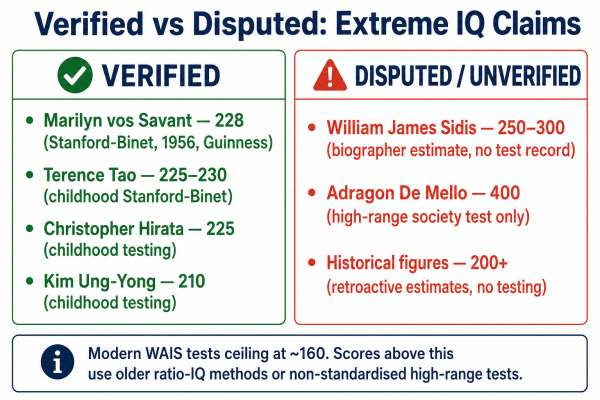
Before diving into the list, there is a critical fact that most articles on this topic skip entirely: modern IQ tests cannot reliably measure scores above approximately 160.
The Wechsler Adult Intelligence Scale (WAIS) and the current Stanford-Binet both ceiling at around 160 on the standard deviation-15 scale. Above that threshold, there are simply too few people to anchor statistically reliable comparisons. As one psychometrician put it: no contemporary test can meaningfully distinguish between an adult IQ of 180 and one of 220. The numbers look different, but the measurement precision to support that difference does not exist.
This is precisely why Guinness World Records retired its Highest IQ category in 1990, explicitly stating that IQ tests were too unreliable to designate a single record holder. That decision has never been reversed. Any list claiming to rank people above 200 is working with one of four unreliable sources: childhood ratio IQ scores, retroactive historical estimates, self-reported results, or scores from non-standardised high-range society tests.
Understanding this does not make the topic less fascinating — it makes it more so. The people on this list are genuinely extraordinary. The numbers just need to be held with appropriate scepticism. For a full explanation of how IQ scoring works and why these ceiling effects occur, see our IQ scale explained guide.
The Highest IQ Scores Ever Recorded — Full Ranking
| Rank | Name | IQ Score | Method | Verification |
| 1 | Marilyn vos Savant | 228 | Stanford-Binet (age 10) | ✅ Guinness Record 1985–1989 |
| 2 | Terence Tao | 225–230 | Stanford-Binet (childhood) | ✅ Widely accepted |
| 3 | Christopher Hirata | 225 | Childhood testing | ✅ Widely accepted |
| 4 | Kim Ung-Yong | 210 | Childhood testing | ✅ Widely accepted |
| 5 | Christopher Langan | 195–210 | Various adult tests | 🟡 Partially verified |
| 6 | William James Sidis | 250–300 | Biographer estimate | ❌ Disputed — no test record |
| 7 | Johann Wolfgang von Goethe | 210–225 | Retroactive estimate | ❌ No test existed |
| 8 | Leonardo da Vinci | 180–220 | Retroactive estimate | ❌ No test existed |
| 9 | Adragon De Mello | 400 | High-range society test | ❌ Not standardised |
| 10 | Albert Einstein | ~160 | Retroactive estimate | 🟡 Never took an IQ test |
Now let us examine each of the most significant figures in detail — with honest assessments of what is actually known.
1. Marilyn vos Savant — IQ 228 (The Only Official Guinness Record)
Marilyn vos Savant holds the only IQ score ever officially listed in the Guinness World Records — a score of 228, derived from a Stanford-Binet test taken when she was 10 years old in September 1956. The test measured her mental age at 22 years and 10 months, producing a ratio IQ of 228 using the formula mental age divided by chronological age multiplied by 100.
She was listed in Guinness from 1985 to 1989. In 1990, Guinness retired the category entirely, citing the impossibility of comparing scores from different tests and eras. Her adult Mega Test score was 186 — still extraordinary, but significantly lower than her childhood figure, which illustrates exactly why childhood ratio IQ scores cannot be compared to adult deviation IQ scores.
Vos Savant has written the "Ask Marilyn" column in Parade magazine since 1986, where she became famous for correctly solving the Monty Hall problem in 1990 — a counterintuitive probability puzzle that generated thousands of objections from mathematicians and academics, most of whom were ultimately wrong. For more on her profile, see our dedicated article on Marilyn vos Savant's IQ.
2. Terence Tao — IQ 225–230 (The Strongest Living Claim)
Among living people, Terence Tao has the most credible claim to the highest IQ. Born in Adelaide, Australia in 1975, Tao began learning calculus at age 7 — the same year he started high school. He completed his PhD at Princeton at 20, joined the UCLA faculty the same year, and was promoted to full professor at 24, making him the youngest ever tenured professor in the university's history.
In 2006, he was awarded the Fields Medal — the mathematical equivalent of a Nobel Prize — for his work in partial differential equations, combinatorics, and number theory. He received a $3 million Breakthrough Prize in Mathematics in 2015. He has published more than 300 research papers and is widely regarded by peers as one of the most gifted mathematicians alive.
His childhood Stanford-Binet score of 225–230 is the most commonly cited figure, but — as with all scores in this range — it was produced using the older ratio method on a child, and cannot be directly compared to a modern adult deviation IQ. What is not in doubt is the extraordinary depth and breadth of his mathematical output, which provides independent evidence of exceptional cognitive ability regardless of any specific number.
3. Christopher Hirata — IQ 225
Christopher Hirata became an International Physics Olympiad gold medallist at age 13 and began working for NASA on a Mars colonisation project at 16. He completed his PhD in astrophysics at Caltech at 22. His childhood IQ score of 225 comes from standardised testing and is widely accepted as credible within its methodological context — a childhood ratio score, not an adult deviation score.
4. Kim Ung-Yong — IQ 210
South Korean civil engineer Kim Ung-Yong was listed in the Guinness World Records as the person with the highest IQ at one point, with a score of 210. He was speaking at age 6 months, reading Korean, Japanese, German, and English by age 3, and was auditing university physics courses at 4. He was invited to work at NASA from age 8 to 16.
What makes his story particularly interesting is what came after. Kim voluntarily left NASA, returned to South Korea, completed a PhD in civil engineering, and became a university professor — deliberately choosing an ordinary professional life over the pressure of being a public prodigy. His story is a useful counterpoint to the idea that the highest IQ automatically produces the most extraordinary life.
5. William James Sidis — IQ 250–300 (The Most Famous Disputed Claim)
William James Sidis is perhaps the most famous name in this conversation — and also the one requiring the most scepticism. Sidis entered Harvard at age 11, gave a lecture to the Harvard Mathematical Club on four-dimensional bodies at 11, and reportedly spoke more than 25 languages. His story is extraordinary by any measure.
The IQ of 250–300, however, is not from any administered test. According to his sister Helena, a psychologist informally assessed Sidis a few years before his death in 1944 and suggested his score was in that range. That informal account — filtered through a family member's recollection — is the entire basis for the figure. No test records exist. No methodology is documented.
Modern psychologists consider the ratio IQ method that would have been used at the time invalid for producing meaningful comparisons at extreme values. The 250–300 figure should be understood as a vivid illustration of his childhood precocity, not as a scientifically meaningful measurement. His adult life — he worked as a clerk, avoided public attention, and died in obscurity at 46 — offers its own commentary on the relationship between childhood IQ and adult achievement. For more, see our William James Sidis IQ profile.
6. Historical Figures — Why Their IQ Scores Are Always Estimates
Many lists include figures like Leonardo da Vinci (180–220), Johann Wolfgang von Goethe (210–225), Isaac Newton (190), and Nikola Tesla (160–310). These numbers share one important characteristic: the people in question lived and died before the IQ test was invented in 1905. Every score assigned to them is a retroactive estimate derived from historians and biographers examining their documented output and applying a rough backwards calculation.
These estimates are interesting as thought experiments but carry no psychometric validity. The same output — writing, invention, scientific discovery — could reflect different combinations of intelligence, knowledge, access to resources, working conditions, and luck. Assigning a single IQ number to Shakespeare or da Vinci based on their body of work tells us more about our desire to quantify genius than about the actual structure of their intelligence. See our related articles on Einstein's estimated IQ and Leonardo da Vinci's IQ for detailed analyses of specific cases.
Why IQ Scores Above 200 Should Be Treated With Scepticism
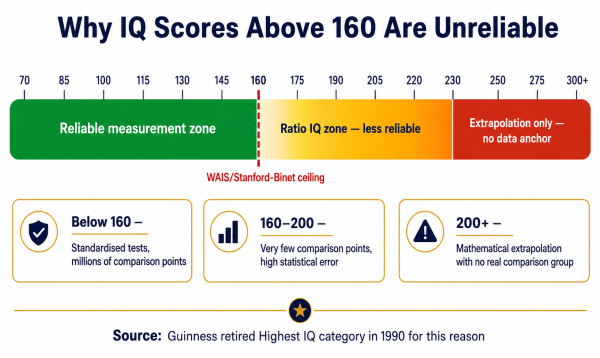
There are four main sources for IQ claims above 200, and none of them are equivalent to a standardised clinical assessment:
- Childhood ratio IQ scores — these can legitimately produce high numbers for young prodigies because they divide mental age by chronological age. A 10-year-old reasoning at the level of a 22-year-old produces a ratio of 2.2 × 100 = 220. But this formula becomes meaningless for adults, and cannot be compared to modern deviation IQ scores used by the WAIS or Stanford-Binet from 1960 onward
- High-range society tests — organisations like the Mega Society, Prometheus Society, and similar groups administer their own unsupervised tests with no standardisation population. Scores from these tests are not comparable to clinical assessments and are not endorsed by mainstream psychometrics
- Retroactive historical estimates — applied to figures who died before IQ testing existed. These are educated guesses, not measurements
- Self-reported or informally assessed scores — including the Sidis figure — where no verified test record exists
The ceiling effect is the fundamental issue: above IQ 160, the number of people available to anchor a reliable comparison group becomes vanishingly small. The precision implied by a score of "276" or "300" does not exist in the psychometric data. For a detailed look at what very high IQ scores actually mean in practice, see our guides on IQ 160 and IQ 145.
What Does Extreme IQ Actually Produce?
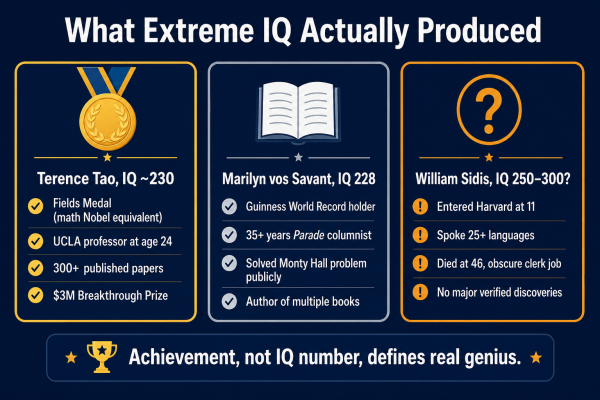
The most instructive comparison in this entire discussion is between Terence Tao and William James Sidis. Tao, with a verified IQ in the 225–230 range, has produced hundreds of original research papers, won the Fields Medal, and is universally regarded by mathematical peers as one of the most productive and original minds in the field. Sidis, with an estimated (but disputed) IQ of 250–300, died at 46 having produced no verified scientific discoveries, no enduring published work, and having spent his adult life deliberately avoiding the intellectual environment that would have tested his alleged abilities.
This contrast illustrates a point that intelligence research has supported for decades: above a cognitive threshold of approximately IQ 120–130, the additional variance in life outcomes is explained more by motivation, emotional regulation, domain focus, and circumstance than by additional IQ points. A score of 160 and a score of 230, if both could be accurately measured, would not produce proportionally different life achievements. For more on this, see our guide on IQ vs problem-solving ability and IQ vs EQ.
The Most Credible Ranking of Highest IQ Ever
If forced to produce a ranking based solely on the most credible evidence available, psychometricians would most likely order it as follows:
- Most credible verified record: Marilyn vos Savant — IQ 228 (Guinness, 1985–1989), with the caveat that this is a childhood ratio score
- Most credible living claim: Terence Tao — IQ 225–230, supported by independent verification of extraordinary mathematical output
- Most credible adult score: Marilyn vos Savant — IQ 186 on the Mega Test as an adult
- Most famous but least credible: William James Sidis — 250–300, based on no surviving test record
The honest answer to "who has the highest IQ of all time" is: we do not know, and probably cannot know. The tools to measure it accurately do not exist above IQ 160. The Guinness World Records retired the category for exactly this reason. What we can say with confidence is that a small group of people — Tao, vos Savant, Hirata, Kim Ung-Yong — demonstrated extraordinary cognitive ability verified through multiple channels, and their achievements speak more convincingly than any number.
The highest IQ ever recorded is 228 — held by Marilyn vos Savant in the Guinness World Records. The highest IQ reliably supported by independent achievement evidence belongs to Terence Tao. Everything above 230 is extrapolation, not measurement.
Curious where your own score sits on this spectrum? Take our free International Standard IQ Test — no registration required, results in under 20 minutes. You can also explore our full Celebrity IQ database or see how specific high scores compare in our guides on IQ 132, IQ 140, and high-IQ societies.
Frequently Asked Questions
Who has the highest IQ of all time?
The highest IQ officially recorded was Marilyn vos Savant's score of 228, listed in the Guinness World Records from 1985 to 1989. Among living people, mathematician Terence Tao is most commonly cited with an estimated IQ of 225–230. William James Sidis is often claimed to have had an IQ of 250–300, but this is disputed and based on no surviving test record.
What is the highest IQ ever recorded?
The highest IQ score officially documented was 228, belonging to Marilyn vos Savant. Guinness retired the Highest IQ category in 1990 after concluding IQ tests were too unreliable to designate a single record holder. The score was based on a childhood Stanford-Binet test using the ratio IQ method.
Why did Guinness stop recording the highest IQ?
Guinness World Records retired the Highest IQ category in 1990 because IQ tests are too unreliable across different eras and methodologies to meaningfully compare scores. Modern standardised tests like the WAIS also ceiling at approximately 160, making scores above that level psychometrically questionable.
Is William James Sidis really the smartest person ever?
Almost certainly not by any verifiable measure. Sidis' IQ of 250–300 is an estimate based on a biographer's account of a psychologist's informal assessment — not a standardised test score. Modern psychologists consider the ratio IQ method used to derive such figures invalid for producing meaningful adult IQ comparisons. His adult life, spent as a clerk in deliberate obscurity, also offers its own commentary on the relationship between claimed childhood IQ and real-world achievement.
Who has the highest confirmed IQ alive today?
Terence Tao, the Australian-American mathematician at UCLA, is most widely cited among living people with an estimated IQ of 225–230 based on childhood Stanford-Binet testing. He is a Fields Medal winner and is widely regarded by peers as one of the most gifted mathematicians alive — making him the strongest case where extreme claimed IQ is supported by extraordinary independent achievement. See our full profile on Terence Tao's IQ.

Comments
Share Your Thoughts