Terence Tao is 51 years old, holds the James and Carol Collins Chair at UCLA, and has published more than 300 peer-reviewed mathematical papers across at least eight distinct disciplines. His colleagues call him "the Mozart of mathematics" — not because of his age when he started, but because, as one fellow mathematician put it, "mathematics just flows out of him."
His IQ is estimated at 225–230 based on childhood Stanford-Binet testing — the highest verified figure among any living person, and one of the most credible extreme IQ claims in history. But unlike most celebrity IQ stories, Tao's number is the least interesting thing about him. The more important question is what he actually did with it.
What Is Terence Tao's IQ?
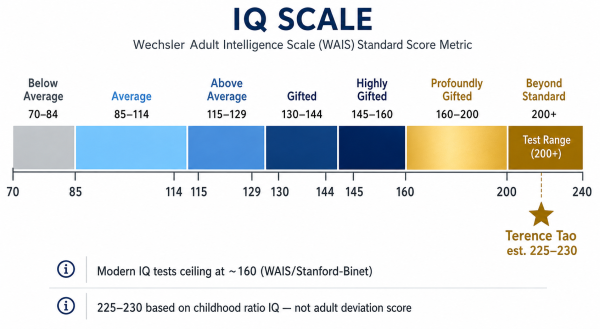
Terence Tao's IQ is most commonly cited as 225–230, derived from childhood Stanford-Binet testing conducted when he was approximately 8–9 years old. At age 8, he scored 760 out of 800 on the math section of the SAT — a test designed for college-bound 17-year-olds. A 1984 study by mathematics educator Ken Clements, who assessed Tao directly, documented that he had demonstrated adult-level intellectual capabilities by age 6, having taught himself to read at age 2 by watching Sesame Street.
It is important to understand what these numbers actually represent. The 225–230 figure is a childhood ratio IQ — calculated by dividing mental age by chronological age and multiplying by 100. This method can legitimately produce very high figures for young prodigies, but it cannot be directly compared to modern adult deviation IQ scores produced by the WAIS or Stanford-Binet from 1960 onward. No contemporary test can reliably distinguish between an adult IQ of 180 and one of 225 — the comparison group at that level is too small to anchor statistically meaningful scores.
What is not in dispute is that Tao's cognitive ability, whatever its precise numerical value, is supported by more independent third-party evidence than virtually any other person on earth. For context on the scoring framework, see our guides on IQ 160, the IQ scale explained, and our full ranking of the highest IQ of all time.
From Adelaide to the World Stage: A Prodigy's Timeline
Terence Tao was born on 17 July 1975 in Adelaide, South Australia, to Chinese immigrant parents — his father Billy, a paediatrician, and his mother Grace, a mathematics teacher. His early development was documented with unusual precision, making his case one of the best-studied examples of extreme childhood giftedness in academic literature.
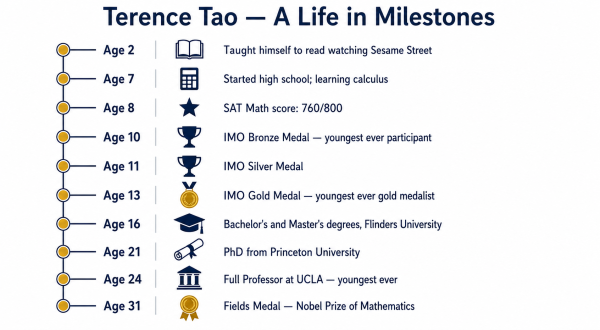
| Age | Milestone |
| 2 | Taught himself to read by watching Sesame Street |
| 7 | Started high school; began learning calculus |
| 8 | Scored 760/800 on the SAT Math section |
| 9 | Taking university-level mathematics at Flinders University |
| 10 | IMO Bronze Medal — youngest participant in competition history |
| 11 | IMO Silver Medal — youngest silver medalist |
| 13 | IMO Gold Medal — youngest gold medalist in history (1988) |
| 16 | Bachelor's and Master's degrees from Flinders University |
| 21 | PhD from Princeton University under Elias Stein |
| 24 | Full Professor at UCLA — youngest in the university's history |
| 31 | Fields Medal — the Nobel Prize of mathematics (2006) |
The International Mathematical Olympiad records are particularly significant because they provide standardised competitive benchmarks. Tao did not just win gold — he won at progressively younger ages than any previous competitor at each level: bronze at 10, silver at 11, gold at 13. Each of these records has stood for nearly four decades.
The Achievements That Prove the Number
Most celebrity IQ articles rely entirely on the claimed score. Tao's case is different: his cognitive ability is supported by a body of independent achievement that has no equivalent among living people.
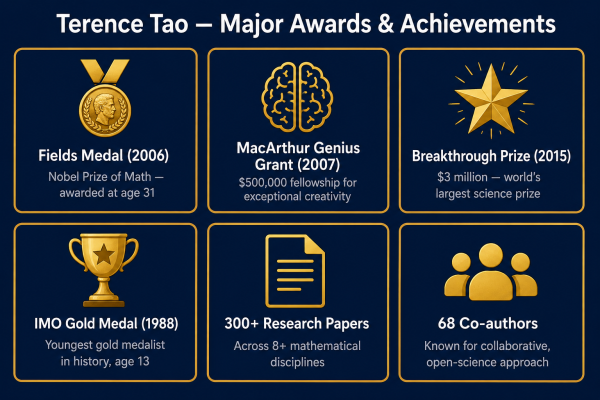
Fields Medal — 2006
The Fields Medal is awarded every four years to at most four mathematicians under 40, and is widely regarded as the highest honour in mathematics. Tao received it in 2006 at age 31. The citation described him as "a supreme problem-solver whose work combines technical power, other-worldly ingenuity for hitting upon new ideas, and a startlingly natural point of view that leaves other mathematicians wondering, 'Why didn't anyone see that before?'"
MacArthur Genius Fellowship — 2007
The MacArthur Foundation awarded Tao a $500,000 "Genius Grant" in 2007 — given to individuals who demonstrate exceptional originality and the potential to make a transformative impact. It requires no application; candidates are nominated and selected entirely by an anonymous committee of independent experts.
Breakthrough Prize in Mathematics — 2015
Tao received the Breakthrough Prize in Mathematics — the world's largest science prize at $3 million — in 2015. He was cited for his numerous breakthrough contributions including work on the Green-Tao theorem, compressed sensing, and harmonic analysis.
Publication Record
Between 2004 and 2006 alone, Tao published 56 peer-reviewed papers — more than many entire university departments produce in a year. His total output exceeds 300 papers across harmonic analysis, partial differential equations, number theory, combinatorics, compressed sensing, and algebraic combinatorics. By 2015, he had collaborated with 68 co-authors across multiple countries, many of whom he had never met in person.
The Green-Tao Theorem: What It Means and Why It Matters
In 2004, Tao and British mathematician Ben Green proved what is now known as the Green-Tao theorem — one of the most celebrated results in 21st-century mathematics.
The theorem concerns prime numbers: the integers divisible only by 1 and themselves (2, 3, 5, 7, 11...). Mathematicians had long suspected that within the infinite sequence of primes, there exist arbitrarily long arithmetic progressions — sequences of primes equally spaced apart, of any length you choose. For example: 5, 11, 17, 23, 29 is a progression of five primes, each separated by 6. The Green-Tao theorem proved this is always possible, regardless of how long a progression you demand.
Smithsonian Magazine compared the achievement to "a violinist suddenly winning a major piano competition" — because number theory and the harmonic analysis techniques Tao brought to bear were considered completely separate fields. The proof required synthesising tools from areas of mathematics that had never been connected before. That kind of cross-disciplinary synthesis is widely considered the hallmark of Tao's work.
What Makes Tao Different From Other Extreme IQ Cases
The most instructive comparison in understanding Tao's significance is not with other mathematicians — it is with William James Sidis, who is often cited as having an even higher IQ (250–300) and who entered Harvard at age 11. Sidis died at 46 having produced no verified scientific discoveries, having worked as a clerk, and having spent his adult life deliberately avoiding intellectual engagement.
| Person | Estimated IQ | Major Achievement | Evidence Quality |
| Terence Tao | 225–230 | Fields Medal, 300+ papers, Green-Tao theorem | ✅ Childhood tests + extraordinary independent output |
| Marilyn vos Savant | 228 | Guinness record, Parade columnist | ✅ Stanford-Binet (childhood), Guinness 1985–89 |
| William James Sidis | 250–300 | Harvard at 11, no major verified work | ❌ Biographer estimate, no test record |
| Albert Einstein | ~160 | Nobel Prize, Theory of Relativity | 🟡 Retroactive estimate, never took IQ test |
| Stephen Hawking | ~160 | Black hole radiation, cosmological theory | 🟡 Retroactive estimate |
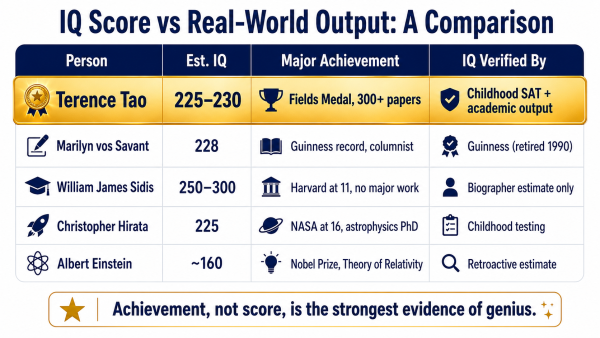
Tao is unusual not because his IQ is the highest ever claimed — it is not — but because he is the rare case where an extreme claimed score is backed by an extraordinary volume of independently verified output. The Fields Medal is not self-reported. The 300+ papers are not self-assessed. The peer recognition from the global mathematics community is not a test score that can be fabricated.
For a deeper look at how Tao's score fits into the broader landscape of extreme IQ claims, see our full guide on the highest IQ of all time.
The Human Behind the Genius
What is perhaps most striking about Tao is what he is not. He is not the isolated, socially awkward stereotype of extreme intellectual giftedness. He grew up in what he describes as a "super-normal" family environment — playing board games with his brothers, reading fantasy novels, and building imaginary worlds with his siblings. His parents were careful to balance his mathematical acceleration with ordinary childhood development.
At UCLA, colleagues describe him as "Mr Fix-it" — the person mathematicians from any specialisation call when they are stuck, because he can enter an unfamiliar problem space, absorb its structure, and identify the path forward faster than anyone with years of specialised experience in that area. By 2015, he had 68 co-authors — an extraordinary number that reflects a fundamentally collaborative rather than competitive approach to mathematics.
He is also increasingly public in his concern about threats to scientific research. In recent years, Tao has emerged as a prominent voice in defence of science funding, speaking out against policies he views as damaging to the long-term foundations of mathematical and scientific progress — evidence of the same analytical clarity applied to social and institutional questions as to abstract theorems.
His view of his own intelligence is characteristically precise. He has noted that his mathematical thinking is not about raw computational speed — it is about seeing the structure of a problem, identifying the right framework before beginning to calculate, and recognising when an approach is fundamentally wrong before wasting time pursuing it. This is exactly the kind of insight that a high-range IQ score is supposed to capture — but which a test score alone can never fully communicate. For more on how this type of reasoning connects to measured intelligence, see our guides on IQ vs problem-solving and cognitive flexibility.
Practical Intelligence: Compressed Sensing and MRI Technology
One of the less celebrated but practically significant aspects of Tao's work is its real-world impact. His research in compressed sensing — developed with Stanford professor Emmanuel Candès — contributed to advances in MRI technology. The work established mathematical principles allowing accurate imaging to be produced from significantly fewer data samples than previously thought necessary, making MRI scans faster, cheaper, and more accessible. This is not incidental — it is the direct translation of abstract mathematical results into medical technology that affects millions of patients.
It is a reminder that the highest levels of abstract intelligence and practical real-world impact are not in tension — in the right environment, with the right direction, they are the same thing.
What Terence Tao's Story Teaches Us About Intelligence
Tao's life offers several genuinely useful insights about what extreme cognitive ability actually means in practice:
- The score is the least important part. Tao's IQ of 225–230 is a childhood ratio score that cannot be directly compared to modern adult assessments. What matters is the output — and that output is extraordinary by any measure
- Collaboration multiplies intelligence. Tao did not build his career by working alone. His 68 co-authors reflect a belief that mathematical progress is fundamentally social — that diverse perspectives and open exchange produce better results than isolated genius
- Childhood prodigy and adult achievement are not the same thing. The contrast with Sidis is instructive. Extraordinary early ability predicts extraordinary adult achievement only when combined with the right environment, emotional development, and sustained motivation
- Breadth and depth are not opposites. Most specialists deepen in one area at the cost of breadth. Tao operates at the frontier of multiple disciplines simultaneously — which his colleagues describe as the defining feature of his thinking
Terence Tao's IQ of 225–230 is the most credible extreme score among living people — but it is his 300+ papers, his Fields Medal, and his Green-Tao theorem that actually prove what a mind at that level can do. The number points at the ceiling. The work is what was built beneath it.
Curious where your own score sits? Take our free IQ test — no registration required, results in under 20 minutes. You can also explore what high scores mean in practice with our guides on IQ 145, IQ 160, and high-IQ societies.
Frequently Asked Questions
What is Terence Tao's IQ?
Terence Tao's IQ is estimated at 225–230, based on childhood Stanford-Binet testing. At age 8, he scored 760/800 on the SAT Math section. These are childhood ratio IQ scores and cannot be directly compared to modern adult deviation scores, but they are among the highest ever documented through standardised assessment. His cognitive ability is further supported by his Fields Medal, 300+ research papers, and peer recognition as one of the greatest living mathematicians.
Is Terence Tao the smartest person alive?
Terence Tao is widely regarded as one of the most gifted mathematicians alive and has the most credible extreme IQ claim among living people. He is unique because his extraordinary cognitive ability is supported by independent third-party evidence through his Fields Medal, 300+ published papers, and universal peer recognition — not just a test score.
What did Terence Tao achieve?
Tao's major achievements include the Fields Medal (2006), youngest gold medalist in IMO history (age 13), youngest full professor in UCLA history (age 24), $500,000 MacArthur Genius Fellowship (2007), $3 million Breakthrough Prize (2015), the Green-Tao theorem on prime numbers (2004), and over 300 published research papers across multiple disciplines. Some of his work on compressed sensing has also contributed to advances in MRI technology.
How young was Terence Tao when he won the IMO gold medal?
Terence Tao won the IMO gold medal at age 13 in 1988 — the youngest gold medalist in the competition's history. He had previously won bronze at age 10 and silver at age 11, both also records for youngest medalists at each level.
What is the Green-Tao theorem?
The Green-Tao theorem, proved by Tao and Ben Green in 2004, establishes that within the infinite sequence of prime numbers, there exist arbitrarily long arithmetic progressions — sequences of equally-spaced primes of any length you choose. It is considered one of the most important results in 21st-century number theory and required synthesising tools from completely separate mathematical disciplines.

Comments
Share Your Thoughts