Daniel Goleman is a psychologist, author, and science journalist best known for popularizing the concept of emotional intelligence (EQ) in his 1995 book Emotional Intelligence: Why It Can Matter More Than IQ. For readers unfamiliar with emotional intelligence, you can explore our article on Emotional Intelligence & Self-Awareness to understand its core principles.
Before Goleman, intelligence was largely associated with cognitive ability — problem-solving, reasoning, and memory. His work revolutionized this view by introducing the idea that emotions play a central role in human performance, relationships, and leadership success — a theme also explored in our IQ vs EQ comparison. Through decades of research, Goleman demonstrated that EQ is often a stronger predictor of success than IQ — particularly in leadership, teamwork, and decision-making. If you’re curious about the role IQ still plays, see our complete guide to IQ.
What Is EQ According to Daniel Goleman?
In Goleman’s model, emotional intelligence (EQ) refers to the ability to recognize, understand, and manage one’s own emotions — and to influence the emotions of others positively. It bridges the gap between emotion and logic, enabling people to make thoughtful decisions even under stress. You can try our EQ Test to see where your emotional skills currently stand. Goleman identified five core components that define emotionally intelligent individuals and effective leaders.
The Five Components of Daniel Goleman’s EQ Model
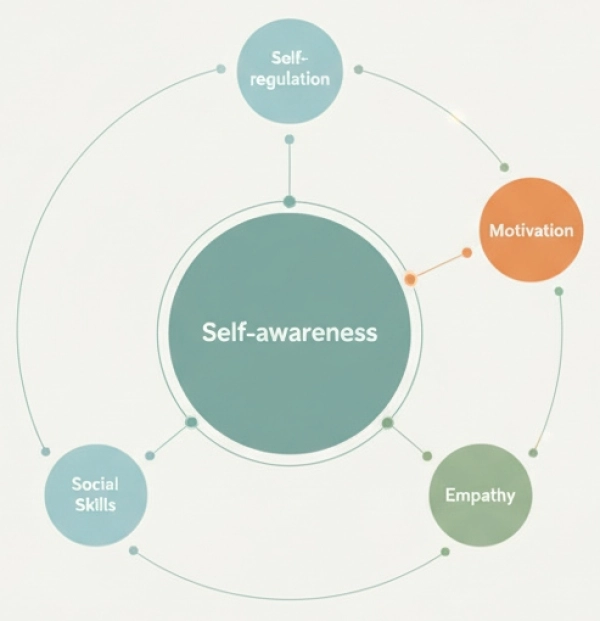
Daniel Goleman’s EQ framework identifies five key components that shape how individuals recognize, understand, and manage emotions — both in themselves and in others. These components work together to influence decision-making, relationships, motivation, and leadership effectiveness.
1. Self-Awareness — The Foundation of Emotional Intelligence
Self-awareness is the cornerstone of Goleman’s EQ model. It refers to the ability to accurately perceive your own emotions, understand what triggers them, and recognize their impact on your thoughts and behaviour. People with strong self-awareness are emotionally honest with themselves — they can identify when their judgement is clouded by stress, ego, or personal bias, and course-correct before acting impulsively. This quality also extends to understanding personal strengths and limitations and recognizing how one’s behaviour influences others.
As Daniel Goleman famously said:
“If you are tuned out of your own emotions, you will be poor at reading them in other people.”
Self-awareness is also central to both cognitive and emotional functioning — a topic explored further in our EQ vs IQ breakdown.
2. Self-Regulation — Managing Emotions Under Pressure
While self-awareness helps you recognize emotions, self-regulation determines how you handle them. Emotionally intelligent individuals can remain calm, focused, and adaptable even during uncertainty or conflict. They don’t suppress feelings, but they manage them productively — pausing before reacting, choosing thoughtful responses, and maintaining integrity under pressure. Goleman highlights three key traits that stem from effective self-regulation: adaptability (staying flexible when faced with change), trustworthiness (acting ethically even when no one is watching), and self-control (responding thoughtfully rather than impulsively). In leadership, self-regulation creates psychological safety — teams feel more secure when their leaders demonstrate emotional stability and fairness.
3. Motivation — The Drive That Comes from Within
Unlike extrinsic motivation, which depends on rewards or recognition, Goleman’s concept of motivation centres on internal passion and purpose. High-EQ individuals are guided by a deep sense of commitment to their values, goals, and vision — they possess an intrinsic desire to achieve excellence and grow, even when challenges arise. This motivation manifests as resilience (persisting despite obstacles), optimism (seeing possibilities instead of limitations), and commitment (staying focused on long-term goals over short-term gratification). In leadership, this form of motivation is contagious — a leader driven by meaning rather than status naturally inspires others to perform beyond expectations.
4. Empathy — Understanding and Connecting with Others
Empathy is the ability to recognize, understand, and share the feelings of others. For Goleman, empathy is not a soft skill — it’s a core leadership competency. It enables leaders to sense emotional undercurrents, interpret nonverbal cues, and respond in ways that make others feel valued. Empathetic leaders excel in active listening (paying full attention without interrupting or judging), perspective-taking (seeing situations from others’ viewpoints), and compassionate response (balancing care with accountability). In the workplace, empathy creates an environment of psychological safety where people feel comfortable expressing ideas and concerns.
As Goleman observed: “Empathy is the key to building lasting human relationships.”
5. Social Skills — Turning Awareness into Influence
The fifth component brings together all other elements of emotional intelligence. It refers to the ability to manage relationships effectively — to influence, communicate, collaborate, and lead. Individuals with strong social skills are not necessarily extroverted, but they are emotionally attuned: they understand group dynamics, negotiate gracefully, and know how to bring people together around a common goal. Key aspects include effective communication, conflict management, influence and inspiration, and team leadership. Goleman emphasizes that great leaders are great connectors — they influence through empathy, understanding, and authenticity rather than hierarchy. Social skills are what transform emotional intelligence into measurable impact.
The Interconnection Between the Five Components
While each of Goleman’s five components can be examined separately, they are deeply interconnected. Self-awareness enables self-regulation; self-regulation supports motivation; empathy and social skills transform personal awareness into effective relationships. Together, they form a dynamic model for emotional maturity that applies equally to personal well-being, teamwork, and leadership excellence.
Goleman’s research shows that the most effective leaders blend cognitive intelligence with emotional intelligence. You can explore how these two forms of intelligence differ in our IQ vs EQ guide.
Why Daniel Goleman’s EQ Framework Matters Today
In today’s fast-paced, technology-driven world, emotional intelligence has become more critical than ever. While traditional measures of intelligence — such as IQ or technical expertise — remain valuable, they no longer guarantee success in modern organisations. According to Goleman’s research, emotional intelligence is often the single most important factor distinguishing exceptional leaders from the rest.
Improved leadership effectiveness: Leaders with high emotional intelligence build trust, inspire teams, and lead through change with empathy. Studies consistently show that EQ-driven leaders outperform peers in employee satisfaction, collaboration, and overall team performance.
Enhanced team performance and collaboration: Goleman’s framework helps leaders and employees recognize emotional cues, manage interpersonal tension, and foster open dialogue. This emotional clarity reduces misunderstandings, strengthens cohesion, and boosts creativity.
Support for mental health and well-being: By applying self-regulation and empathy, individuals can manage emotional overload, recover from setbacks, and maintain psychological balance. Goleman emphasizes that emotional literacy directly contributes to resilience and well-being.
Increased adaptability and agility: High-EQ individuals remain composed under pressure, learn from feedback, and help others navigate uncertainty. Emotional intelligence builds the flexibility needed for long-term growth and innovation.
Stronger organisational culture: Emotionally intelligent leadership fosters inclusivity, trust, and collaboration. Employees feel psychologically safe to share ideas and take creative risks. According to Goleman’s research, almost 90% of top-performing leaders score high in emotional intelligence.
How to Develop EQ Based on Goleman’s Principles
Daniel Goleman emphasizes that emotional intelligence is not innate — it can be developed through awareness, reflection, and consistent practice. Reflect daily on what emotions you experienced, what triggered them, and how you could respond better. Seek honest feedback from colleagues and mentors to uncover blind spots. Practise empathy intentionally by listening without judgement and trying to understand how others feel. Manage stress before it manages you through mindfulness, breathing exercises, or brief pauses before responding. Build genuine connections through transparent communication, appreciation, and authentic interaction — strong social bonds reinforce motivation, empathy, and emotional stability.
You can also assess your EQ using our Emotional Intelligence Test.

Daniel Goleman EQ and Leadership
Goleman’s exploration of EQ didn’t stop with personal awareness — he linked it directly to leadership effectiveness. In his later work, particularly in Primal Leadership (co-authored with Richard Boyatzis and Annie McKee), Goleman demonstrated how emotional intelligence is the foundation of great leadership: not a “soft skill,” but a measurable and trainable competency that drives organisational success.
The Power of Resonant Leadership
Goleman introduced the idea of “resonant leadership” — the ability of a leader to create emotional harmony and positive energy within a team. Resonant leaders don’t just manage people; they inspire and connect with them emotionally. They understand how moods and emotions spread within groups, influencing motivation, performance, and company culture. Emotionally intelligent leaders can read the room, sense tension, and steer emotions in productive directions — building psychological safety where employees feel seen, heard, and valued.
Core Traits of Emotionally Intelligent Leaders
Leaders with high EQ share several defining traits. They recognize and manage their emotional impact on others — aware of how their tone, expressions, and words influence team morale, they pause, reflect, and respond with intention rather than reacting impulsively. They communicate vision with authenticity, inspiring through genuine purpose and shared values. They stay calm and decisive under pressure, maintaining composure and clarity that reassures teams. And they foster trust through empathy and consistency, listening deeply and demonstrating fairness in decisions.
From Authority to Influence
Traditional leadership models focused on hierarchy, command, and control. Goleman’s EQ framework redefines leadership as influence built on emotional connection. A leader’s effectiveness, he argues, lies not in dominance but in the ability to align emotions with goals — turning collective energy into purposeful action. Through empathy, authenticity, and social awareness, emotionally intelligent leaders shape environments where people feel motivated to give their best. In short, EQ transforms authority into influence — the true hallmark of exceptional leadership.
Conclusion: Daniel Goleman’s Lasting Legacy on Emotional Intelligence
Daniel Goleman’s work has profoundly reshaped how the world understands success, intelligence, and leadership. Before his research, “being smart” was largely defined by IQ or technical expertise. Goleman’s EQ framework challenged this assumption, revealing that emotional and social intelligence are just as vital — if not more so — in determining professional and personal achievement.
By emphasizing emotional awareness, empathy, motivation, and social skill, Goleman bridged the gap between psychology and practical leadership. His theory empowered organisations to see leaders not only as decision-makers but as emotional architects who shape culture, engagement, and trust. Developing your EQ, according to Goleman, isn’t about suppressing emotions — it’s about understanding and channeling them to make wiser decisions, strengthen relationships, and sustain long-term success.
As Goleman famously stated:
“Emotional intelligence, more than IQ or expertise, accounts for 85% to 90% of success at work.”
Two decades later, that insight remains as relevant as ever. The future of leadership isn’t built on intellect alone — it’s powered by empathy, awareness, and emotional connection. Take our free EQ Test to discover where your emotional intelligence stands today.

Comments
Share Your Thoughts