Mensa is the world's oldest and most recognized high-IQ society — and one of the most frequently searched topics in intelligence discussions. This guide covers what Mensa is, its founding history, who qualifies and how, the IQ threshold on different test scales, and what membership actually offers. For context on other high-IQ societies, see the High IQ Societies overview. To see how Mensa's threshold appears in individual IQ score guides, see IQ 129 and IQ 130.
What Is Mensa?
Mensa is a nonprofit organization open to people who score at or above the 98th percentile on a recognized standardized intelligence test. Its sole membership criterion is intellectual performance at this threshold — not education, professional status, nationality, race, or religion. The name comes from the Latin word for "table," symbolizing a round-table society of intellectual equals.
Mensa has three stated aims: to identify and foster human intelligence, to encourage research into the nature and uses of intelligence, and to provide a stimulating intellectual and social environment for members. It is explicitly non-political and non-religious.
Founding History
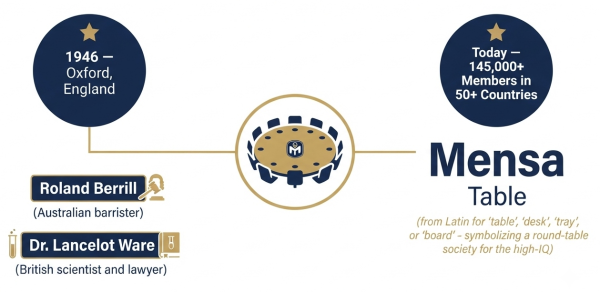
Mensa was founded in Oxford, England in 1946 by two people:
- Roland Berrill — an Australian barrister living in England who believed that a society of highly intelligent people might generate ideas to benefit humanity
- Dr. Lancelot Ware — a British scientist and lawyer who had the technical expertise to design a qualifying intelligence test
The original vision was explicitly egalitarian: intelligence regardless of social background, education, or nationality. The round-table metaphor was deliberate — no hierarchical structure within the membership, and no distinction based on which member scored highest. British Mensa remains the founding chapter, while American Mensa has grown into the largest single chapter by membership.
The Mensa IQ Requirement: 98th Percentile Across All Scales
The Mensa threshold is always the 98th percentile — the top 2% of the population on a recognized intelligence test. The specific qualifying score depends on which test was taken and which standard deviation scale it uses:
| Test | SD Scale | Qualifying Score | Percentile |
| WAIS-IV (Wechsler Adult) | SD = 15 | 130 | 98th |
| Stanford-Binet 5th Edition | SD = 15 | 130 | 98th |
| Cattell Culture Fair (B III) | SD = 24 | 148 | 98th |
| Raven's Advanced Progressive Matrices | Percentile-based | 95th percentile on RPM | ~98th on IQ scale |
Important note on the Cattell scale: The Cattell Culture Fair Test uses a standard deviation of 24 rather than 15, which is why a score of 148 on the Cattell corresponds to the same population position as a score of 130 on the WAIS or Stanford-Binet. These are not higher IQ numbers — they are the same 98th percentile position expressed on a different scale. Confusing Cattell scores with WAIS scores is a common error in celebrity IQ comparisons online. For more on IQ scale differences, see the IQ Scale Explained guide.
Two Ways to Qualify for Mensa
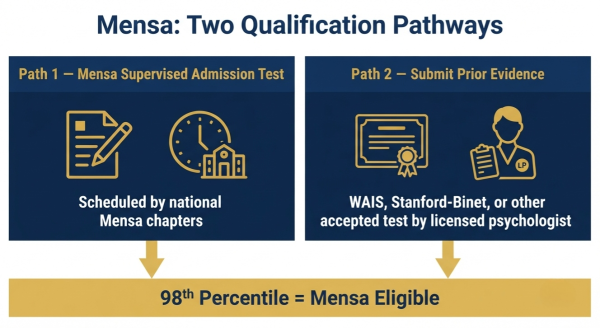
Path 1: Take Mensa's Supervised Admission Test
National Mensa chapters administer their own supervised admission tests in person. American Mensa, for example, uses the Mensa Admission Test — a proctored, multi-component assessment that includes pattern recognition, spatial reasoning, and abstract reasoning components. This test is not the same as the WAIS or Stanford-Binet and is specifically designed for Mensa admissions purposes. Sessions are scheduled through national chapter websites.
Path 2: Submit Evidence of a Prior Qualifying Test
If you have previously taken an accepted standardized test and achieved a qualifying score — administered by a licensed psychologist, educational institution, or other accredited professional — you can submit that evidence for Mensa admission. Accepted tests include the WAIS, Stanford-Binet, and other recognized assessments administered under supervised conditions.
What is not accepted: Online IQ tests, including self-administered free tests, are not accepted as qualifying evidence for Mensa membership. The Mensa website offers a "Mensa Workout" practice assessment — this is explicitly not an official qualifying test and is designed for practice purposes only. For context on how to take an IQ assessment that measures the right abilities, see the International Standard IQ Test and the High Range IQ Test.
Mensa's Global Presence
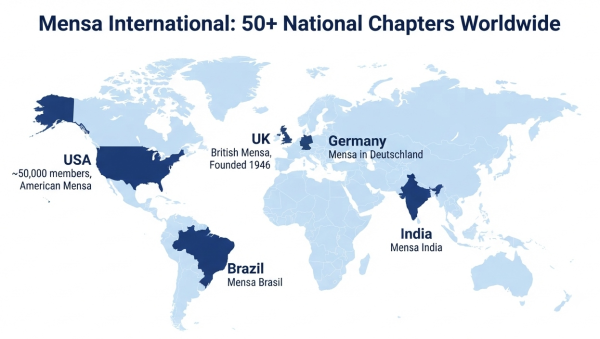
Mensa International operates through more than 50 national chapters worldwide, with approximately 145,000–150,000 members in total. The largest chapters include:
- American Mensa: ~50,000 members — the largest single national chapter
- British Mensa: The founding chapter, established in Oxford in 1946
- Mensa in Deutschland (Germany): One of the most active European chapters
- Mensa India: A rapidly growing chapter with strong youth engagement
- Mensa Brasil: One of the most prominent chapters in Latin America
Regardless of which national chapter you join, Mensa membership is internationally recognized — you can attend events and connect with members across other chapters. For more on joining Mensa online specifically, see how to join Mensa online.
What Membership Offers
Mensa membership provides access to:
- Special Interest Groups (SIGs): Member-run groups covering AI, philosophy, chess, creative writing, science, languages, board games, and hundreds of other topics
- Events and conventions: Including the annual American Mensa Mind Games, regional gatherings, intellectual symposiums, and local meetups
- Publications: National and international Mensa journals, newsletters, and member forums
- Online communities: Forums, discussion groups, and member directories for connecting globally
- Youth programs: Several national chapters run gifted youth programs. See IQ Test for Kids and supporting gifted children after an IQ test
Membership fees vary by national chapter — American Mensa, for example, is approximately $79 per year for adults as of this writing, with reduced rates for students and seniors. The value depends significantly on how actively you engage with events and groups.
Mensa vs. Other High-IQ Societies
Mensa is the most widely known high-IQ society but not the only one. For comparison:
| Society | Threshold | Percentile | SD-15 equivalent |
| Mensa International | Top 2% | 98th | ~IQ 130 |
| Intertel | Top 1% | 99th | ~IQ 135–137 |
| Triple Nine Society | Top 0.1% | 99.9th | ~IQ 146 |
| Mega Society | Top 0.0001% | 99.9999th | ~IQ 176 |
See the full Top 5 High IQ Societies guide for complete details on each organization's requirements and purpose.
Frequently Asked Questions
What IQ do you need to join Mensa?
Mensa requires a score at or above the 98th percentile on a recognized standardized intelligence test. On tests using SD=15 (WAIS, Stanford-Binet), this is approximately IQ 130. On the Cattell Culture Fair Test (SD=24), the equivalent qualifying score is approximately 148 — same population position, different scale. All qualifying scores represent the 98th percentile, not a higher intelligence level.
When was Mensa founded?
Mensa was founded in 1946 in Oxford, England by Roland Berrill (Australian barrister) and Dr. Lancelot Ware (British scientist and lawyer). The name means "table" in Latin, symbolizing a round-table society of intellectual equals.
How many members does Mensa have?
Approximately 145,000–150,000 members across more than 50 national chapters worldwide. American Mensa is the largest single chapter with approximately 50,000 members.
Can I qualify for Mensa with an online IQ test?
No. Mensa does not accept self-administered online IQ tests as qualifying evidence. Tests must be supervised — either Mensa's own in-person Admission Test or a standardized test administered by a licensed psychologist or educational institution. The "Mensa Workout" on Mensa's website is explicitly not an official qualifying test.
How does Mensa compare to other high-IQ societies?
Mensa is the most accessible and largest, requiring the 98th percentile (IQ ~130 on SD-15 tests). Intertel requires the 99th percentile, the Triple Nine Society the 99.9th, and the Mega Society the 99.9999th. See the full High IQ Societies guide for comprehensive comparison.

Comments
Share Your Thoughts