IQ 129 is a score that generates a very specific question: am I almost gifted, or already there? The answer requires understanding exactly where 129 sits in the classification system — and why the 1-point distance from IQ 130 matters administratively but not cognitively. This guide gives you the precise statistics, the correct WAIS-IV classification, the Mensa question answered honestly, and a clear picture of career and cognitive implications. For full IQ range context, see the IQ Scores guide.
IQ 129: The Exact Statistics
On the standard bell curve (mean = 100, SD = 15), a score of 129 sits 1.93 standard deviations above the population mean, placing it at the 97th percentile. You score higher than approximately 97% of the general population. Roughly 1 in 37 people score at this level or above.
| IQ Score | Percentile | SD Above Mean | Rarity |
| 120 | 91st | +1.33 | 1 in 11 |
| 125 | 95th | +1.67 | 1 in 20 |
| 129 | 97th | +1.93 | ~1 in 37 |
| 130 | 98th | +2.0 | 1 in 50 |
| 135 | 99th | +2.33 | 1 in 100 |
On the WAIS-IV, IQ 129 is classified as Superior — the band covering 120–129. It is the highest possible score within the Superior classification. IQ 130 marks the beginning of the Very Superior / Gifted range. This makes IQ 129 a boundary position with a specific significance: the top of one classification, 1 point from the next. To understand the full framework, read The IQ Scale Explained.
The Mensa Question: Honest Answer
Mensa International requires a score at or above the 98th percentile, corresponding to approximately IQ 130 on SD-15 tests. IQ 129 at the 97th percentile falls 1 point and 1 percentile position short of the Mensa cutoff. It does not qualify.
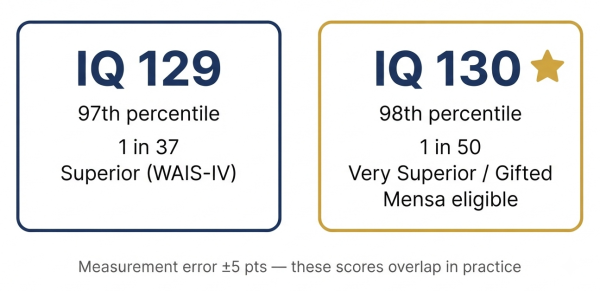
However, there is a nuance worth understanding: all IQ tests carry a standard error of measurement of approximately ±5 points. An observed score of 129 means the true score likely falls somewhere between 124 and 134. A score in the Mensa-qualifying range is statistically plausible — which is why retesting is the appropriate response if Mensa membership is a genuine goal. For context on the societies and their thresholds, read the What Is Mensa guide and the High IQ Societies overview.
The 1-point difference between IQ 129 and IQ 130 has significant administrative consequences — for Mensa eligibility and WAIS-IV classification — but no meaningful cognitive significance. Both scores reflect the same level of exceptional intellectual ability in practice.
Is IQ 129 "Almost Genius"?
The direct answer: the framing itself needs revisiting. "Genius" is not a formal psychometric classification in modern psychology — the term was used historically for IQ 140+ but has since been retired as a scientific label. IQ 130 is the threshold for the Gifted / Very Superior classification, not "genius." IQ 129 is the top of the Superior range — an exceptional score that is 1 point from a formal classification boundary but cognitively indistinguishable from 130.
What both IQ 129 and IQ 130 share is the same practical cognitive profile: scores in the top 2–3% of the population, access to virtually any academic or professional track, and the cognitive foundation for highly demanding work. The number matters for administrative purposes — the classification cutoff is where it is — but it does not define your cognitive ceiling.
Cognitive Profile at IQ 129

1. Advanced Abstract and Pattern Reasoning
People at IQ 129 identify structural relationships in data, arguments, and systems that are not immediately visible to most others. They can hold and manipulate complex mental models, evaluate multiple solution paths simultaneously, and recognize when a problem is being framed incorrectly. This is the cognitive basis of strong performance in mathematics, research, strategic planning, and systems design. For how this is measured, see Verbal and Nonverbal Tests of Intelligence.
2. High Working Memory
Working memory — holding and manipulating multiple pieces of information simultaneously — is consistently strong at this cognitive level. This enables effective multi-step planning, following complex reasoning chains, and tracking several variables under cognitive load. See the IQ and Memory guide for the research behind this connection.
3. Rapid Concept Acquisition
New domains, frameworks, and skill sets are absorbed quickly and deeply — not just the content but the underlying architecture. This enables faster competence in new areas and effective transfer of insight across disciplines. The ability to grasp structural principles after minimal exposure is one of the most practically valuable cognitive traits at this level.
4. Verbal Precision and Analytical Communication
Command of language at IQ 129 tends toward sophistication: structured argumentation, nuanced vocabulary, and the ability to translate complex ideas into clear explanation for different audiences. This directly supports performance in law, writing, leadership, research communication, and any role where analytical depth must be externalized clearly. Explore the Linguistic Intelligence guide for more.
5. Creative Synthesis and Divergent Thinking
The Superior range is associated with strong divergent thinking — approaching problems from unconventional angles, connecting insights across traditionally separate domains, and generating solutions that reframe the question rather than just answering it. This supports innovation in science, technology, design, and creative fields where standard approaches are insufficient.
What Research Shows About IQ 129 Outcomes
Research on average IQ by profession is a useful reference point for understanding what IQ 129 means practically. Studies place most demanding professional fields in the following ranges:
- Physician mean: approximately 120–125 — see average IQ of doctors
- Lawyer mean: approximately 115–122 — see average IQ of lawyers
- Engineer mean: approximately 115–120 — see average IQ of engineers
IQ 129 exceeds the average cognitive baseline for all of these careers, meaning cognitive ability is not the limiting factor. The differentiators at this level — as with IQ 126 and IQ 132 — are domain expertise, conscientiousness, communication skill, and sustained effort. See the full data in average IQ by profession and IQ and income research.
Best Career Paths for IQ 129
At IQ 129, the question is not "what can I access?" but "what will challenge and sustain me over time?" The Superior range provides broad access — the key is matching cognitive style to the right domain.
Research and Science
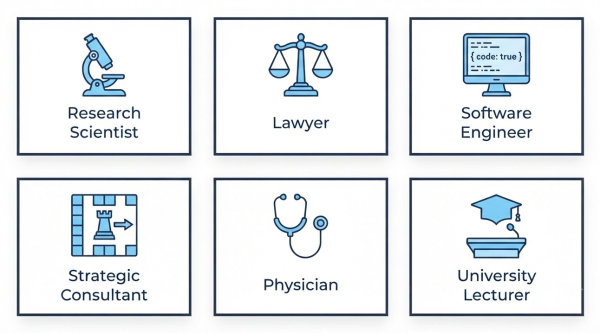
- Research Scientist: Abstract modeling, hypothesis testing, long-form intellectual focus.
- Data Scientist / ML Engineer: Pattern recognition, quantitative reasoning, systems design. See IQ for software engineers.
- Academic Researcher / University Lecturer: Intellectual autonomy, knowledge creation, long-form mastery.
Law and Strategy
- Lawyer / Policy Analyst: Multi-layered argumentation, verbal precision, strategic judgment.
- Management Consultant / Strategist: Cross-domain synthesis, diagnostic reasoning, high-stakes decisions.
- Quantitative Analyst: Mathematical modeling, probabilistic reasoning.
Medicine and Human Services
- Physician / Specialist: Complex diagnostic reasoning, continuous learning, technical depth.
- Clinical Psychologist: Theoretical depth, behavioral complexity, human system analysis.
Creative and Entrepreneurial
- Product Designer / Architect: Merging analytical and creative thinking in human-centered systems.
- Entrepreneur (complex domains): Pattern-based opportunity identification, systems innovation.
For more on matching score level to career access, see jobs for IQ 125, jobs for IQ 130–140 for comparison just above this range, and what jobs require high IQ.
The Broader Picture: IQ 129 Is Not a Ceiling
IQ scores carry a measurement error of ±5 points. An observed 129 means the true score likely ranges from approximately 124 to 134 — which includes scores below the Superior range and scores well into Very Superior. This range matters: it contextualizes the 1-point gap from IQ 130 as a measurement artifact as much as a cognitive fact.
Beyond measurement, research on neuroplasticity confirms that cognitive performance continues to respond to environmental demands throughout adulthood. The Flynn Effect demonstrates that measured IQ across populations responds significantly to environmental changes. Read whether IQ can be improved for what the evidence actually supports.
Understanding your full cognitive and personality profile gives a more complete picture than any single number. Consider taking the EQ Test, reading IQ vs EQ, and exploring MBTI or DISC for the full picture.
Frequently Asked Questions
What percentile is IQ 129?
IQ 129 corresponds to the 97th percentile — meaning you score higher than approximately 97% of the general population. It sits 1.93 standard deviations above the mean. Roughly 1 in 37 people score at this level or above.
Is IQ 129 considered genius?
"Genius" is not a formal psychometric classification in modern psychology. IQ 129 is classified as Superior on the WAIS-IV — the highest score in that band. The formal Gifted / Very Superior classification begins at IQ 130. Neither 129 nor 130 is "genius" by any current scientific standard. Both reflect exceptional cognitive ability in the top 2–3% of the population.
Does IQ 129 qualify for Mensa?
No — Mensa requires the 98th percentile, corresponding to approximately IQ 130 on SD-15 tests. IQ 129 falls 1 point and 1 percentile position short. However, given the ±5 point measurement error, a true score in the Mensa-qualifying range is plausible. Retesting on an approved Mensa test is the appropriate next step if membership is a goal. See how to join Mensa online.
How does IQ 129 compare to IQ 125 and IQ 132?
IQ 125 sits at the 95th percentile (1 in 20) and IQ 132 at the 98th (1 in 50, just above Mensa). IQ 129 at the 97th percentile (1 in 37) falls between them — top of the Superior range, below the formal Gifted threshold. In practical cognitive terms, the differences between these three scores are modest. See IQ 125 and IQ 132 for detailed comparisons.
What famous people have an IQ around 129?
Estimated celebrity IQ scores are rarely verified and widely debated. IQ 129 is within the range commonly cited for many successful politicians, executives, and academics. Explore the Celebrity IQ Database for detailed breakdowns and the important caveats about how these estimates are derived.

Comments
Share Your Thoughts