High IQ societies are organizations that restrict membership to individuals who demonstrate exceptional cognitive ability on recognized standardized tests. They vary enormously in size, selectivity, and what membership offers — from Mensa's 145,000+ members and global local chapters to ultra-select groups with membership in the dozens. This guide covers the five most widely recognized societies, their thresholds and histories, and which might suit different goals. For the IQ framework underlying all these thresholds, see the IQ Scale Explained guide.
Overview: How High IQ Society Thresholds Compare
| Society | Founded | Threshold | ~SD-15 Equivalent | Approx. Rarity |
| Mensa International | 1946 | 98th percentile | IQ ~130 | 1 in 50 |
| Intertel | 1966 | 99th percentile | IQ ~135–137 | 1 in 100 |
| Triple Nine Society | 1978 | 99.9th percentile | IQ ~146 | 1 in 1,000 |
| Prometheus Society | 1982 | ~99.997th percentile | IQ ~160 est. | ~1 in 30,000 |
| Mega Society | 1982 | 99.9999th percentile | IQ ~176 est. | ~1 in 1,000,000 |
Note: SD-15 equivalents for Prometheus and Mega Society are estimates. At these extreme levels, test measurement is difficult — most standard IQ tests have ceiling effects well below these ranges, and qualifying typically requires specialized high-ceiling assessments. See the High Range IQ Test guide for context on assessments designed for the upper end of the distribution.
1. Mensa International — The Most Recognized and Accessible
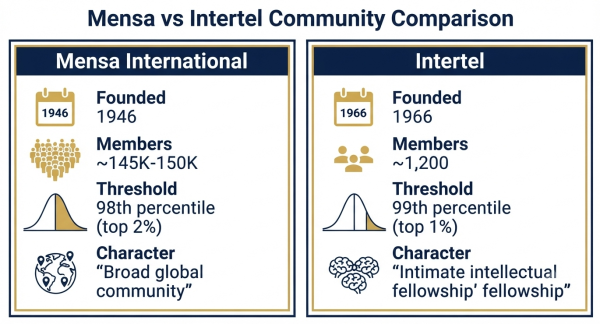
Founded: 1946, Oxford, England
Threshold: 98th percentile (IQ ~130 on SD-15 tests, top 2%)
Membership: ~145,000–150,000 across 50+ national chapters
Mensa is the oldest, largest, and most globally distributed high IQ society. Founded in 1946 by Roland Berrill and Dr. Lancelot Ware, it requires performance at the 98th percentile on a recognized standardized test. The name means "table" in Latin — representing a round table of intellectual equals regardless of background. Mensa offers the broadest range of activities: local chapter meetups, Special Interest Groups (SIGs) spanning hundreds of topics, annual conventions, intellectual games events, publications, and youth programs. For complete qualification details and the two admission pathways, see the What Is Mensa guide. For the online test question, see Can You Join Mensa with an Online IQ Test?
IQ scores near the Mensa threshold: IQ 129 (1 point below), IQ 131, IQ 132.
2. Intertel — The 99th Percentile Fellowship
Founded: 1966
Threshold: 99th percentile (IQ ~135–137 on SD-15 tests, top 1%)
Membership: Approximately 1,000–1,500 members
Intertel was founded one step above Mensa in selectivity — the 99th percentile rather than the 98th. The society is considerably smaller and more intimate than Mensa, emphasizing quality of intellectual exchange over size. Intertel produces member journals with substantive essays and intellectual contributions, and hosts annual gatherings. The community character tends toward thoughtful, longer-form intellectual discourse rather than the broader social mix of Mensa. For IQ context at this range: IQ 135 and IQ 136.
3. Triple Nine Society — Top 0.1%
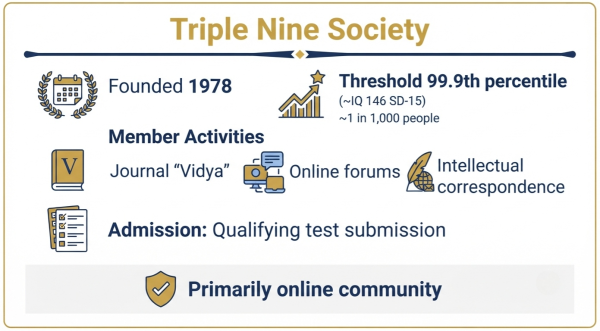
Founded: 1978
Threshold: 99.9th percentile (IQ ~146 on SD-15 tests, top 0.1% — approximately 1 in 1,000)
Membership: Several hundred to approximately 1,500 members
The Triple Nine Society (TNS) is one of the more established of the high-selectivity societies, having operated for over four decades. TNS members tend to be drawn to abstract intellectual topics — philosophy, mathematics, science, and speculative ideas — and the society operates primarily through its publication Vidya and online correspondence. Admission requires submission of scores from tests that specifically appear on TNS's accepted assessments list. Standard IQ tests like the WAIS max out well below TNS's threshold, so qualifying typically requires specialized assessments designed to measure at the extreme upper end of the distribution. For IQ context near this threshold: IQ 145 and IQ 143.
4. Prometheus Society — Ultra-High Selectivity
Founded: 1982
Threshold: ~99.997th percentile (IQ ~160 estimated on SD-15 — approximately 1 in 30,000)
Membership: Very small — active membership typically in the dozens
The Prometheus Society was founded in 1982 and accepts individuals at approximately the 99.997th percentile. At this level, qualifying requires extremely high-ceiling IQ tests — standard clinical assessments have ceiling effects that make measurement unreliable at this range. Prometheus is primarily an intellectual correspondence society with minimal formal structure. Its small size means it operates mainly through member interaction rather than formal events. For IQ context at this range: IQ 160.
5. Mega Society — The Most Exclusive Published Threshold
Founded: 1982
Threshold: 99.9999th percentile (IQ ~176 estimated on SD-15 — approximately 1 in 1,000,000)
Membership: Fewer than 30 verified members globally
The Mega Society publishes the most extreme selectivity threshold of any established high IQ society — the 99.9999th percentile, corresponding to roughly 1 person in 1 million. With fewer than 30 members globally, it operates entirely through correspondence and online communication. At this level, the psychometric challenges are substantial — no standardly normed test reliably measures at this range, and qualifying scores are typically from purpose-designed ultra-high-ceiling assessments whose norming is itself contested. The Mega Society operates a journal (Noesis) and accepts applications with supporting test documentation.
Which Society Should You Consider?
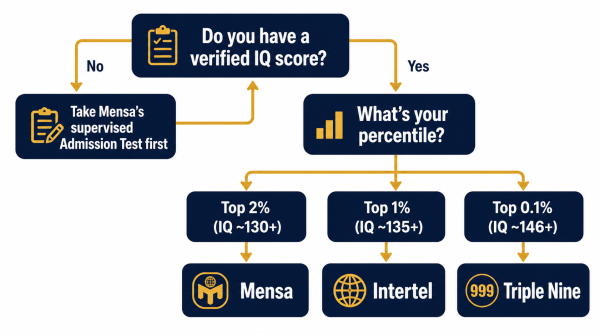
For most people interested in high IQ societies, the practical path is:
- Start with Mensa: It has the most transparent admission process, the most accessible threshold, and the widest range of activities. Take their supervised Admission Test to get a verified performance baseline.
- If your verified score is above 135–137 (IQ SD-15 equivalent): Intertel offers a more intimate intellectual community worth exploring alongside or instead of Mensa.
- If you have a verified score at or above the 99.9th percentile: The Triple Nine Society is the most established society at this level with a documented track record and clear admission process.
- Prometheus and Mega Society: These are for individuals with documented performance on specialized high-ceiling assessments. The psychometric challenges at these levels mean that qualifying scores are rare and the admission processes require documentation that most standard testing cannot provide.
For the IQ test itself, see the International Standard IQ Test and High Range IQ Test for context on what different assessment levels involve.
Frequently Asked Questions
What is the most accessible high IQ society?
Mensa International — requiring the 98th percentile (IQ ~130 on SD-15 tests, top 2%). With ~145,000–150,000 members and 50+ national chapters, it offers the broadest activities and the most widely available supervised admission testing. See the full What Is Mensa guide.
How do the IQ thresholds of high IQ societies compare?
Mensa (98th percentile, IQ ~130), Intertel (99th, IQ ~135–137), Triple Nine Society (99.9th, IQ ~146), Prometheus (~99.997th, IQ ~160 estimated), Mega Society (99.9999th, IQ ~176 estimated). All SD-15 equivalents for Prometheus and Mega are estimates — qualifying at these levels typically requires specialized high-ceiling assessments not standard clinical tests.
Which society requires the highest IQ?
The Mega Society publishes the highest threshold at the 99.9999th percentile (IQ ~176 SD-15 estimated, approximately 1 in 1 million). With fewer than 30 verified members globally, it operates entirely through correspondence. At these extreme levels, psychometric measurement is challenging and qualifying scores come from purpose-designed ultra-high-ceiling assessments.
What does Triple Nine Society membership involve?
Triple Nine Society (founded 1978) requires the 99.9th percentile (~IQ 146 SD-15, top 0.1%). Members participate primarily through the journal Vidya and online forums. Admission requires qualifying scores from accepted assessments — standard clinical tests like the WAIS typically cannot measure reliably at this threshold due to ceiling effects.
Which high IQ society should I join?
Start with Mensa — it has the clearest admission process and broadest activities. If your verified score places you at the 99th percentile or above, Intertel is worth considering alongside Mensa. For those with scores at the 99.9th percentile or above, the Triple Nine Society is the most established option at that level. See the guide on how Mensa admission works.

Comments
Share Your Thoughts