Your child has scored in the gifted range on an IQ test. Before scheduling enrichment programs or telling family members, the most valuable thing a parent can do is understand what this score actually means — and what it doesn't. A score of 130+ identifies a child in the top 2% of their age group for the cognitive abilities measured by that test. It opens specific questions about educational environment and support needs. It doesn't guarantee academic success, explain emotional behaviour, or define your child's identity. For context on what IQ scores mean at this level, see good IQ scores for kids by age.
Step 1: Read the Full Report, Not Just the Score
A comprehensive IQ test produces subscores across multiple cognitive domains — not just a single composite number. These subscores matter more than the total:
- Verbal Comprehension: Language-based reasoning, vocabulary, verbal concept formation
- Visual Spatial: Spatial reasoning, pattern recognition, visual problem-solving
- Fluid Reasoning: Abstract and inductive reasoning — the most "culture fair" subtest cluster
- Working Memory: Holding and manipulating information in the mind
- Processing Speed: Speed and accuracy of simple cognitive tasks
A child might score 145 in Fluid Reasoning and 108 in Processing Speed — both would average to a composite that obscures the remarkable abstract reasoning. Conversely, a significant gap between subscores can indicate twice-exceptionality (more on this below) and is clinically meaningful. Always ask the psychologist to explain what the subscore pattern means for your child specifically.
Step 2: Understand Asynchronous Development
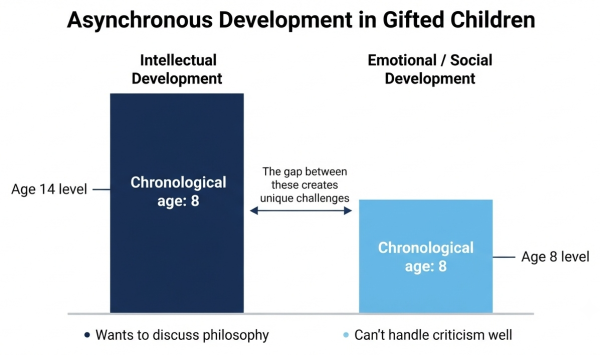
Asynchronous development is the most important concept for parents of gifted children to understand — and the one most commonly overlooked. It means that a gifted child's intellectual development does not advance at the same rate as their emotional, social, or physical development.
A child may have the abstract reasoning abilities of a 14-year-old, the knowledge interests of a 16-year-old, and the emotional regulation of a typical 8-year-old — because they are 8 years old. This produces real challenges:
- Extreme frustration when peers aren't interested in their intellectual passions
- Intense emotional reactions that seem disproportionate to their verbal sophistication
- Difficulty handling failure, mistakes, or criticism despite high cognitive ability
- Social isolation when age peers and intellectual peers are different people
- Perfectionism driven by awareness of high standards they cannot yet emotionally tolerate not meeting
Recognizing asynchrony prevents the common mistake of assuming a cognitively advanced child should handle everything with equal maturity. They need intellectual challenge appropriate to their cognitive age and emotional support appropriate to their chronological age. See IQ vs EQ in childhood for the research on how these develop differently.
Step 3: Know About Gifted Underachievement
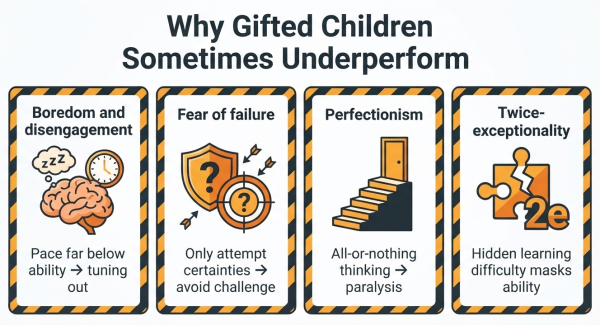
Gifted underachievement — when a child's school performance is substantially below their measured cognitive potential — is surprisingly common, and parents are often caught off guard when their "gifted" child receives mediocre grades or resists schoolwork. The causes are distinct from simple laziness:
- Chronic boredom and disengagement: When classroom pace is far below cognitive ability for years, gifted children can develop habits of minimal effort, learn that schoolwork requires no challenge, and disengage. By the time difficulty arrives (often in secondary school), they have no coping mechanisms for challenge
- Perfectionism and fear of failure: Some gifted children collapse their identity into "being smart." When that identity feels threatened by a hard problem they can't immediately solve, avoidance — not attempting the challenge — protects the identity. They only attempt things they're certain to succeed at
- Asynchronous executive function: High fluid reasoning doesn't predict organization, task initiation, time management, or sustained attention — all executive functions that school performance requires. A gifted child can reason at a very high level and still struggle to organize their homework or start a long assignment
- Social masking: Some gifted children, particularly girls, deliberately underperform to fit in with peers. Appearing too smart or different can create social costs that feel more immediate than academic ones
Addressing underachievement requires identifying which cause applies to your child, not applying generic motivation strategies. See gifted vs high achiever for useful distinctions.
Step 4: Screen for Twice-Exceptionality (2e)
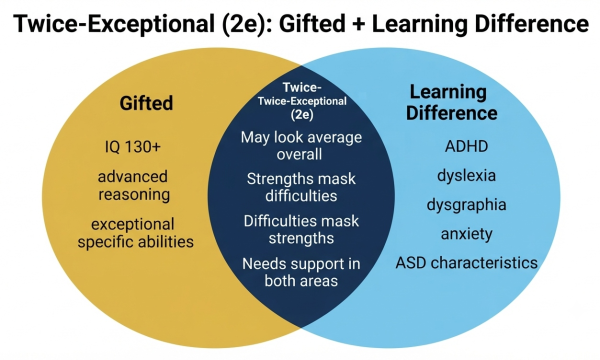
Twice-exceptional (2e) children are gifted and have a co-occurring learning difference or neurodevelopmental condition — ADHD, dyslexia, dysgraphia, anxiety, autism spectrum characteristics, or auditory/visual processing disorders. This combination creates a complex profile:
- Giftedness masks the learning difference: Very high reasoning ability compensates for the difficulty, producing average overall performance. The gifted level is invisible; the difficulty is invisible; only "average" shows up
- The learning difference masks the giftedness: Written output difficulties, attention issues, or processing differences suppress visible performance, obscuring the exceptional cognitive strengths
Signs a child may be 2e: exceptional verbal reasoning but far below average written output; advanced abstract thinking but significant difficulties with sustained attention; outstanding content knowledge but significant reading decoding difficulties; very high subscore ranges in a psychoeducational evaluation (e.g., Fluid Reasoning at 99th percentile, Processing Speed at 25th percentile). A comprehensive neuropsychological evaluation — specifically analyzing subscore patterns, not just the composite — is needed to identify 2e. Knowing a child is 2e changes the support strategy entirely: they need challenge in their areas of strength and specific accommodations for their areas of difficulty, simultaneously.
Step 5: How to Talk to Your Child About the Score
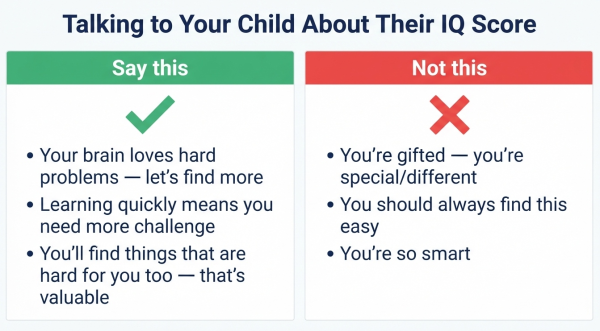
What you say and how you frame the score significantly affects how a child relates to learning over the long term. The research on growth mindset (Carol Dweck's work) and gifted children's psychology consistently shows that collapsing a child's identity into "being smart" creates fragility — avoiding challenge to protect the label. More effective framing:
- Focus on what the score means practically: "The test showed your brain is really good at solving certain kinds of problems quickly — that means you need harder challenges to stay interested"
- Normalize future difficulty: "You'll find things that are genuinely hard for you — that's valuable and important, because hard things teach you how to persist"
- Praise effort and process, not fixed traits: "I love how you kept trying when that was tricky" rather than "You're so smart"
- Avoid making it a social distinction: Don't frame giftedness as being better than peers — frame it as learning differently
Step 6: Educational Options to Explore
Once you understand your child's full profile, there are practical educational decisions to consider:
- Gifted programs: Many districts offer pullout enrichment or full-time gifted programs — these provide intellectual peers and appropriately challenging material
- Subject acceleration: Moving ahead in specific subjects (most commonly mathematics) where ability is strongest — without full grade skip
- Grade acceleration: For profoundly gifted children (IQ 145+), a full grade skip is often beneficial — research supports this for well-selected candidates
- Enrichment outside school: University Saturday programs, specialized summer camps (Johns Hopkins CTY, Davidson Academy for highly gifted), online courses, mentorship
- Advocacy at school level: Request a meeting to discuss an enrichment plan, differentiated instruction, or compacting (completing standard curriculum faster to allow deeper exploration)
For signs of giftedness that may have preceded the test, see early signs of a high IQ child. For more resources on what to do next, see the full Parents and Kids guide collection.
Frequently Asked Questions
My child scored 130+ — what should I do first?
Read the full psychologist's report and understand the subscore pattern, not just the composite. Schedule a meeting with your child's school to discuss educational options. Learn about asynchronous development to understand what your child may be experiencing emotionally. And think carefully about how to talk to your child about the score in a way that builds curiosity and growth mindset rather than a fragile "genius" identity.
What is asynchronous development in gifted children?
Asynchronous development means a gifted child's intellectual, emotional, and social development advance at different rates. A cognitively advanced child may have the reasoning interests of a 14-year-old and the emotional regulation of a typical 8-year-old — because they are 8. This creates specific challenges: frustration with peers, intense emotional reactions, perfectionism, and social isolation. They need intellectual challenge appropriate to their cognitive level and emotional support appropriate to their chronological age simultaneously. See IQ vs EQ in childhood.
Why do some gifted children underperform at school?
Gifted underachievement has specific causes: chronic boredom producing disengagement and minimal-effort habits; perfectionism causing avoidance of anything that might not be immediately mastered; asynchronous executive function (high reasoning with weaker organization or attention); unidentified twice-exceptionality masking difficulties; and social masking. Each requires a different response — identifying which applies to your child is the critical first step. See gifted vs high achiever.
What is twice-exceptional (2e) and could my gifted child be 2e?
2e children are gifted (IQ 130+) with a co-occurring learning difference — ADHD, dyslexia, dysgraphia, ASD characteristics, or anxiety. High cognitive ability can mask the learning difficulty, and the learning difficulty can mask the giftedness, producing an "average" overall picture that is clinically misleading. Signs include very high subscore variability in psychoeducational testing, exceptional reasoning alongside significant difficulties in specific areas. A neuropsychological evaluation analyzing subtest profiles is needed to identify 2e.
Should I tell my child they are gifted?
Yes, in age-appropriate and well-framed terms. Avoid making giftedness central to their identity or implying effortless superiority. More effective: explain they tend to learn some things quickly and need harder challenges; normalize that they will find things genuinely difficult; praise effort and process, not fixed traits. Children who understand their profile without collapsing their identity into a label handle both success and difficulty better long-term.

Comments
Share Your Thoughts