Struggling in school often leads people to question their intelligence. Grades, test scores, and comparisons with peers can make it feel as if IQ is the root cause of academic difficulty. In reality, as explained in IQ and academic performance , the relationship between IQ and school success is far more complex—and IQ is rarely the sole or even primary reason someone struggles.

What IQ Actually Measures
IQ (Intelligence Quotient) is a standardized measure of specific cognitive abilities. It is designed to assess how efficiently a person processes information under controlled conditions, particularly in tasks similar to academic testing. If you want a deeper foundation, you can explore what IQ really is and how it’s defined.
IQ tests primarily measure:
- Logical and abstract reasoning
- Pattern recognition and relationships
- Processing speed
- Spatial and numerical reasoning
These abilities are useful in structured environments where problems are clearly defined and solutions are objectively correct. This is why IQ correlates moderately with performance on exams and traditional academic tasks, a relationship examined more closely in IQ vs academic achievement.
However, IQ tests measure how you think in artificial testing conditions—not how you function in real learning environments over time. Differences between verbal and nonverbal intelligence testing can also affect how well IQ reflects actual classroom performance, especially for students whose strengths lie outside traditional formats (see verbal and nonverbal tests of intelligence).
Crucially, IQ does not measure many of the traits that strongly influence academic success, including:
- Work ethic and persistence
- Study skills and learning strategies
- Emotional intelligence and stress regulation
- Creativity and curiosity
- Interest, motivation, or engagement
This is why researchers increasingly emphasize the role of emotional intelligence (EQ) alongside cognitive ability. Traits such as self-awareness and emotional regulation—explained in emotional intelligence and self-awareness—often predict how well students cope with academic pressure.
As a result, IQ captures only a narrow slice of what it takes to succeed academically.
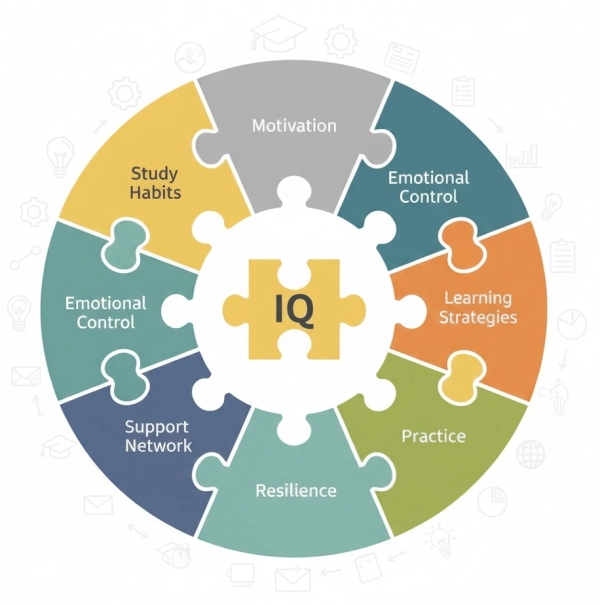
The Relationship Between IQ and Academic Performance
IQ and academic achievement are correlated, but they are far from identical. A higher IQ can make learning feel easier and faster, particularly in early education or highly theoretical subjects.
That said, academic success depends on many additional factors beyond cognitive ability. Studies comparing grades and standardized outcomes show that IQ and GPA are related but not interchangeable, as discussed in IQ vs GPA. Research consistently shows that:
- Many students with average IQs perform at high academic levels
- Some students with high IQs struggle academically or underperform
- Differences in study habits often outweigh differences in intelligence
IQ sets a range of cognitive potential, not a fixed outcome. Within that range, effort, strategy, and environment determine performance.
Common Reasons People Struggle Academically
In most cases, academic difficulties are driven by factors that have little or nothing to do with intelligence. This misconception is explored in depth in does a low IQ mean you will fail at school?.
1. Ineffective Study Methods
Many students are never taught how to study effectively. Common habits such as rereading notes, highlighting text, or passively listening to lectures feel productive but produce weak learning outcomes.
Without evidence-based strategies like active recall, spaced repetition, and practice testing, even highly intelligent students can struggle—something often mistaken for a lack of ability rather than poor technique. Related factors that distort test outcomes are explained in factors affecting IQ test results.
2. Motivation and Interest
Learning becomes significantly harder when material feels boring, irrelevant, or overwhelming. Low motivation often leads to procrastination, shallow engagement, and poor retention.
This is not a sign of low intelligence—it is a natural response to disengagement. Many students who feel “not naturally smart” are actually facing motivational barriers rather than cognitive ones (see not naturally smart).
3. Learning Style Mismatch
Traditional education systems favor verbal instruction, textbooks, and timed exams. However, many people learn more effectively through:
- Hands-on practice
- Visual demonstrations
- Discussion and explanation
- Trial-and-error learning
When teaching methods do not match how someone learns best, academic performance can suffer—even when understanding is present.
4. Time Management and Organization
Academic success requires consistent planning, prioritization, and follow-through. Poor time management can undermine performance regardless of intelligence.
Common issues include:
- Cramming instead of spaced study
- Missed deadlines
- Inconsistent routines
These problems are skill-based, not intelligence-based—and they can be improved.
5. Anxiety, Stress or Test Pressure
Emotional factors play a major role in academic performance. Test anxiety, chronic stress, and fear of failure can significantly impair:
- Memory retrieval
- Concentration
- Logical reasoning
Under stress, even well-learned material can become temporarily inaccessible. This is an emotional response—not a reflection of IQ.

When IQ Can Play a Role
IQ may influence academic performance in certain contexts, such as:
- Highly abstract or fast-paced academic environments
- Subjects that rely heavily on theoretical reasoning (e.g., advanced mathematics or physics)
- Time-pressured exams that reward speed over depth
Even in these situations, effective study strategies, repeated practice, and emotional regulation can substantially reduce the impact of cognitive differences.
Why Average-IQ Students Often Succeed
Students with average IQs frequently perform well because they develop complementary strengths that compensate for cognitive limitations.
These strengths often include:
- Strong discipline and consistency
- Effective, structured study habits
- Willingness to seek help and feedback
- Persistence through confusion or difficulty
Academic systems tend to reward reliability and sustained effort more than raw brilliance.
What to Focus on Instead of IQ
If you are struggling academically, focusing on IQ is rarely productive. Your time is better spent improving factors that are within your control:
- Learning evidence-based study techniques
- Creating consistent study routines
- Breaking material into manageable pieces
- Practicing under realistic exam conditions
- Actively addressing anxiety and stress
These areas are more actionable—and more impactful—than worrying about where you fall on the IQ scale (see the IQ scale explained).
Should You Take an IQ Test?
An IQ test can offer insight into how you process information, but it should never be treated as a verdict on your academic future. Without context, scores are easily misinterpreted.
If you do choose to test, understanding how often you should take an IQ test and how to interpret results is essential to avoid false conclusions (see how often should you take an IQ test).
Final Perspective
For most people, IQ is not the main reason they struggle academically. Learning strategies, emotional factors, motivation, and environment play a far greater role.
Academic success is not about being the smartest person in the room—it is about learning how to learn, staying consistent, and adjusting when something doesn’t work.
And those skills can be developed.

Comments
Share Your Thoughts