Vietnam presents one of the most fascinating — and most instructive — cases in the global study of national cognitive performance. On the one hand, early IQ data from rural Vietnamese populations produced estimates as low as IQ 78, among the lowest figures in the Lynn and Becker dataset. On the other hand, Vietnam's 2022 PISA score of 468 places it above many wealthy OECD nations — including countries with GDP per capita many times greater than Vietnam's roughly $4,300 at the time.
This 20-point discrepancy is not an error. It is a window into something genuinely important about what cognitive assessments measure and what drives population-level cognitive performance. Research published in 2025 in Open Psych concluded that Becker's rural Vietnamese estimate of IQ 78 is inconsistent with Vietnam's PISA data, and that "the true national IQ is somewhere between 95 and 100." Separately, Vietnam has been identified as one of the countries with the largest discrepancies between different IQ estimates in the entire dataset — over 20 points between the highest and lowest figures.
This guide covers Vietnam's IQ data honestly: the sources of the discrepancy, why Vietnam's PISA performance is so remarkably high given its income level, what drives this educational outperformance, and what Vietnam's case tells us about the relationship between poverty, education, and cognitive assessment scores.
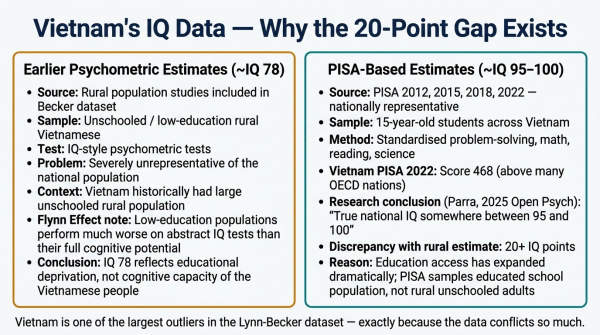
Vietnam's IQ Data: What the Sources Show — and Why They Conflict
| Source | Vietnam Estimate | Notes |
| Becker dataset (rural estimate) | ~IQ 78 | Based on unschooled/low-education rural samples — highly unrepresentative |
| Parra (2025, Open Psych) | IQ 95–100 | PISA-based national estimate; more representative |
| World Population Review (2026) | ~IQ 94–96 | Aggregated estimates |
| PISA 2022 (math score) | 468 | Above many OECD nations; above USA (465) |
| Warne (2022) review | 20+ point discrepancy | Vietnam among largest outliers in entire dataset |
Vietnam is explicitly identified in the academic literature as one of the two countries (along with Egypt) with the largest discrepancies in IQ estimates across different data sources — over 20 IQ points between the highest and lowest figures. This unusual range has a specific explanation: Becker's dataset included early psychometric studies of rural Vietnamese populations who had minimal formal education, producing the IQ 78 figure. This estimate is not wrong as a description of those specific samples — it accurately reflects how those populations performed on those tests at that time. What it is not is a good estimate of Vietnam's national cognitive ability.
The Flynn Effect demonstrates precisely why: populations with minimal formal education perform dramatically worse on abstract cognitive tests than populations with full educational attainment — not because of different underlying cognitive potential, but because the specific skills that IQ tests measure (abstract reasoning, pattern recognition, verbal analysis) are substantially developed through formal schooling. As Vietnam's school enrolment expanded dramatically following the Doi Moi reforms from 1986 onward, and as the school-attending population became the primary population sampled in PISA assessments, the measured cognitive performance picture changed dramatically.
The Vietnam PISA Paradox: Outperforming Wealthy Nations
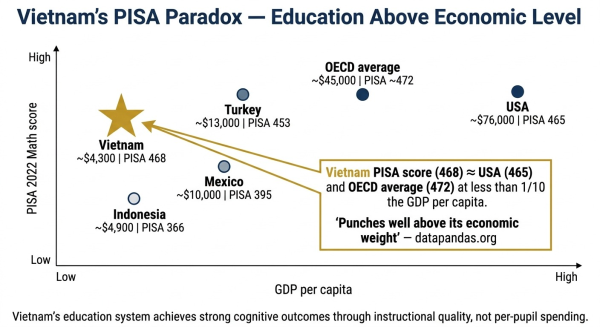
Vietnam's 2022 PISA score of 468 in mathematics is genuinely remarkable in economic context. Vietnam's GDP per capita in 2022 was approximately $4,300 — roughly comparable to Indonesia ($4,900) and substantially below Mexico ($10,000) or Turkey ($13,000). Yet Vietnam's PISA score exceeds Indonesia by approximately 100 points, Mexico by approximately 73 points, and Turkey by approximately 15 points. Vietnam's PISA score is essentially equivalent to the United States (465) and close to the OECD average (~472) — countries with GDP per capita roughly 15–17 times higher.
This phenomenon has attracted research attention precisely because it challenges a simple wealth-to-cognition model. As one comprehensive analysis noted, "Vietnam's education system punches well above its economic weight: the country scored 468 on the 2022 PISA exam, higher than many OECD nations with far larger budgets." The implication is clear: what drives cognitive assessment performance is not money per se, but how educational resources are deployed, and the cultural and institutional context that determines how seriously students engage with academic content.
Vietnam is not the only example of this pattern — Iran, despite decades of international sanctions severely limiting its economic development, also scores above its economic level on cognitive assessments, attributed to a tradition of university education and competitive academic culture. But Vietnam is the most striking example among developing nations in Southeast Asia.
What Drives Vietnam's Educational Outperformance
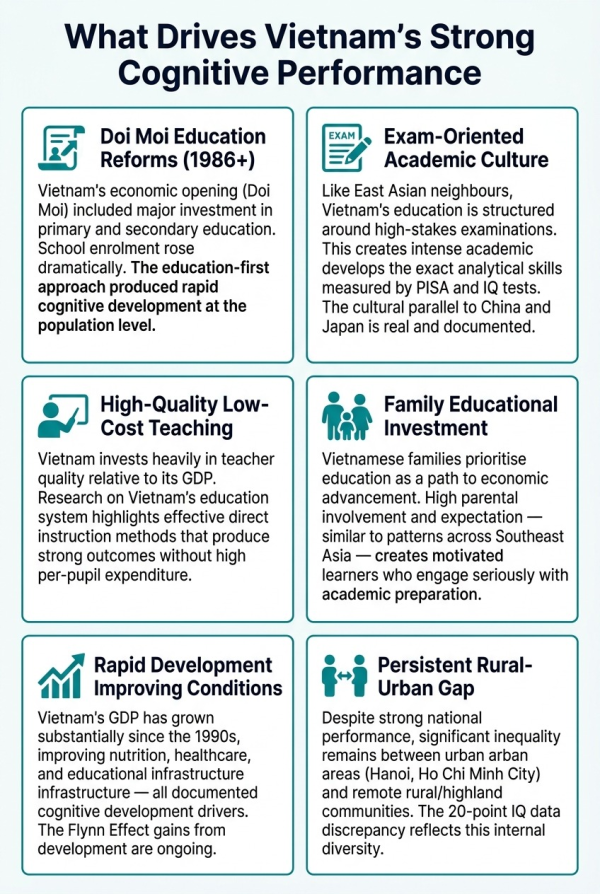
The Doi Moi reforms and educational investment. Vietnam's 1986 Doi Moi ("renovation") economic reforms opened the country to market forces and generated sustained economic growth that was channelled substantially into educational infrastructure. Primary school enrolment, which was low in many rural areas through the 1970s and early 1980s, rose to near-universal levels by the 2000s. This rapid expansion of school access created exactly the Flynn Effect dynamic that drives generational IQ gains — large portions of the population gaining formal educational experience that develops the analytical skills cognitive tests measure.
Exam-oriented academic culture. Vietnam's educational culture shares key features with its East Asian neighbours: high-stakes national examinations (Vietnam's university entrance exam is the Thi THPT Quoc Gia), strong family emphasis on academic achievement, and a curriculum focused on mathematics and analytical problem-solving. These features produce students who are well-prepared for exactly the kinds of questions that PISA assessments and IQ tests present. Research on Vietnam's education system attributes much of its success to structured direct instruction in core analytical subjects.
Teacher quality relative to income level. Research has specifically highlighted Vietnam's ability to produce strong educational outcomes through teaching quality rather than high expenditure. Vietnamese teachers, despite modest salaries by international comparison, deliver effective instruction in mathematics and science — the subjects most directly measured by PISA and most closely related to IQ test performance.
Cultural prioritisation of education. Vietnamese families across income levels invest significantly in children's education as the primary pathway to economic advancement. This cultural emphasis — shared across the country's Buddhist and Confucian heritage — creates motivated learners who engage seriously with academic preparation, contributing to the national PISA performance.
The ongoing rural-urban gap. Despite Vietnam's impressive national PISA performance, significant internal inequality remains. Urban areas — particularly Hanoi and Ho Chi Minh City — have substantially better educational infrastructure and outcomes than remote rural provinces and highland communities. The early IQ estimate of 78 from rural Vietnamese populations, while unrepresentative of the national average, was not fabricated — it reflected the genuine educational deprivation experienced by communities with limited school access. This gap is the target of ongoing Vietnamese government education investment. As covered in our guide on nutrition and IQ, improving nutritional and healthcare access in rural areas will further support cognitive development as these investments compound over generations.
What Vietnam's Case Tells Us About National IQ
Vietnam is perhaps the most instructive single case in the entire national IQ dataset for understanding what these scores actually measure and what drives them. The 20-point discrepancy between the rural psychometric estimate (IQ ~78) and the PISA-based national estimate (IQ ~95–100) is not a data error — it is an accurate reflection of the cognitive performance difference between populations with minimal formal education and populations with full secondary schooling.
This directly refutes any genetic interpretation of national IQ differences. The Vietnamese population did not change genetically between the 1970s (when rural unschooled samples produced the IQ 78 estimates) and the 2010s–2020s (when PISA-enrolled students produced the IQ 95–100 equivalent performance). What changed was educational access and quality — a purely environmental shift. The cognitive performance improvement is a direct demonstration of the Flynn Effect operating in real time: as education expanded, measured cognitive ability rose by approximately 17–22 IQ-equivalent points across a single generation.
This is consistent with what the broader research literature shows: IQ tests measure skills substantially built through formal education, and populations gaining access to quality education will show dramatic IQ gains regardless of genetic background. For more on the Flynn Effect and what it means for national IQ data, see our Japan IQ guide where Japan's similar post-WWII IQ gains are discussed.
Vietnam in Southeast Asian Context
| Country | IQ Estimate | PISA 2022 (Math) | GDP per capita (~2022) |
| Singapore | ~106 | 575 (#1) | $82,000 |
| Japan (reference) | ~106 | 536 (#3) | $34,000 |
| Vietnam | ~95–100 | 468 | $4,300 |
| Thailand | ~91 | ~393 | $7,200 |
| Indonesia | ~87 | 366 | $4,900 |
| Philippines | ~83 | 355 | $3,600 |
Vietnam stands out clearly in this regional comparison: it achieves PISA performance comparable to wealthy OECD nations while operating at a Southeast Asian developing-country income level. Its scores exceed Indonesia, Thailand, and the Philippines by substantial margins despite similar or lower GDP per capita. This regional pattern validates the finding that educational quality and cultural emphasis on academic preparation — not economic wealth — are the primary drivers of cognitive assessment performance.
Vietnam's cognitive performance story is one of the most instructive in global intelligence research. A 20-point discrepancy between rural psychometric data (~IQ 78) and PISA-based national estimates (~IQ 95–100) makes Vietnam one of the largest outliers in the entire Lynn-Becker dataset — and also one of the most revealing. The discrepancy is not a measurement error; it is a documentation of the Flynn Effect in real time, as formal education expanded across Vietnam's population following the Doi Moi reforms. Vietnam's 2022 PISA score of 468 — above many wealthy OECD nations — demonstrates that educational quality and cultural academic emphasis can produce strong cognitive assessment performance at a fraction of the income levels that other high-performing nations require. Vietnam does not punch above its weight genetically. It punches above its economic weight educationally — and that is a much more interesting and hopeful story.
For related guides, see our Japan IQ guide, our China IQ guide, and our discussion of nutrition and IQ. For context on how education builds the cognitive skills that IQ tests measure, see our average IQ by education guide. Take our free IQ test — no registration, results in under 20 minutes.
Frequently Asked Questions
What is the average IQ in Vietnam?
Vietnam's national IQ estimate is approximately 95–100 based on PISA performance, according to a 2025 Open Psych analysis. Earlier estimates as low as IQ 78 in the Lynn-Becker dataset reflect unschooled rural samples and are not representative of the full population. Vietnam has one of the largest IQ data discrepancies of any country — over 20 points — reflecting the gap between its educated urban population and historically underserved rural communities.
Why does Vietnam score so high on PISA despite being a developing country?
Vietnam's 2022 PISA score of 468 — above many wealthy OECD nations — reflects an education system that punches well above its economic weight. Key factors include exam-oriented academic culture, strong teacher quality relative to income level, post-Doi Moi educational investment, and family prioritisation of education. Vietnam achieves strong cognitive outcomes through instructional quality, not high per-pupil spending.
Why is Vietnam's IQ data so inconsistent?
Vietnam has a 20+ point discrepancy between its lowest and highest IQ estimates — one of the largest in the entire dataset. The low estimate (~78) comes from unschooled rural samples from earlier decades; the higher estimate (~95–100) comes from PISA data on school-enrolled students. This discrepancy documents the Flynn Effect in real time: expanded education access produced dramatic measured cognitive gains.
How does Vietnam compare to other Southeast Asian countries?
Vietnam's PISA 2022 score (468) substantially exceeds Indonesia (366), the Philippines (355), and Thailand (~393), despite comparable or lower GDP per capita. Only Singapore (~575) among Southeast Asian nations scores significantly higher. Vietnam's educational outperformance relative to its income level is one of the most documented patterns in regional cognitive assessment data.
Does Vietnam's PISA score mean Vietnamese people are genetically smarter?
No. Vietnam's strong PISA scores reflect educational quality and cultural academic emphasis, not genetic differences. The 20-point range in Vietnam's IQ estimates — from the same population, in different educational conditions — directly demonstrates that cognitive assessment performance is shaped by environment, not fixed genetics. This is the Flynn Effect operating visibly across a single generation.

Comments
Share Your Thoughts