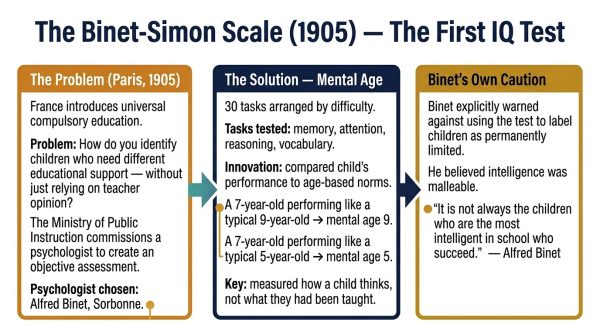
In 1905, the French government faced a practical problem. Universal compulsory education had just been introduced across France, and classrooms were filling with children who had never been formally assessed. Some were struggling not because they were poorly behaved or unmotivated, but because they genuinely needed different instruction. The Ministry of Public Instruction needed a way to identify these children — and to do it objectively, without relying solely on the impressions of individual teachers.
They commissioned Alfred Binet, a psychologist at the Sorbonne, to build the tool. Together with physician Théodore Simon, Binet published the first practical intelligence scale in 1905. It contained 30 tasks arranged by difficulty, from the simplest sensory tests to abstract reasoning problems. It introduced the concept of mental age — the idea that a child's cognitive performance could be compared to the typical performance of children of a specific age. A seven-year-old who solved problems at the level of a typical nine-year-old had a mental age of nine. A seven-year-old who solved problems at the level of a typical five-year-old had a mental age of five.
That test — the Binet-Simon Scale — became the foundation of all modern IQ testing. Revised by Lewis Terman at Stanford University in 1916, it gave rise to the Stanford-Binet Intelligence Scale, which has been in continuous use for over 100 years. The current version is the Stanford-Binet Fifth Edition (SB5), published in 2003, which measures five cognitive factors in both verbal and nonverbal domains across the full age range from 2 to 85+.
This guide covers the complete history of the Binet IQ test, how the modern Stanford-Binet works, what it measures, and how it compares to other major intelligence assessments.
Alfred Binet and the Original 1905 Scale
Alfred Binet was not the first person to attempt to measure human intelligence scientifically. Francis Galton in England had spent decades trying to correlate physical measurements — head circumference, reaction time, sensory acuity — with intellectual ability. James McKeen Cattell in the United States had developed "mental tests" based on similar principles. Both approaches had largely failed: physical measurements did not correlate with the cognitive abilities they were supposed to predict.
Binet took a different approach. Rather than measuring the physical correlates of intelligence, he tried to measure intelligence directly — by presenting cognitive tasks that required the kinds of reasoning, memory, and judgment that intelligence was presumed to involve. The tasks were deliberately heterogeneous: some tested vocabulary, some tested memory for sentences, some tested ability to identify absurdities in pictures, some tested practical reasoning. The idea was that a child with genuinely above-average intelligence would perform better than average across this diverse range of tasks, regardless of specific subject-matter knowledge.
This insight — measuring cognitive function directly through diverse reasoning tasks rather than through physical proxies — was the fundamental contribution of the Binet-Simon Scale, and it is the principle that all subsequent intelligence tests have built upon.
Binet himself was sceptical of hereditarian interpretations of his test. He explicitly believed intelligence was malleable and that his scale was a practical educational tool, not a measure of fixed biological capacity. He warned against what he called "brutal pessimism" — the assumption that low test scores indicated a permanent, immutable ceiling on a child's potential. These cautions were not always heeded by subsequent researchers who applied his scale to purposes he had not intended.
Lewis Terman and the Stanford-Binet: The IQ Formula Arrives
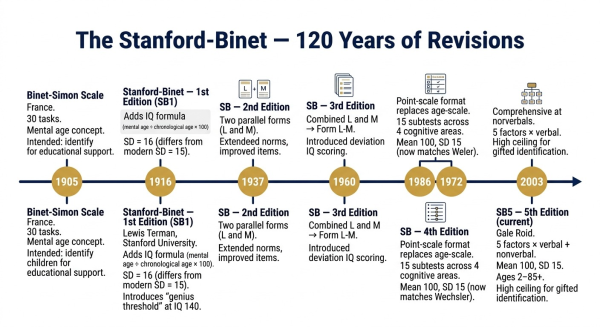
Binet's 1905 test was rapidly translated and adapted across multiple countries. In the United States, Lewis Terman — a psychologist at Stanford University — produced the most influential American adaptation in 1916. The Stanford-Binet Intelligence Scale, as Terman's version was called, made several important changes to Binet's original:
The IQ formula. The concept of the intelligence quotient — IQ — was not Binet's. It was introduced by German psychologist Wilhelm Stern in 1912. Terman adopted it for the Stanford-Binet: IQ = (mental age ÷ chronological age) × 100. A child with a mental age of 10 and a chronological age of 10 would have an IQ of exactly 100. A child with a mental age of 12 and a chronological age of 10 would have an IQ of 120. This ratio formula — now called the "ratio IQ" — was used by the Stanford-Binet for decades. It was eventually replaced by "deviation IQ" scoring in later editions.
Expanded norms. Terman substantially extended Binet's item bank and normed the test on American children, producing a more comprehensive and reliable instrument for the US population.
The genius threshold. Terman's 1916 classification introduced the label "genius or near genius" for IQ 140 and above — the origin of the "genius threshold" concept explored in our IQ 140 guide.
The Genetic Studies of Genius. Terman used his IQ 140+ cutoff to recruit the subjects for his landmark longitudinal study of gifted children — covered in detail in our IQ 140 guide — which followed 1,528 high-IQ children for over 80 years and became one of the most influential long-term studies in psychology.
The Stanford-Binet underwent further revisions in 1937 (a two-form version), 1960 (combining the two forms and introducing deviation IQ scoring), 1986 (a major restructuring into a point-scale format with 15 subtests), and finally 2003 (the current Fifth Edition). Each revision renormed the test against a new population sample to correct for the Flynn Effect — the observed generational rise in raw IQ scores — and to improve cultural fairness and structural validity.
The Stanford-Binet Fifth Edition (SB5): What It Measures
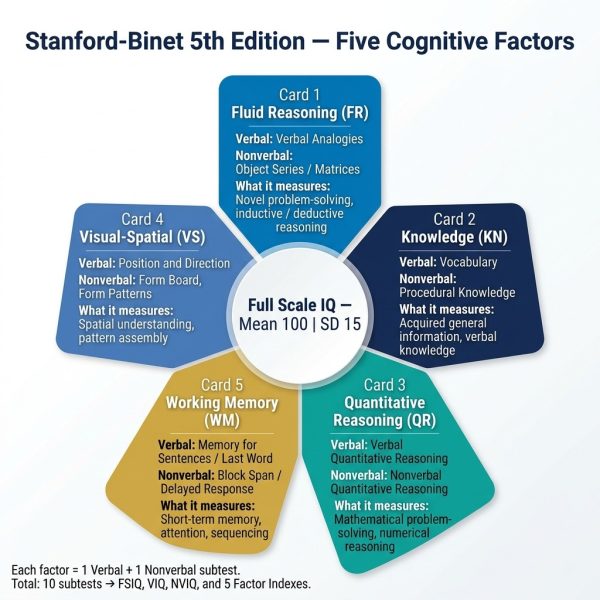
The Stanford-Binet Fifth Edition (SB5), published in 2003 by Gale Roid, is the most comprehensive revision in the test's history. It measures five cognitive factors, each assessed in both a verbal and a nonverbal domain, producing a total of 10 subtests:
The Five Cognitive Factors
Fluid Reasoning (FR). The ability to solve novel problems through inductive and deductive reasoning — problems that cannot be solved through memorised knowledge but require the examinee to identify rules, relationships, and patterns in new material. Nonverbal: Object Series / Matrices (pattern completion). Verbal: Early Reasoning, Verbal Absurdities, Verbal Analogies.
Knowledge (KN). Accumulated general information, vocabulary, and procedural knowledge acquired through education and everyday experience. This is what cognitive scientists call crystallised intelligence — the stored product of prior learning. Nonverbal: Procedural Knowledge, Picture Absurdities. Verbal: Vocabulary.
Quantitative Reasoning (QR). Mathematical problem-solving and numerical reasoning ability. Both verbal and nonverbal versions present mathematical problems, with the nonverbal version using pictures and diagrams to reduce the language demands of the mathematics. This factor is particularly relevant for mathematical giftedness assessment.
Visual-Spatial Processing (VS). The ability to understand and manipulate spatial relationships — pattern assembly, spatial orientation, and the ability to identify relationships between objects in space. Nonverbal: Form Board, Form Patterns. Verbal: Position and Direction. This factor is especially relevant for identifying strengths in individuals with verbal learning difficulties.
Working Memory (WM). The ability to hold information in short-term memory while performing mental operations on it. Nonverbal: Block Span, Delayed Response. Verbal: Memory for Sentences, Last Word. Working memory is one of the most practically relevant cognitive factors for academic performance and is specifically assessed because of its well-established role in learning and academic achievement.
The Scores the SB5 Produces
The SB5 is an adaptive test — two initial routing subtests determine the appropriate difficulty level for the remaining eight subtests, ensuring that each examinee encounters items near their ability level throughout the administration. The test produces several layers of scores:
- Subtest Scaled Scores — each of the 10 subtests produces a score with mean 10 and SD 3
- Five Factor Index Scores — each factor combines its verbal and nonverbal subtests into a score with mean 100 and SD 15
- Verbal IQ (VIQ) — combines the five verbal subtests; mean 100, SD 15
- Nonverbal IQ (NVIQ) — combines the five nonverbal subtests; mean 100, SD 15
- Abbreviated Battery IQ (ABIQ) — two routing subtests only; used when a quick estimate is needed
- Full Scale IQ (FSIQ) — combines all 10 subtests; mean 100, SD 15; range reported 40–160
All composite scores use deviation IQ scoring (mean 100, SD 15), matching the scale used by the Wechsler tests, so that scores from the two instruments can be meaningfully compared. For context on what specific scores on this scale mean, see our IQ score guides beginning with the IQ scale explained.
An Important Note on Standard Deviations: Historical vs Modern SB Scores
One technical point that is frequently misunderstood when interpreting historical IQ scores from the Stanford-Binet: the older editions of the test (before the 1986 Fourth Edition fully transitioned) used a standard deviation of 16 rather than the 15 used by the Wechsler tests and the current SB5.
This matters because a score of 132 on an older Stanford-Binet (SD = 16) does not mean the same thing as a score of 132 on the WAIS-IV (SD = 15) or the current SB5 (SD = 15). The two instruments are on slightly different scales. Converting between them requires adjusting for the different standard deviations: a score that is 2 standard deviations above the mean corresponds to IQ 132 on an SD = 16 scale but IQ 130 on an SD = 15 scale.
This is relevant for interpreting historical celebrity IQ claims, Mensa qualification from older tests, and any IQ score reported from a Stanford-Binet administered before approximately 1986. When reading IQ scores from older sources, always check which standard deviation was used. For more on this and related measurement issues, see our guide on what IQ actually measures.
The Stanford-Binet vs the Wechsler: What Makes Each Distinctive
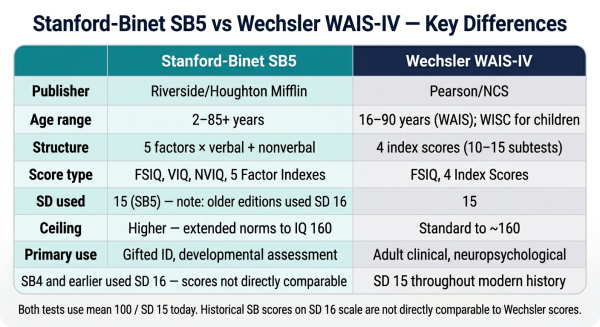
The Stanford-Binet and the Wechsler Intelligence Scales are the two dominant clinical intelligence assessments in the English-speaking world. Both use mean 100 / SD 15 scoring on their current editions. Their primary differences are structural and practical:
| Feature | Stanford-Binet SB5 | Wechsler WAIS-IV |
| Age range | 2 to 85+ years | WAIS: 16–90; WISC: 6–16; WPPSI: 2½–7½ |
| Structure | 5 factors × verbal + nonverbal = 10 subtests | 4 index scores across 10–15 subtests |
| Composite scores | FSIQ, VIQ, NVIQ, ABIQ, 5 Factor Indexes | FSIQ, 4 Index Scores (VCI, PRI/VSI, WMI, PSI) |
| Score ceiling | FSIQ range 40–160; higher ceiling for gifted assessment | FSIQ range 40–160 (extended norms available) |
| Historical SD | SD 16 (pre-4th edition); SD 15 (4th edition and SB5) | SD 15 throughout modern history |
| Primary clinical use | Gifted identification, early childhood, broad age range | Adult neuropsychological evaluation, clinical diagnosis |
The SB5 is particularly valued for gifted identification because of its wider item range — it includes more very difficult items than the WAIS-IV, which means it maintains greater accuracy at the high end of the distribution. For more on how IQ test design affects high-end scores, see our IQ 160 guide. For a guide to the Wechsler specifically, see our Wechsler IQ test guide.
What Binet Intended — and What His Test Became
A final note that matters for understanding the Binet legacy honestly: Alfred Binet's original intention for his test was modest, practical, and explicitly opposed to the uses to which it was subsequently put.
Binet designed a diagnostic tool for Paris educators. He did not believe intelligence was a fixed, single entity that could be summarised in a single number and compared between individuals as a measure of their inherent worth. He was sceptical of hereditarianism and specifically warned against the "brutal pessimism" of treating his test results as permanent verdicts on children's potential.
Lewis Terman's 1916 Stanford revision transformed Binet's cautious educational tool into a broad claim about fixed, heritable intelligence — and was subsequently used to justify immigration restriction (large-scale IQ testing of immigrants at Ellis Island), military sorting (Army Alpha and Beta tests in World War I), and eugenic policies that Binet would almost certainly have opposed. Binet died in 1911, five years before Terman published his revision.
The modern Stanford-Binet has moved substantially away from these early misapplications. The SB5 includes structural features specifically designed to reduce cultural and linguistic bias, incorporates nonverbal assessment pathways for individuals with language difficulties, and is normed on representative population samples. It is used primarily for educational and clinical purposes — identifying learning needs, assessing giftedness, evaluating cognitive development — consistent with Binet's original practical vision, if not exactly as he designed it. For more on what IQ tests can and cannot tell us, see our guide on what IQ actually measures.
The Binet IQ test — in its modern form as the Stanford-Binet Fifth Edition — is a 120-year-old line of cognitive assessment that began as a practical tool for Paris schoolchildren and became the foundation of the entire field of intelligence measurement. The SB5 measures five cognitive factors (Fluid Reasoning, Knowledge, Quantitative Reasoning, Visual-Spatial Processing, and Working Memory) across verbal and nonverbal domains, producing a Full Scale IQ and a detailed cognitive profile. Understanding its history — including what Binet intended, what Terman added, and what the modern revision does and doesn't claim — is essential to interpreting any score from this instrument accurately.
For more on how IQ test scores work, see our IQ scale explained and our guide on what IQ actually measures. For the Wechsler test that most adults in English-speaking countries encounter clinically, see our Wechsler IQ test guide. To find out where your own cognitive profile sits, take our free IQ test — no registration, results in under 20 minutes.
Frequently Asked Questions
What is the Binet IQ test?
The Binet IQ test refers to a line of intelligence assessments originating with the Binet-Simon Scale, developed in 1905 by French psychologist Alfred Binet and physician Théodore Simon to identify French schoolchildren needing different educational support. It introduced the concept of mental age. Adapted by Lewis Terman at Stanford University in 1916 as the Stanford-Binet Intelligence Scale, the current version is the Stanford-Binet Fifth Edition (SB5), published in 2003.
What does the Stanford-Binet test measure?
The SB5 measures five cognitive factors: Fluid Reasoning, Knowledge, Quantitative Reasoning, Visual-Spatial Processing, and Working Memory. Each is assessed in both verbal and nonverbal domains (10 subtests total). Scores produced include a Full Scale IQ (FSIQ), Verbal IQ (VIQ), Nonverbal IQ (NVIQ), Abbreviated Battery IQ (ABIQ), and five Factor Index scores. All use mean 100, SD 15 deviation scoring.
What is the difference between the Binet-Simon test and the Stanford-Binet?
The Binet-Simon Scale (1905) was Binet and Simon's original French test — 30 tasks producing a mental age score. The Stanford-Binet (1916) was Terman's American adaptation that introduced the IQ formula and greatly expanded the test. The Stanford-Binet has been revised five times since 1916. The key practical difference: the original Binet used ratio IQ and measured mental age; the modern SB5 uses deviation IQ (mean 100, SD 15) and measures five cognitive factors in verbal and nonverbal domains.
Why did Alfred Binet create the IQ test?
Binet created his test for a specific practical purpose: the French government needed a way to identify children who needed different educational support following the introduction of universal compulsory education. He was sceptical of fixed-intelligence theories and designed his scale as a practical educational diagnostic tool — not as a measure of innate, heritable cognitive capacity. He explicitly believed intelligence was malleable.
How is the Stanford-Binet scored?
The SB5 uses deviation IQ scoring with mean 100 and SD 15, matching the Wechsler scales. The FSIQ range is 40–160. The test also produces Verbal IQ, Nonverbal IQ, Abbreviated Battery IQ, and five Factor Index scores. Note: earlier Stanford-Binet editions before the 4th edition (1986) used SD 16 — historical scores on older editions are not directly comparable to Wechsler or SB5 scores.

Comments
Share Your Thoughts