For decades, IQ was viewed as a fixed trait — something you’re born with and can’t really change. But modern neuroscience paints a very different picture. Today, we know the brain is highly malleable, especially during childhood. The real question isn’t “Can IQ be improved?” It’s “How early and how effectively can we do it?” For a deeper explanation of how IQ actually works, see our complete guide to IQ.
Let’s dive into what current brain science reveals about growing intelligence in children — and what actionable steps parents and educators can take starting today.
What Is IQ, Really?
IQ (Intelligence Quotient) measures a child’s cognitive abilities — how they think, analyse, solve problems, remember information, and understand verbal or visual cues. It reflects several mental domains including problem-solving, working memory, spatial reasoning, logical thinking, and language skills.
While genetics play a role, modern neuroscience shows that IQ is far more flexible than once believed. Environmental factors, learning experiences, and brain development shape a large part of a child’s cognitive ability. In other words, IQ isn’t a fixed limit — it’s a snapshot of where a child is right now, not a ceiling of where they can go. Parents often ask what counts as a “good” IQ result — our full breakdown of IQ scores can help.
The Science Behind It: Neuroplasticity — The Brain’s Superpower
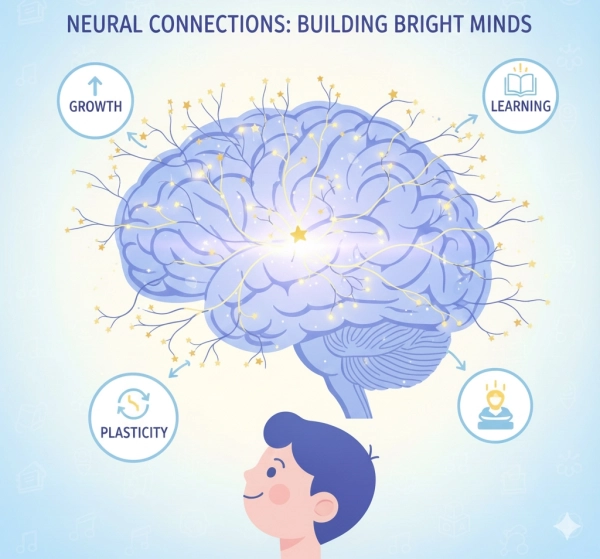
Neuroplasticity refers to the brain’s ability to grow new neural connections and reorganize itself based on experience. This process is especially powerful during childhood, when the brain is forming millions of synapses every second. Our article on neuroplasticity of the brain explains this clearly for general readers.
Neural pathways grow stronger the more they are used. Early childhood (ages 0–12) is a critical window for boosting cognitive skills. The environment — rich or poor — directly influences how the brain develops, and stimulation, emotional safety, and even nutrition can expand IQ capacity. Because of neuroplasticity, a child’s IQ score can rise significantly with the right experiences and support.
Science-Backed Ways to Improve a Child’s IQ
1. Cognitive Enrichment Through Play
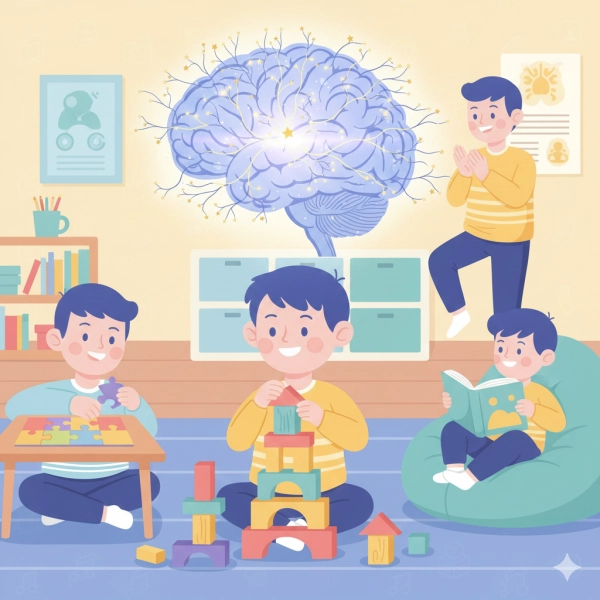
Play is not just entertainment — it’s one of the most powerful drivers of brain development. Brain-building activities include puzzles and pattern games, strategy or logic games, LEGO and building sets, and open-ended toys that require planning or design. These strengthen visual-spatial reasoning, working memory, and problem-solving — all core components of IQ. A child building complex structures with LEGO is actively practising mental rotation, sequencing, and structural reasoning — skills strongly correlated with higher IQ in later years. For visual thinkers especially, see our guide on visual thinking in children.
2. Language Exposure and Multilingualism
Language is one of the strongest predictors of cognitive growth. Children exposed to diverse vocabulary, rich conversations, or multiple languages develop stronger verbal reasoning and executive functioning. To support verbal IQ growth: read aloud daily, encourage storytelling, role-play and imagination, ask open-ended questions (“Why do you think…?”), and introduce a second language early, even casually. Studies consistently show that bilingual children perform better in tasks involving attention, task switching, and working memory.
3. Physical Movement Fuels Mental Growth
Physical activity boosts blood flow to the brain and increases levels of BDNF (Brain-Derived Neurotrophic Factor) — a key protein for learning, memory, and cognitive flexibility. Regular exercise produces better memory retention, enhanced focus and attention, faster mental processing, and improved emotional regulation. Children who move regularly simply think better — a well-established finding in developmental neuroscience.
4. Mindful Screen Time with Interactive Content
Not all screen time is harmful — it’s the type of content that matters. Helpful digital activities include logic apps, interactive problem-solving games, digital puzzles, and creative tools such as animation or drawing apps. Fast-paced, overstimulating content that overwhelms the developing nervous system should be avoided. Interactive learning can support cognitive development when used sparingly and under parental guidance.
5. Nutrition for Brain Health
A child’s brain requires the right nutrients to build cells, maintain connections, and support memory and focus. Top brain-boosting nutrients include omega-3 fatty acids (found in fish, nuts, and seeds), iron (lean meat, beans, leafy greens), choline (eggs), and antioxidants (berries, colourful vegetables). Balanced nutrition sustains energy levels and supports stable cognitive performance throughout the day.
IQ Scores Can Change — But There’s a Window
Long-term research shows that a child’s IQ can shift by 10–20 points during early childhood, depending on stimulation, environment, and education quality. However, neuroplasticity gradually slows after adolescence — which is why early investment in cognitive development matters so much. The earlier parents and educators create enriched environments, the greater the cumulative effect on a child’s intellectual development.
Final Thoughts: Focus on Growth, Not Just Scores
Raising a highly capable, confident child isn’t about chasing genius-level IQ numbers. It’s about creating an environment where curiosity, deep thinking, emotional safety, and resilience can thrive. Instead of asking “Is my child smart?”, a more useful question is: “How can I help my child grow smarter every single day?”
With consistent cognitive stimulation, supportive parenting, and a rich environment, every child can enhance their intellectual potential — and build a lifelong love of learning in the process. Explore our full Parents & Kids guide collection for more evidence-based resources on raising confident, capable children.

Comments
Share Your Thoughts