Does your child love puzzles, patterns, or building things — but struggle with reading or verbal instructions? They may be a visual thinker: someone who processes the world through images, shapes, and spatial understanding rather than words. This cognitive style often aligns with strengths highlighted in image-based IQ tests for kids, which offer a fairer way to measure non-verbal reasoning.
Traditional IQ tests often overlook this type of intelligence. That’s where non-verbal IQ assessments come in — offering a more inclusive way to recognize how kids really think. For a deeper overview of how intelligence is measured overall, see our complete guide to IQ.
What Is Visual Thinking?
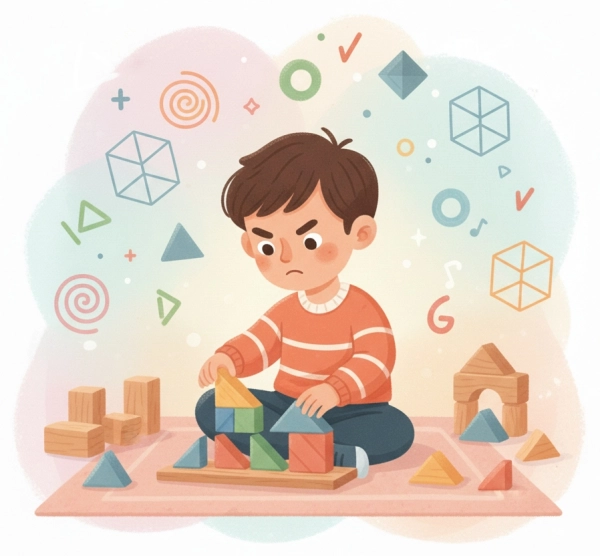
Visual thinking is a cognitive style in which individuals process, understand, and remember information primarily through images, spatial relationships, diagrams, and patterns — rather than through words or auditory input. Visual thinkers often “see” solutions unfold in their minds before they can explain them verbally. This type of cognition is closely connected to visual-spatial intelligence, one of the core forms of human problem-solving.
Visual thinkers tend to excel at puzzles, drawing, building, and spatial manipulation. They understand concepts best through visual cues such as diagrams, videos, or demonstrations, and they learn faster when information is presented visually rather than textually. They may struggle with long verbal instructions, spelling, or purely linguistic tasks, and they tend to prefer hands-on experiences over lectures. Some of the world’s greatest innovators were visual thinkers — including Albert Einstein, who described his thoughts as “images and feelings,” and Temple Grandin, known for her vivid visual cognition.
If you’re curious about how giftedness appears in children, see our guide on how to support gifted children after an IQ test.
Why Standard IQ Tests Can Miss Visual Thinkers
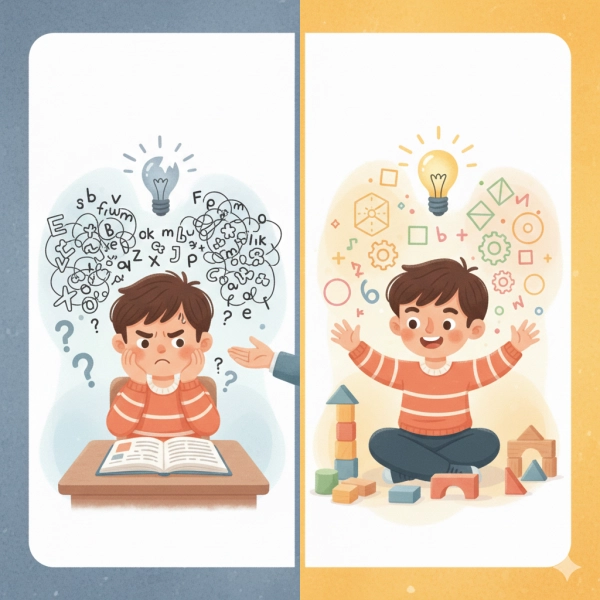
Despite being widely used, traditional IQ tests place heavy emphasis on verbal comprehension, vocabulary, language-based reasoning, and auditory working memory. These tests accurately measure many cognitive abilities, but they don’t fully capture non-verbal intelligence — which is the core strength of visual thinkers. Parents sometimes wonder whether IQ scores change with age when they see their child perform unevenly across different assessments.
For children who are highly creative, think in 3D, have strong spatial intuition, or struggle with reading or verbal expression, traditional IQ metrics may underestimate their true cognitive potential. This is also significant for children with learning differences such as dyslexia, ADHD, autism spectrum profiles, or language delays — all of which can coexist with exceptional visual-spatial abilities.
How Image-Based IQ Tests Work
Image-based IQ tests are designed to highlight pure reasoning ability without relying on reading or language skills, providing a more accurate representation of how visual thinkers process information. Our IQ Test for Kids uses child-friendly visual logic tasks appropriate for ages 5–12.
These tests typically include visual pattern sequences (such as rotating shapes, symmetry puzzles, and abstract matrices), picture-based logic puzzles with no written instructions, non-verbal reasoning tasks that measure problem-solving and pattern recognition, and zero language dependency, which eliminates verbal or cultural barriers. Because they rely solely on visual cues, even young children can participate and demonstrate their abilities long before they develop strong reading or writing skills.
Unlike traditional IQ tests, image-based tests often feel like games. Kids engage naturally because they’re solving puzzles rather than reading paragraphs, there’s no pressure to speak or memorize words, and the visuals feel intuitive and exciting. This typically results in more accurate scores because children feel curious rather than anxious.

Benefits of Image-Based IQ Tests
1. Fairer for Neurodiverse Learners
Children with dyslexia, ADHD, autism spectrum profiles, or language delays often possess exceptionally strong visual reasoning. Image-based tests allow these strengths to shine without interference from reading, handwriting, or auditory challenges.
2. Early Identification of Strengths
Visual-spatial intelligence often appears before verbal intelligence. A child may struggle to read but effortlessly assemble complex LEGO sets, draw detailed maps, or solve multi-step puzzles. Image-based tests help parents and teachers recognise these abilities early, guiding better learning pathways.
3. Reduced Test Anxiety
Because there’s no vocabulary to recall and no oral reading required, children feel less judged, more confident, and more motivated. The test becomes a puzzle-solving experience rather than a performance evaluation.
4. Culturally Inclusive and Multilingual Friendly
No language means no cultural bias. These tests work equally well for children from multilingual households, immigrant families, and non-native English-speaking environments — making image-based assessments accessible worldwide.
Signs Your Child Might Be a Visual Thinker
Common signs include a love for LEGO, Minecraft, origami, drawing, or map-making; difficulty with spelling or phonics despite strong reasoning; excellent memory for places, faces, or routes; solving problems by “seeing” the answer before explaining it verbally; preferring pictures, diagrams, or videos over reading; and building or creating complex structures spontaneously. If this sounds familiar, your child may benefit greatly from a visual-based IQ assessment.
What to Do After the Test
If your child performs strongly on an image-based IQ test, celebrate their learning style — visual thinking is common among engineers, architects, scientists, artists, designers, and innovators. Communicate with teachers about incorporating visual aids, hands-on activities, step-by-step diagrams, concept maps, and models into classroom learning. Encourage hobbies that boost spatial reasoning such as robotics, animation, architecture kits, engineering sets, strategy games, or visual coding platforms like Scratch.
Visual thinkers often develop rapidly once they are taught in alignment with their strengths. Some parents choose our High Range IQ Test as children grow older to measure advanced reasoning skills more precisely.
Final Reminder: There’s No One Right Way to Be Smart
Visual thinking isn’t “better” or “worse” than verbal thinking — it’s simply different. Many children who struggle in traditional classrooms flourish once their visual intelligence is recognized and nurtured. Once understood, visual thinkers become more confident, more engaged, and more motivated to learn. They often grow into engineers, inventors, designers, animators, scientists, and innovative problem-solvers who make unique contributions to the world.
Want to get started? Try our IQ Test for Kids to discover your child’s visual reasoning strengths, and explore our full Parents & Kids guide collection for more evidence-based resources on child development.

Comments
Share Your Thoughts