Memory and intelligence are deeply connected — but the connection is far more specific than most people realise. The relationship is not "better memory = higher IQ." It is: higher working memory capacity is one of the strongest correlates of fluid intelligence ever measured, while other types of memory — rote recall, photographic memory, the ability to memorise facts — predict IQ much more weakly, if at all.
The strength of the working memory–IQ connection surprised researchers when it was first quantified. In their landmark 1990 study, Kyllonen and Christal found latent-variable correlations between working memory and reasoning that ran from r = .80 to .90 — so strong they famously asked in their paper title whether "reasoning ability is (little more than) working memory capacity." Subsequent meta-analyses settled the estimate somewhat lower (r ≈ .50–.60 in observed measures, r ≈ .80–.90 in latent variable studies), but the relationship remains one of the most robust in all of cognitive science.
This guide covers what the research shows about IQ and memory: which memory types predict intelligence and how strongly, what working memory actually is and why it is so central to IQ, a surprising finding about quantity versus quality, and the evidence on whether improving working memory can improve IQ.
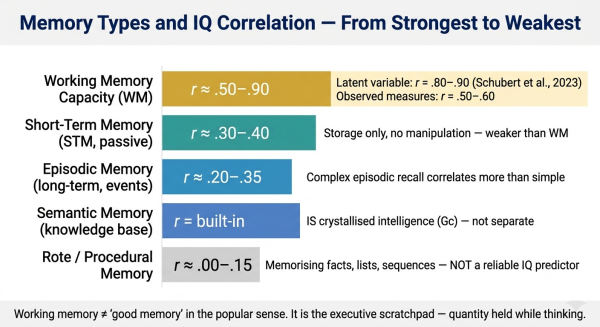
Memory Types and Their IQ Correlations
Memory is not a single thing. The cognitive science literature distinguishes several distinct memory systems that have different relationships with IQ:
Working Memory — Strongest IQ Correlation
Working memory is the cognitive scratchpad — the ability to hold information in mind while simultaneously doing something with it. The correlation between working memory capacity and fluid intelligence (Gf — the ability to reason and solve novel problems) is among the highest in cognitive science. It is well-established that individual differences in working memory are strongly correlated to individual differences in fluid intelligence, with correlations of .80–.90 reported in latent-variable studies (Schubert et al., 2023). Observed (measured) correlations typically settle in the r ≈ .50–.60 range after accounting for measurement noise.
Engle, Tuholski, Laughlin and Conway (1999) used confirmatory factor analysis to carefully separate working memory from short-term memory and estimate each factor's correlation with fluid intelligence independently. The results were clean: working memory correlated r = .59 with Gf as a latent factor; short-term memory correlated only r = .31. The difference between these two values pinpoints what it is about working memory that matters for intelligence — not passive storage, but active maintenance combined with executive attention and manipulation.
Short-Term Memory — Moderate IQ Correlation
Short-term memory (STM) — passive, temporary storage without active manipulation — correlates more modestly with IQ, typically at r ≈ .30–.40. On the WAIS-IV, Digit Span Forward (repeat a sequence of numbers in order) is a short-term memory measure; Digit Span Backward and Digit Span Sequencing involve active manipulation and are therefore working memory measures. The distinction is clinically meaningful: low performance on backward and sequencing tasks relative to forward span suggests specific working memory deficits, not general memory problems. For more on how these subtests work, see our WAIS-IV guide.
Episodic Memory — Modest IQ Correlation
Episodic memory — the ability to recall personal experiences, events, and contextually encoded information — correlates modestly with intelligence, particularly for complex or semantically rich material. The correlation is typically r ≈ .20–.35 for general episodic tasks, though it rises when the task requires the kind of active encoding and elaboration associated with working memory and executive function. The number of things people can remember is robustly correlated with fluid intelligence — the larger number remembered, the higher the IQ, as Awh and colleagues have documented.
Semantic Memory — Part of Intelligence, Not Separate
Semantic memory — general knowledge and accumulated factual information about the world — is not meaningfully separable from crystallised intelligence (Gc) in the CHC framework. Gc is essentially the organised product of accumulated semantic learning. High IQ people have, on average, larger and better-organised semantic knowledge networks — but this is partly because higher fluid intelligence facilitates more efficient learning and better elaborative encoding of new information, not because semantic memory and IQ are separately correlated.
Rote / Procedural Memory — Minimal IQ Correlation
The ability to memorise sequences, lists, and facts through repetition — rote memory — does not reliably predict high IQ. Procedural memory (memory for how to perform skilled actions) is similarly independent of IQ. A person can have an exceptional ability to memorise phone numbers, card sequences, or historical dates without having correspondingly high fluid intelligence. This distinction matters for understanding what IQ tests measure and what they don't — IQ tests do not directly measure rote memorisation ability.
What Working Memory Is: The Scratchpad Model
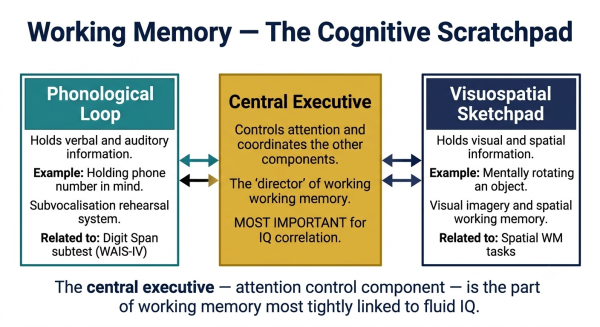
Alan Baddeley's multi-component model of working memory — the dominant framework in working memory research — describes three major components:
The Phonological Loop holds and rehearses verbal and auditory information. It is the mechanism underlying the experience of mentally "saying" a phone number to yourself to keep it in mind. The phonological loop is tested by Digit Span Forward on the WAIS-IV and similar measures. It is important for language comprehension, reading, and verbal reasoning — but it is not the component most tightly linked to fluid intelligence.
The Visuospatial Sketchpad holds and manipulates visual and spatial information — mental imagery, spatial relationships, visual patterns. It underlies the ability to mentally rotate objects, navigate spatially, and maintain visual working memory. It is tested by visual WM tasks and spatial span measures.
The Central Executive is the control system that coordinates the other components, regulates attention, and manages the manipulation of information across the entire working memory system. It is the component most tightly linked to fluid intelligence. The central executive manages which information receives attention, resolves interference between competing representations, and controls the updating of working memory contents as new information arrives. This is precisely what fluid reasoning requires: holding multiple pieces of information simultaneously, manipulating them according to problem rules, and preventing irrelevant information from interfering with the solution process.
The tight WM–Gf correlation makes theoretical sense when viewed this way: fluid intelligence — the ability to reason through novel problems — requires exactly the capacity that working memory provides: holding multiple variables in mind, manipulating them, and tracking the state of a problem across multiple steps. For more on how working memory is measured in clinical IQ assessment, see the Working Memory Index section of our WAIS-IV guide.
Quantity, Not Quality: A Surprising Finding
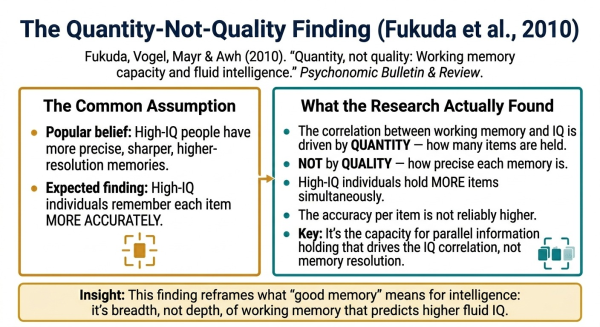
A 2010 study by Fukuda, Vogel, Mayr and Awh published in Psychonomic Bulletin & Review produced one of the most counterintuitive findings in working memory research: the correlation between working memory and fluid intelligence is driven by the quantity of items held — not by the quality or resolution of those memories.
The intuitive prediction would be that high-IQ people hold more precise, sharper, higher-resolution mental representations. Fukuda and colleagues found something different. They measured both how many items participants could hold in visual working memory (capacity) and how precisely each item was remembered (resolution). The correlation with fluid intelligence came entirely from capacity — how many items were simultaneously maintained. The precision per item showed no reliable correlation with IQ.
This reframes what "good memory" means for intelligence. It is not that high-IQ people remember each individual thing more vividly or precisely. It is that they can hold more things simultaneously — a larger "working set" — while reasoning through complex problems. A high-IQ person solving a multi-step reasoning problem is not necessarily seeing each step more clearly. They are more likely maintaining more steps in active memory at once, which allows them to track more complex relationships and avoid losing track of earlier steps.
Working Memory Training and IQ: The Evidence
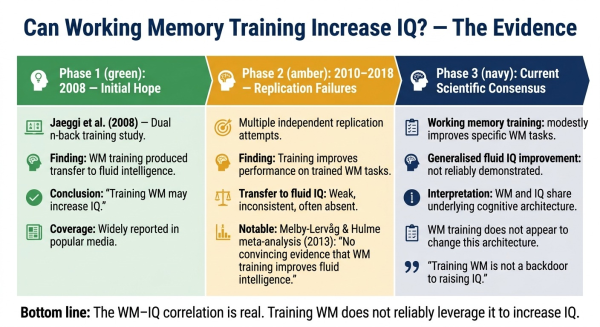
Given the strong working memory–IQ correlation, an obvious question arises: if working memory capacity is so tightly linked to fluid intelligence, can training working memory improve IQ?
The research on this question went through a characteristic cycle of initial promise, replication failure, and eventual consensus:
The initial hope (2008): Jaeggi et al. published a study in PNAS suggesting that n-back working memory training transferred to gains on fluid intelligence measures. The paper attracted enormous attention — it suggested that a specific cognitive training regime might actually raise IQ.
The replication difficulty (2010–2018): Subsequent replication attempts produced inconsistent results. Some studies found transfer; many did not. The Melby-Lervåg and Hulme (2013) meta-analysis, covering 23 studies, concluded that while working memory training reliably improves performance on trained WM tasks, there was "no convincing evidence of a far transfer effect on standardized tests of fluid intelligence." Later meta-analyses continued to find inconsistent or absent transfer.
The current consensus: Working memory training appears to be a domain-specific skill-learning process. It improves performance on tasks structurally similar to the training tasks but does not reliably change the underlying cognitive architecture that produces the WM–IQ correlation. The relationship between working memory and intelligence reflects shared cognitive infrastructure — both depend on the same attentional control systems and prefrontal networks — but training WM does not appear to be a lever that raises this shared foundation. Training chess does not make you better at other strategy games; training specific WM tasks does not reliably make you better at reasoning tasks that depend on working memory in a different way.
This is consistent with the broader literature on cognitive training and IQ discussed in our guide on can IQ be improved.
Memory and IQ in IQ Testing
The memory-intelligence relationship is directly reflected in the structure of major IQ tests. The WAIS-IV Working Memory Index (WMI) measures working memory capacity through Digit Span (forward, backward, and sequencing conditions) and Arithmetic (mental arithmetic under time pressure). This index is intended to capture the executive-attentional component of working memory — the part most tightly linked to fluid intelligence.
The WMI is also the index most sensitive to sleep deprivation, anxiety, and ADHD — which is consistent with the working memory–attention control framework. When attentional control is disrupted (by fatigue, anxiety, or attentional dysregulation), working memory capacity declines and WMI scores fall, even in individuals whose underlying fluid reasoning capacity is intact. This is why a low WMI with normal or high PRI (Perceptual Reasoning Index) scores is a common pattern in clinical ADHD assessment. For more on how these patterns work in practice, see our WAIS-IV guide.
The relationship between memory and IQ is one of the most important and most specific in cognitive science. Working memory capacity — the ability to hold and manipulate information while actively reasoning — correlates with fluid intelligence at r ≈ .50–.90, one of the strongest relationships in the field. Short-term and episodic memory correlate more modestly (r ≈ .20–.40). Rote and procedural memory are essentially unrelated to IQ. The quantity of items held in working memory predicts IQ better than the resolution of those memories. And working memory training — despite initial optimism — does not reliably improve fluid IQ in the way the strong correlation might suggest. Memory and intelligence are deeply interconnected, but the connection runs through the attentional, executive control architecture of working memory, not through memory ability in general.
For more on how memory is tested in clinical IQ assessment, see our WAIS-IV guide. For related guides on what affects cognitive performance, see our sleep and IQ guide and our nutrition and IQ guide. Take our free IQ test — no registration, results in under 20 minutes.
Frequently Asked Questions
Is there a relationship between memory and IQ?
Yes, but it depends on memory type. Working memory (active manipulation of information) correlates with fluid IQ at r ≈ .50–.90 — one of the strongest relationships in cognitive science. Short-term memory (passive storage) correlates at r ≈ .30. Rote and procedural memory show minimal IQ correlation.
Does a good memory mean a high IQ?
Not in general. A good working memory (ability to hold and manipulate multiple items simultaneously) is strongly associated with high IQ. But rote memory — the ability to memorise facts, lists, or sequences through repetition — does not reliably predict IQ. The Fukuda et al. (2010) finding was that it's the number of items held in working memory, not the precision of each, that correlates with IQ.
What is working memory and why is it important for IQ?
Working memory is the cognitive scratchpad — holding and manipulating information during active mental processing. Its central executive component (attention control) is most tightly linked to fluid intelligence. Kyllonen and Christal (1990) found latent-variable correlations of r ≈ .80–.90 between working memory and reasoning, leading them to ask whether reasoning is "little more than working memory capacity."
Can you improve IQ by improving working memory?
Probably not significantly. Despite initial optimism after Jaeggi et al. (2008), subsequent meta-analyses found that working memory training improves trained tasks but does not reliably transfer to fluid IQ gains. The WM–IQ correlation reflects shared cognitive architecture, not a lever that can be pulled to raise intelligence.
Do people with high IQ have better memory?
High-IQ people have larger working memory capacity and tend to perform better on complex episodic memory tasks. But they do not reliably have better rote or photographic memory. The key difference is how much they can hold in mind simultaneously while reasoning, not how sharp each individual memory is.

Comments
Share Your Thoughts