When parents see their child's IQ score, they often have two immediate questions: Is this good? And what does it mean for my child's future? This guide answers both — with accurate context about what IQ scores measure in children, what the correct classification system says, and why the number on a test is one useful piece of information rather than a verdict. For the foundational science of IQ measurement, see What Is IQ?
The Most Important Thing to Understand: IQ Is Age-Normed
Children's IQ tests — including the WISC-V (Wechsler Intelligence Scale for Children) and the Stanford-Binet — are calibrated against the performance of other children the same age. This means:
- An IQ of 100 means exactly average for a child's age group — at any age
- A 6-year-old with IQ 100 and a 12-year-old with IQ 100 are both average for their respective age groups
- IQ does not measure how advanced a child is compared to older children — it measures relative position within their own age cohort
This is why "average IQ by age" tables that show different numbers for different ages are misleading — by design, 100 is average at every age on properly normed tests. What varies with age is the absolute level of cognitive development, not the IQ score itself.
WISC-V Classification System for Children
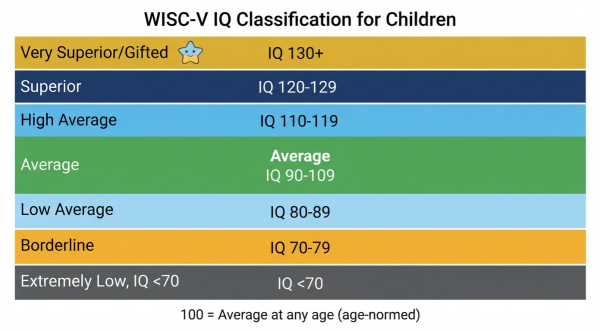
| IQ Score | WISC-V Classification | Percentile | What It Means for Your Child |
| 130 and above | Very Superior (often called Gifted) | 98th+ | Top 2% of age group; may qualify for gifted programs |
| 120–129 | Superior | 91st–97th | Strong reasoning and learning speed; likely academic strength |
| 110–119 | High Average | 75th–90th | Above-average cognitive development; learns more readily than most peers |
| 90–109 | Average | 25th–73rd | Typical developmental range; includes approximately 50% of all children |
| 80–89 | Low Average | 9th–23rd | Below average but functional; may benefit from additional academic support |
| 70–79 | Borderline | 2nd–8th | Significantly below average; professional evaluation recommended |
| Below 70 | Extremely Low | Below 2nd | Requires professional evaluation; intellectual disability possible but not automatic |
Note: "Gifted" is an informal educational label, not an official WISC-V classification. "Very Superior" is the WISC-V's highest classification. For more on the official classification system, see the IQ Scale Explained guide and the WISC/WAIS classification guide.
Understanding Measurement Error: IQ Is a Range, Not a Fixed Number
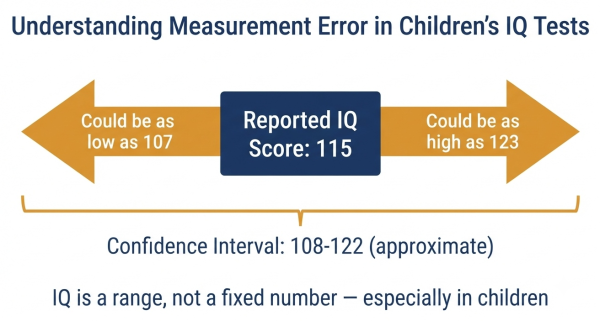
One of the most important things parents should know about IQ scores — and one of the most frequently overlooked — is that a reported IQ score is an estimate with a confidence interval, not a precise fixed number. For the WISC-V, the standard error of measurement is approximately 3–5 points, meaning the true score likely falls within approximately ±5–10 points of the reported score.
In practical terms: a reported IQ of 115 should be understood as "probably somewhere between 107 and 123." A score of 128 is not meaningfully different from 132 — they overlap within the measurement error. This matters most at classification boundaries:
- A child scoring 128 is within measurement error of the gifted threshold (130) — a single test is not conclusive
- A child scoring 72 may not be "Extremely Low" — measurement error could place their true score in the Borderline range
- Decisions about gifted programs, educational placement, or any clinical determination should always consider the full confidence interval, not just the single reported number
What Affects a Child's IQ Score?
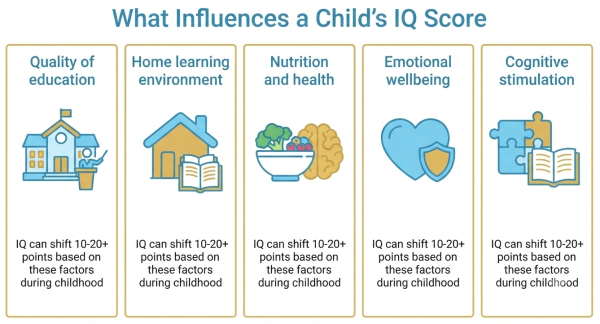
Children's IQ scores are substantially more responsive to environmental factors than adult scores, because childhood and adolescence are periods of rapid brain development. Research shows IQ scores can shift by 10–20 points or more over several years based on:
- Quality of education: Access to good teaching, appropriately challenging material, and a supportive classroom environment has measurable effects on cognitive development
- Home learning environment: Reading together, open-ended conversations, educational play, and intellectual engagement all support cognitive growth
- Nutrition and health: Adequate nutrition — particularly during early development — directly affects brain development. Sleep quality is also significant. See nutrition and IQ and sleep and IQ
- Emotional wellbeing: Chronic stress, trauma, or emotional insecurity can suppress cognitive test performance — sometimes substantially — without representing the child's underlying capacity
- Cognitive stimulation: Puzzles, games that require reasoning, and environments that reward curiosity all promote cognitive development
A child scoring below average at age 6 may score average or above-average by age 10 with appropriate support. The Flynn Effect — the documented rise in average IQ scores across generations due to environmental improvements — demonstrates that measured IQ responds to environmental conditions at the population level. See the Flynn Effect guide. For specific guidance on supporting cognitive development in children, see can you improve your child's IQ.
What a High IQ Score Does — and Doesn't — Mean
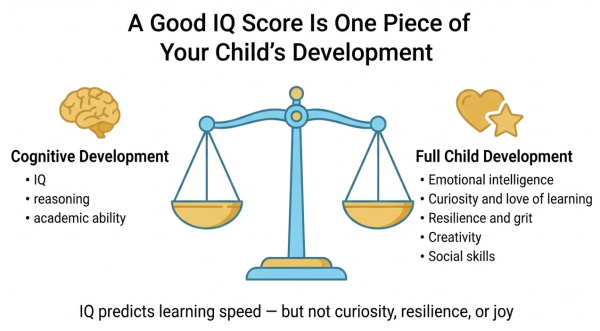
A high IQ score in a child predicts: faster-than-average learning speed in most academic subjects, stronger performance on tasks involving abstract reasoning and pattern recognition, and a potentially easier time in standard academic settings. It does not predict: creativity, wisdom, emotional regulation, social competence, long-term motivation, or life satisfaction. For the research on what IQ predicts versus what other factors predict, see IQ vs EQ and IQ vs EQ in childhood.
Gifted children (IQ 130+) can and do face challenges that average IQ does not protect them from: social isolation if they feel different from peers, perfectionism and anxiety around academic performance, underachievement if not appropriately challenged, and emotional intensity or asynchronous development — emotional maturity lagging cognitive ability. See supporting gifted children after an IQ test.
How Parents Can Support Cognitive Development
Research consistently shows that the most impactful parental investments in children's cognitive development include:
- Reading together regularly — builds vocabulary, verbal reasoning, and the habit of sustained attention. The gap between children who are read to and those who are not is substantial and measurable in cognitive assessments
- Asking open-ended questions — "What do you think would happen if...?" builds the reasoning and inference skills that IQ tests measure
- Providing appropriate challenge — work that's neither too easy nor overwhelming builds the executive function and persistence that support long-term cognitive growth
- Praising effort rather than intelligence — "You worked hard at that" rather than "You're so smart" builds a growth mindset and reduces the anxiety that can suppress performance
- Ensuring adequate sleep and nutrition — both have direct, documented effects on cognitive performance
For specific guidance: how to raise your child's IQ and brain games that boost children's IQ. To assess your child's current cognitive abilities in a structured way, try the IQ Test for Kids.
Frequently Asked Questions
What is a good IQ score for a child?
IQ scores are age-normed — 100 is average at any age. Generally: 90–109 is Average (typical development, ~50% of children). 110–119 is High Average. 120–129 is Superior. 130+ is Very Superior (often called Gifted, top 2%). A score should always be interpreted with its confidence interval (±5–10 points) — a single number is an estimate, not a fixed value.
Is IQ the same at different ages in children?
Because IQ tests are age-normed, 100 means average at every age. What changes with age is absolute cognitive development — an older child can do things cognitively that a younger child cannot. But IQ scores reflect relative position within an age group, so a 100 at age 6 and a 100 at age 12 both mean "average for that age group."
Can a child's IQ score change?
Yes — substantially, particularly during childhood. Research shows IQ can shift 10–20+ points over several years based on education quality, home environment, emotional wellbeing, and cognitive stimulation. A below-average score at age 6 does not predict a below-average score at 10 with appropriate support. See can you improve your child's IQ.
What IQ is considered gifted for a child?
Most gifted education programs use IQ 130 (98th percentile) on standardized tests like the WISC-V or Stanford-Binet. Some programs use 125, especially when combined with other evidence. "Gifted" is an educational planning label — it doesn't capture the full range of a child's strengths. See early signs of a high IQ child.
What tests measure IQ in children?
The most common standardized children's IQ tests are: WISC-V (ages 6–16, most common for school evaluations), Stanford-Binet 5th edition (ages 2–85+), WPPSI-IV (ages 2.5–7), and KABC-II (ages 3–18). All are administered by licensed psychologists under standardized conditions — not parent-administered online tests.

Comments
Share Your Thoughts