Raising a well-rounded child today requires more than focusing on academic strengths alone. While IQ tests measure how children think — how they reason, solve problems, and process information — EQ reveals how they feel, connect, and communicate. Understanding the balance between these two forms of intelligence is essential for parents who want to support both cognitive growth and emotional resilience. In a world where quick thinking and empathy matter equally, knowing how IQ and EQ work together can help you guide your child toward confidence, well-being, and long-term success.
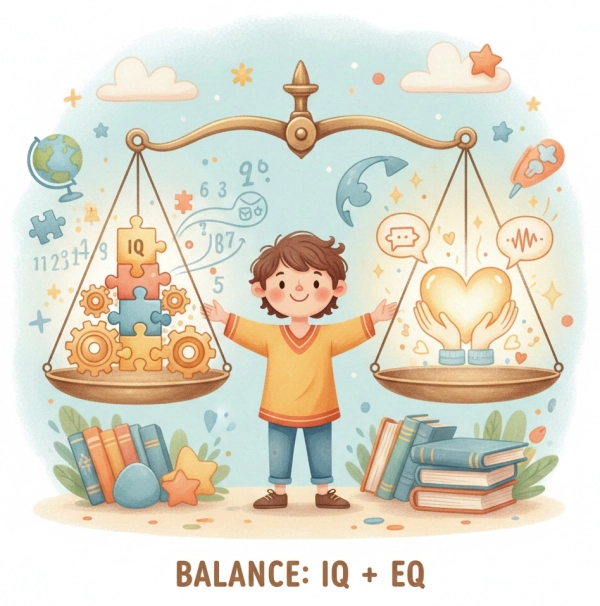
Understanding IQ and EQ in Kids
IQ (Intelligence Quotient) and EQ (Emotional Quotient) represent two very different — but equally important — forms of human intelligence. IQ measures cognitive abilities such as reasoning, memory, analytical thinking, numerical skills, and problem-solving. To explore IQ in more detail, see our complete guide to IQ.
Meanwhile, EQ measures emotional skills including empathy, emotional regulation, communication, and understanding social cues. Both shape how children grow intellectually and emotionally — and the most effective parenting approaches nurture both dimensions simultaneously.
Why IQ Matters in Childhood
A strong IQ can help children excel in structured learning environments. Kids with higher cognitive scores often grasp complex or abstract concepts more quickly, solve problems independently at an early age, show advanced reasoning in math, logic, or STEM activities, demonstrate early reading fluency and strong working memory, and learn faster with less repetition. IQ lays the foundation for academic growth, especially in analytical thinking and pattern recognition.
Parents who want a clearer picture of their child’s cognitive profile sometimes use age-appropriate assessments like our IQ Test for Kids or explore different types of intelligence tests. However, IQ alone does not predict long-term happiness or real-world capability — many high-IQ children struggle socially or emotionally if other skills are underdeveloped.
Why EQ Might Matter Even More
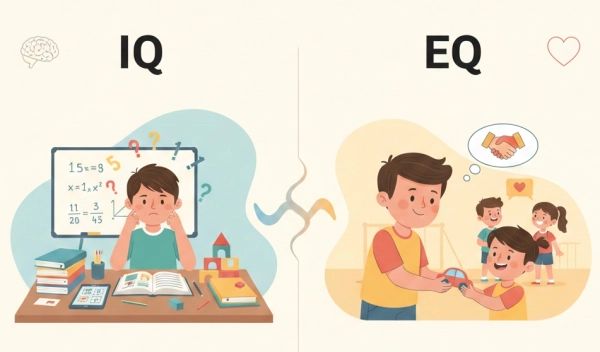
EQ plays a central role in helping children navigate life outside of academics. Kids with strong emotional intelligence tend to recognize and manage their own emotions even under stress, communicate clearly and calmly, empathize with friends, siblings, and adults, build healthy social relationships, work well in teams, and show resilience when facing frustration, failure, or change.
Research increasingly suggests that EQ may correlate more closely than IQ with well-being, leadership potential, and long-term success. For parents exploring social-emotional growth, see how emotional intelligence develops in our EQ assessment guide.
The Ideal Approach: Develop Both IQ and EQ Together
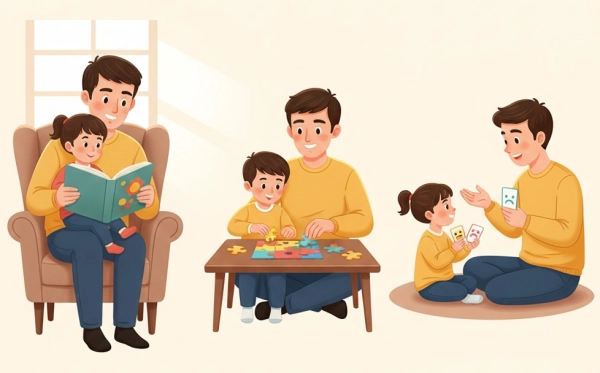
Parents don’t need to choose between raising a “smart child” or an “emotionally strong child.” The most successful long-term outcomes come from nurturing both simultaneously.
1. How to Boost IQ
- Encourage curiosity with puzzles, STEM toys, strategy games, and science experiments.
- Read together daily and explore open-ended questions (“Why do you think this happens?”).
- Provide challenging activities that stimulate problem-solving.
- Use cognitive assessments like our IQ Test for Kids to identify strengths.
- Support their interests — math, music, coding, robotics, or creative arts.
- Try fun brain games that boost IQ in children for engaging, screen-time-friendly options.
2. How to Boost EQ
- Help children name and validate their feelings (“It’s okay to feel upset — let’s talk about it.”).
- Model healthy emotional expression and active listening.
- Teach empathy by discussing perspectives in stories or real-life events.
- Use cooperative board games to teach teamwork and patience.
- Practice role-play scenarios to build conflict-resolution skills.
- Encourage gratitude, kindness, and regular reflection.
Common Myths
| Myth | Reality |
|---|---|
| IQ is fixed at birth | Brain development continues into early adulthood |
| EQ can’t be taught | Emotional skills can be nurtured through parenting and school |
| Smart kids don’t need EQ | Even gifted children struggle without emotional support |
For parents curious about how cognitive abilities evolve, our article on average IQ by age is also helpful.
Real-Life Impacts: Success Is More Than Smarts
A child with a 130 IQ may struggle in group settings if they lack EQ. Meanwhile, a child with average IQ but high EQ may thrive as a leader, negotiator, or team player. In the 21st century, collaboration, empathy, and adaptability are as essential as raw intellect — and the children who develop all three consistently outperform those who develop only one.
What Schools and Tests Miss
Traditional schooling tends to emphasize IQ-based performance — grades, standardized tests, and academic competitions — while overlooking emotional development. That’s why many parents look into stress-free assessments like our free IQ test guide with instant results alongside social-emotional learning programs. Together, these give a more complete picture of a child’s strengths and development needs.
Conclusion: It’s Not Either-Or
IQ may open doors, but EQ determines how confidently and compassionately a child walks through them. By nurturing both, you give your child the cognitive skills to succeed — along with the emotional tools to thrive.
Ready to explore your child’s strengths? Try our IQ Test for Kids to uncover their unique thinking style in a fun, pressure-free way. And browse our full Parents & Kids guide collection for more evidence-based resources on raising confident, capable children.

Comments
Share Your Thoughts