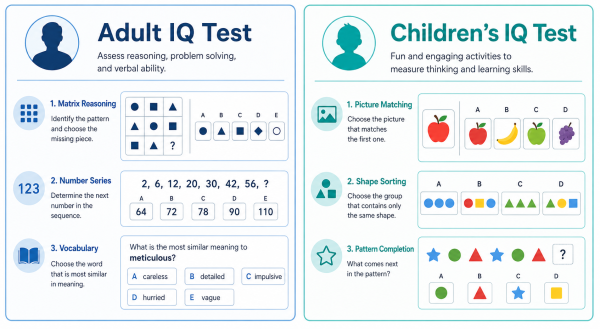
IQ tests are not one-size-fits-all instruments. The version designed for a 35-year-old professional and the one given to an 8-year-old child differ significantly in structure, scoring, content, and purpose. Understanding these differences helps parents, educators, and adults interpret results more accurately and choose the right assessment for the right context.
The Core Difference: What Each Test Is Measuring
Both adult and children’s IQ tests measure general cognitive ability, but they do so against very different reference points. An adult IQ test compares your performance to other adults of a similar age. A children’s IQ test compares a child’s performance to other children of the same age group — typically in narrow bands of one year or less.
This distinction matters because cognitive ability develops rapidly during childhood. A child who scores well at age 7 is being compared to other 7-year-olds, not to the adult population. The same raw score can mean very different things depending on developmental stage, which is why age-normed comparisons are essential. For a foundational explanation of how IQ scoring works, see what is IQ — a complete guide to intelligence quotient.
How Adult IQ Tests Work
The most widely used adult IQ assessments are the Wechsler Adult Intelligence Scale (WAIS) and the Stanford-Binet Intelligence Scales (for ages 16 and above). These tests are designed for individuals aged roughly 16 to 90 and are structured around multiple subtests covering four broad cognitive domains: verbal comprehension, perceptual reasoning, working memory, and processing speed.
Adult tests assume a baseline level of language development, abstract thinking, and cultural exposure. Questions involve increasingly abstract reasoning, analogies, vocabulary, and complex spatial tasks. The scoring uses a standardised mean of 100 and a standard deviation of 15, so results are directly comparable across the adult population. You can see how these scores map to real-world classifications in the IQ scale explained from low to genius.
Online adult IQ tests — including those available on CheckIQFree — follow similar structural principles with visual reasoning tasks designed to minimise language and cultural bias. These are covered in detail in our International Standard IQ Test.
How Children’s IQ Tests Work
Children’s IQ tests are built around developmental norms. The most commonly used instruments include the Wechsler Intelligence Scale for Children (WISC), the Stanford-Binet (for ages 2 and above), and the Kaufman Assessment Battery for Children (KABC). These tests are almost always administered by a trained psychologist rather than taken independently.
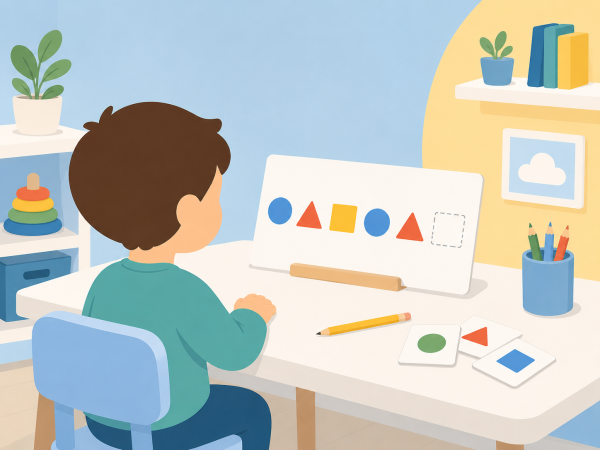
The structure of a children’s test adapts to the age of the child. For younger children (ages 2–6), tests rely more heavily on visual tasks, object manipulation, and picture-based reasoning rather than language. For older children (ages 7–16), the test introduces more verbal and abstract components that gradually resemble adult assessments. Questions are shorter, simpler, and broken into smaller steps to account for shorter attention spans and limited working memory capacity.
Parents curious about how children’s assessments work in practice can also explore our IQ Test for Kids, designed as a gentle, age-appropriate introduction to cognitive assessment for children aged 6–12.
Key Differences Between Adult and Children’s IQ Tests
| Feature | Adult IQ Test | Children’s IQ Test |
| Age range | 16 and above | 2–16 years |
| Norming group | Adult population | Same-age peers |
| Question format | Abstract, verbal, spatial | Visual, picture-based, simpler verbal |
| Administration | Self-administered or clinical | Almost always clinical |
| Duration | 60–90 minutes (clinical) | 45–75 minutes (clinical) |
| Primary purpose | Career, research, self-knowledge | Educational placement, gifted screening, developmental assessment |
| Score stability | High (stable in adulthood) | Lower (still developing) |
Score Stability: Adults vs Children
One of the most important differences between adult and children’s IQ tests is how stable the resulting scores are. In adults, IQ scores tend to remain relatively consistent over time. Research consistently shows that adult cognitive ability — particularly fluid reasoning and crystallised intelligence — changes slowly and predictably, mostly declining slightly in later life.
In children, IQ scores are considerably less stable, especially before age 10. A child’s cognitive profile is actively developing, meaning a score at age 7 may differ meaningfully from a score taken at age 11. This is one reason child psychologists rarely draw firm conclusions from a single childhood test and instead look at patterns across multiple assessments. For a broader discussion of how much IQ can change, see can IQ be improved?
Why Children’s Tests Are Almost Always Clinically Administered
Unlike most adult IQ tests, children’s assessments are rarely self-administered. A trained psychologist is needed to observe the child’s behaviour during testing, adjust pacing, maintain rapport, and account for factors like test anxiety, language barriers, or attention difficulties. The quality of the test administration directly affects the accuracy of the results.
This is especially relevant for parents seeking assessments for gifted identification, learning disability evaluation, or school placement decisions. The accuracy concerns around unsupervised testing are explored in how accurate are IQ tests for children?
What Factors Affect Results Differently in Adults and Children
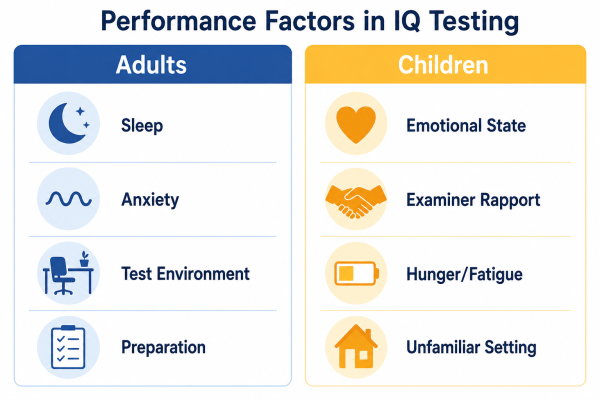
Both adults and children are affected by the same broad categories of performance factors — sleep, anxiety, motivation, and test environment. However, the relative weight of these factors differs significantly between age groups.
Children are more sensitive to emotional state, relationship with the examiner, unfamiliar environments, and hunger or fatigue. A child who feels anxious or rushed may perform considerably below their actual ability. Adults are generally better at managing these variables, though anxiety and poor preparation still matter — as covered in what affects your IQ test results and common mistakes that lower IQ test scores.
Can Adults Take Children’s IQ Tests (and Vice Versa)?
Technically yes, but the results are meaningless. An adult taking a children’s test would score at ceiling for their age group, producing an inflated and uninterpretable number. A child taking an adult test would be compared against adults, almost certainly producing a deflated score that reflects developmental stage rather than cognitive ability.
Accurate IQ measurement always requires using the test normed for the appropriate age group. This is a fundamental requirement of psychometric validity.
When Should a Child Be Tested?
There is no universal right age for a child to take a formal IQ test. Common situations where testing is appropriate include suspected giftedness, learning difficulties, school placement decisions, and developmental evaluations. Most psychologists recommend waiting until at least age 6 for meaningful results, as cognitive profiles before this age are highly fluid.
Parents can find more detailed guidance in IQ testing for kids — what parents should know and should parents be concerned about their child’s IQ?
Verbal vs Nonverbal Components: A Key Design Difference
Both adult and children’s tests include verbal and nonverbal components, but the balance shifts significantly by age. Children’s tests for younger age groups rely more heavily on nonverbal tasks — matching shapes, completing patterns, identifying similarities between objects — because young children’s language ability varies widely and should not be the primary bottleneck in a cognitive assessment.
Adult tests assume stronger verbal ability and include more language-dependent subtests. This distinction matters for people whose first language is not English or who come from linguistically diverse backgrounds. The broader topic of verbal and nonverbal intelligence is explained in verbal and nonverbal tests of intelligence.
What to Do With the Results
Whether the test is for an adult or a child, IQ scores should be treated as one piece of information among many — not as a fixed label. For adults, a score is most useful when it informs career decisions, learning strategies, or self-understanding. For children, results should be used to support educational planning, identify areas of strength, and guide appropriate intervention when needed.
Parents of children with below-average scores will find practical guidance in how to support a child with a below-average IQ, while those with high-scoring children can explore signs of high intellectual potential in children.
Final Thoughts
Adult and children’s IQ tests share the same underlying goal — measuring general cognitive ability — but differ substantially in format, norming, administration, and interpretation. Using the right test for the right age group, under the right conditions, is what makes results meaningful. A score is only as good as the context in which it was produced. Explore more in our Blog and Parents & Kids sections.

Comments
Share Your Thoughts