Can you improve your IQ? This question has generated significant research — and significant confusion. The honest answer requires distinguishing between what IQ measures, what can change versus what stays stable, and what the evidence actually supports versus what gets marketed as "brain training." This guide covers the research on neuroplasticity, the Flynn Effect evidence, the fluid vs crystallized intelligence distinction, and what environmental and lifestyle factors have the strongest scientific support. For the foundational IQ framework, start with What Is IQ?
The Short Answer: Partly — With Important Nuances
IQ is not fully fixed. The evidence for this comes from three major sources:
- Adolescent IQ variability: A 2011 study from University College London (Ramsden et al.) found that IQ scores in teenagers can shift by up to 20 points over several years, correlated with changes in educational engagement and general cognitive challenge
- The Flynn Effect: Average population IQ has risen approximately 3 points per decade across the 20th century due to environmental improvements — the strongest evidence that IQ is substantially shaped by non-genetic factors
- Environmental sensitivity: Research on early childhood, nutrition, education, and health consistently shows large IQ effects, demonstrating that cognitive development responds to environmental conditions
However, the picture is more complicated for adults, where dramatic IQ improvement from brain training alone is not well-supported. The most reliable approach is optimizing the environmental and lifestyle factors that support cognitive function — not chasing a different number on a test. To understand which factors matter most, see also the neuroplasticity guide.
Fluid vs. Crystallized Intelligence: Why the Distinction Matters
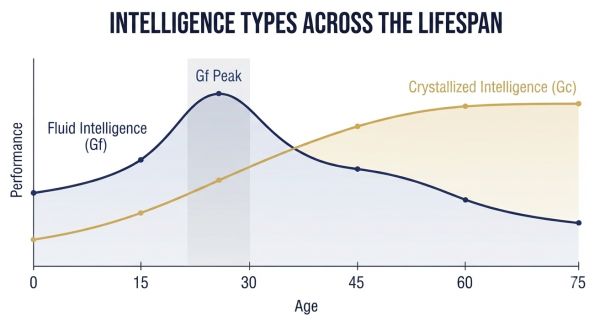
The most important distinction for understanding IQ improvement is the difference between two types of intelligence identified by Raymond Cattell:
Fluid Intelligence (Gf) — the ability to reason in novel situations without relying on stored knowledge: pattern recognition, abstract problem-solving, and working memory under new conditions. This is what most people mean by "raw intelligence" or "quick thinking." It tends to peak in the mid-20s and shows gradual decline with age.
Crystallized Intelligence (Gc) — accumulated knowledge, vocabulary, expertise, and learned reasoning skills built through education and experience. It tends to remain stable or increase into middle age and beyond, because it is continuously accumulated rather than biologically constrained.
This distinction matters for "can IQ be improved?" because:
- Fluid intelligence is harder to improve dramatically in adults — it reflects working memory capacity, processing speed, and neural efficiency that are substantially genetically influenced
- Crystallized intelligence is highly responsive to sustained learning, reading, and education — and contributes significantly to the verbal comprehension and knowledge components of many IQ tests
- The measurable IQ improvements from education primarily work through crystallized intelligence — building the knowledge structures and verbal reasoning capacity that IQ tests assess
For more on how these connect to the WAIS-IV structure, see the WAIS-IV complete guide.
The Flynn Effect: The Strongest Evidence That IQ Responds to Environment
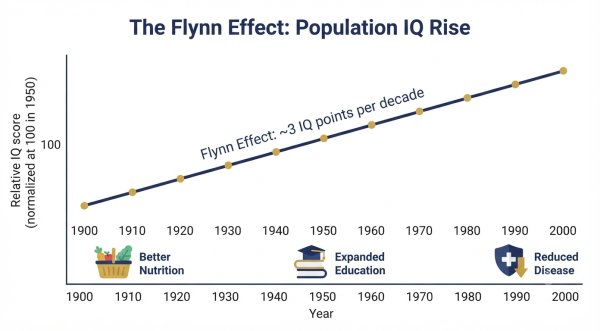
The Flynn Effect — documented by researcher James Flynn across decades of data — shows that average IQ scores have risen approximately 3 points per decade throughout most of the 20th century across dozens of countries. These gains cannot be genetic: the time scale is too short. They are attributed to environmental improvements:
- Better nutrition — particularly reduced malnutrition and improved childhood nutrition
- Expanded formal education — more years of schooling and higher quality instruction
- Reduced infectious disease burden — which impairs brain development when present in early childhood
- Smaller family sizes — associated with greater cognitive investment per child
- More cognitively demanding daily environments — abstract thinking required by modern media, technology, and work
The Flynn Effect is the strongest real-world evidence that population-level IQ responds to environmental conditions. By extension, individual-level IQ can also respond to environmental optimization — particularly the same factors that drove population gains: nutrition, education, health, and cognitive engagement. Read the full Flynn Effect guide for the complete research.
Brain Training Apps: The Evidence
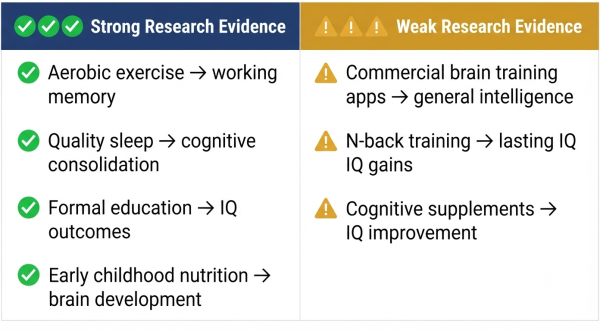
Commercial brain training apps — Lumosity, Elevate, Peak, and others — market themselves as intelligence-improving tools. The evidence does not support these claims at the level they suggest:
- In 2016, Lumosity's parent company Lumos Labs paid a $2 million FTC fine for deceptive advertising, admitting that claimed scientific proof of IQ improvement did not hold up to scrutiny
- A 2014 consensus statement signed by over 70 cognitive scientists concluded that existing evidence does not support using brain training games to improve performance on other tasks or to reduce cognitive decline
- Research consistently shows "near transfer" — improvement on the specific tasks practiced — but very limited "far transfer" to general intelligence measures
This does not mean cognitive training is worthless — it means that isolated digital games, practiced in brief sessions, have limited evidence for general intelligence improvement. What does have stronger evidence is sustained, challenging engagement with real cognitive domains: formal education, language learning, musical training, chess, and reading — activities that engage multiple cognitive systems simultaneously over extended periods.
What Does Have Strong Research Support
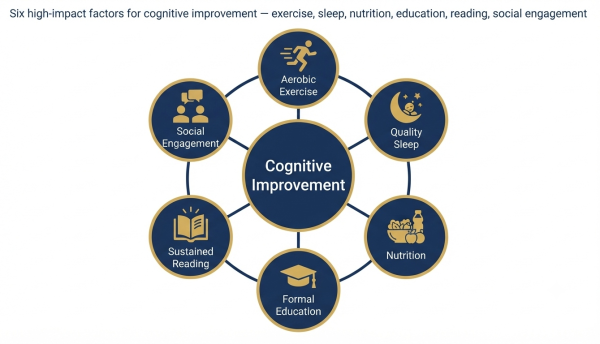
1. Physical Exercise
Aerobic exercise is among the most robustly supported cognitive enhancers in the research literature. It promotes neurogenesis (creation of new neurons) in the hippocampus, increases BDNF (brain-derived neurotrophic factor), and is associated with measurable improvements in working memory, executive function, and processing speed. Studies link consistent aerobic exercise to larger hippocampal volume, which directly correlates with learning and memory performance. See the full guide: exercise and the brain.
2. Sleep
Sleep consolidates newly learned information into long-term memory, clears metabolic waste products from the brain, and maintains the working memory and executive function capacities that IQ tests measure. Chronic sleep deprivation has measurable negative effects on most cognitive functions — effectively lowering IQ-relevant performance in the short term. See sleep and IQ.
3. Nutrition
Nutrition has particularly strong effects during development — malnutrition in early childhood can reduce IQ by multiple points. In adults, diets rich in omega-3 fatty acids, antioxidants, and B vitamins support neuronal health and are associated with better cognitive aging. The research on nutrition as a direct IQ improver in healthy adults is less dramatic but consistent in supporting cognitive maintenance. See nutrition and IQ.
4. Education
Formal education has one of the strongest documented effects on IQ scores of any environmental factor. Research suggests that each additional year of schooling is associated with approximately 1–5 IQ points, with higher quality education showing larger effects. Education primarily works through crystallized intelligence — building knowledge, verbal reasoning capacity, and systematic thinking habits. See average IQ by education level.
5. Sustained Intellectual Challenge
Learning a new language, mastering a musical instrument, studying a complex domain, or engaging seriously with chess or logic puzzles keeps neural pathways flexible and active. These activities engage multiple cognitive systems simultaneously — memory, attention, pattern recognition, and executive function — and the transfer effects to general cognitive performance are better supported than those from single-domain brain games. See chess and IQ and cognitive flexibility.
Realistic Expectations: What Can Actually Change?
The research supports the following realistic picture for adults:
- Fluid intelligence: Relatively stable after the mid-20s; can deteriorate with poor health, sleep deprivation, or sustained stress; can be maintained with exercise and cognitive engagement; dramatic improvement is not well-supported
- Crystallized intelligence: Highly responsive to sustained learning throughout adulthood; the main pathway through which education and intellectual engagement improve IQ test performance
- Working memory: The most trainable of the IQ-relevant capacities, showing meaningful improvements with structured training — though long-term transfer to general IQ is still limited
- Overall cognitive performance: Can be meaningfully supported through the lifestyle factors above, especially exercise, sleep, and nutrition — which reduce the environmental "drag" on cognitive function
The goal of cognitive optimization is not to change the number on a test — it is to ensure your brain operates as close to its biological potential as possible, without the drag of poor health, sleep deprivation, inadequate nutrition, or insufficient cognitive challenge.
Frequently Asked Questions
Can IQ be improved?
Partly. IQ scores can shift during childhood and adolescence — research has documented changes of up to 20 points based on educational engagement. The Flynn Effect shows population IQ has risen 3 points per decade from environmental improvements. In adults, dramatic IQ improvement from brain training alone is not well-supported, but optimizing lifestyle factors (exercise, sleep, nutrition, education) supports the cognitive capacities IQ tests measure.
Do brain training apps actually improve IQ?
The evidence is weak. In 2016, Lumosity paid a $2 million FTC fine for deceptive advertising. A 2014 statement by 70+ cognitive scientists concluded that brain games do not support general intelligence improvement. Apps improve performance on specific practiced tasks ("near transfer") but show very limited effects on general intelligence ("far transfer"). Sustained engagement with real cognitive domains — education, language learning, chess — has better evidence.
What is the difference between fluid and crystallized intelligence?
Fluid intelligence (Gf) is abstract reasoning in novel situations — peaks in the mid-20s, harder to improve dramatically. Crystallized intelligence (Gc) is accumulated knowledge and learned skills — continues growing with education and experience throughout adulthood. Most educational improvements to IQ work primarily through crystallized intelligence. See the WAIS-IV guide for how these are assessed.
Why does the Flynn Effect suggest IQ can be improved?
The Flynn Effect — average IQ rising 3 points per decade across the 20th century — proves that IQ responds substantially to environmental conditions. The gains are too rapid to be genetic. They resulted from better nutrition, expanded education, reduced disease burden, and more cognitively demanding environments. This demonstrates that individual IQ can also respond to environmental optimization. See the Flynn Effect guide.
What has the biggest impact on IQ?
The strongest research-supported factors are: quality education (especially during development), aerobic exercise (promotes neurogenesis and working memory), sleep (consolidates memory and maintains executive function), nutrition (especially during early childhood), and sustained intellectual challenge across the lifespan. See exercise and the brain, sleep and IQ, and nutrition and IQ.

Comments
Share Your Thoughts