The "IQ vs soft skills" debate in hiring is real — but it's often framed as a binary when the research shows a more nuanced picture. Cognitive ability and non-cognitive traits both predict job performance, and they predict different things. Understanding what the research actually shows — including what "soft skills" means in scientific context — helps both employers design better selection processes and candidates understand what they're actually being evaluated on. For the broader research context, see Why Employers Trust IQ Tests and IQ vs EQ.
What "Soft Skills" Actually Means in Hiring Research
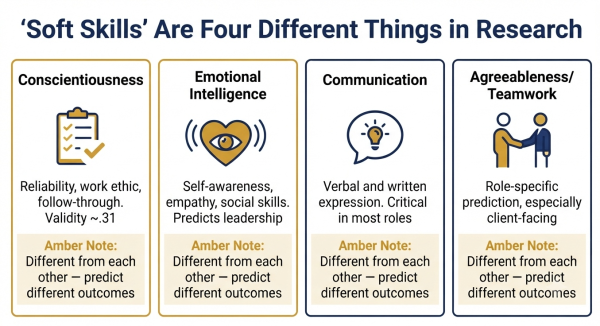
The term "soft skills" is routinely used in hiring discussions to mean everything from punctuality to empathy. But in the research literature, these traits are distinct — they have different definitions, different assessment methods, and different predictive relationships with job performance:
- Conscientiousness: Reliability, organization, follow-through, work ethic, attention to detail — the non-cognitive trait with the strongest and most consistent research support for job performance prediction. Conscientiousness has approximately .31 validity for overall job performance across meta-analytic studies, and is the component of the Big Five personality model most reliably associated with sustained high performance
- Emotional Intelligence (EQ): Self-awareness, self-regulation, empathy, and social skill — most strongly predictive of leadership effectiveness, team cohesion, and client-facing performance. Predicts less well for purely technical individual contributor roles
- Communication ability: Clear, effective verbal and written expression — critical for most professional roles but difficult to assess reliably at scale (writing samples, structured interviews, and presentation tasks are the most defensible methods)
- Agreeableness, openness, and teamwork: Role-specific predictors — particularly relevant for client-facing, creative, and collaborative roles, but not uniformly strong predictors across all occupational categories
These are not one thing. Conflating them into "soft skills" obscures that they predict different outcomes and require different assessment approaches. See the EQ assessment for context on the emotional intelligence dimension specifically.
What the Research Shows: Validity Coefficients
From Schmidt and Hunter (1998) and subsequent meta-analyses on selection validity:
| Predictor | Validity for Job Performance | What It Predicts Best |
| Cognitive ability (GMA) | ~.51 | Learning speed, analytical tasks, novel problem-solving |
| Conscientiousness | ~.31 | Sustained effort, reliability, long-term performance |
| GMA + Conscientiousness | ~.60 | Combined — most predictive combination without interviews |
| GMA + Structured Interview | ~.63 | Combined — highest practical validity |
| Emotional Intelligence | ~.24–.30 (varies by role) | Leadership effectiveness, team cohesion, client outcomes |
| Unstructured interview | ~.20 | Often interviews presentation skill more than job performance |
The key finding: IQ has higher standalone predictive validity than any single "soft skill" measure. But IQ and conscientiousness together predict better than either alone, and the combination with structured interviews is the most practically powerful approach.
IQ Predicts Different Things Than Conscientiousness
The important distinction is not just which predicts more — it's that they predict different things:
- Cognitive ability predicts: How quickly you learn complex material, performance on analytical tasks, ability to solve novel problems, adaptability to new systems — things that matter most in early career and in roles with high novelty and complexity
- Conscientiousness predicts: Sustained effort over time, reliability, work ethic, follow-through on commitments, consistent quality — things that distinguish long-term high performers from those who start strong but plateau or underperform over time
A high-IQ employee who lacks conscientiousness may learn quickly but fail to deliver consistently. A highly conscientious employee without sufficient cognitive ability may work hard but struggle to master the role's complexity. The most durable hires typically have both. For the career implications of IQ and EQ interaction, see IQ vs EQ.
How the Balance Shifts by Career Stage and Role
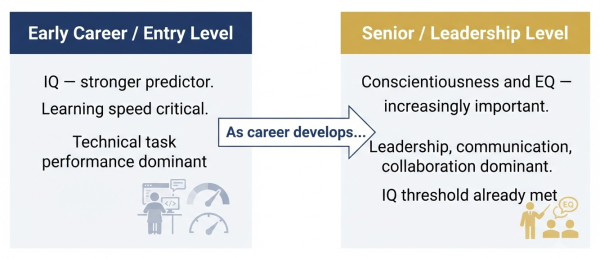
Early Career and Entry-Level Roles
At entry level, cognitive ability is the stronger predictor — learning speed is critical, technical task performance is primary, and the gap between high and low cognitive ability candidates is most visible when both are new to the role. This explains why cognitive assessments have high ROI for graduate and entry-level hiring. See how recruiters use IQ tests.
Senior and Leadership Roles
As seniority increases, the cognitive threshold for the role has typically already been demonstrated. The primary differentiators become conscientiousness (sustained high performance over years), emotional intelligence (leadership effectiveness, team development, stakeholder management), and communication (translating complex work into actionable direction for others). For roles where EQ becomes the primary differentiator, see jobs where EQ beats IQ.
Role-Specific Variation
Some roles prioritize specific non-cognitive traits: client-facing sales and service roles weight EQ and communication heavily; research and technical specialist roles weight IQ and conscientiousness; project management and operations roles weight conscientiousness and communication; leadership roles increasingly weight EQ, communication, and conscientiousness alongside cognitive ability.
How Are Soft Skills Actually Assessed in Hiring?
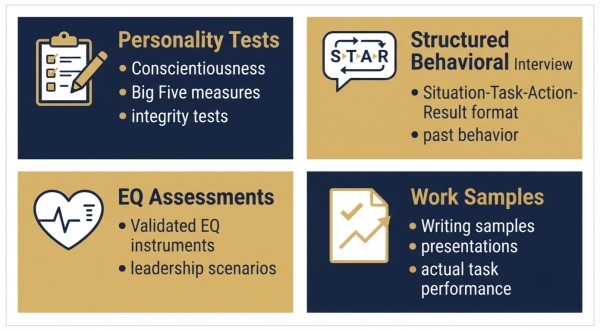
Unlike cognitive tests (objectively scorable in minutes), most soft skill assessment requires more structured methods:
- Conscientiousness: Big Five personality measures, integrity tests, structured work history review — asking candidates about specific examples of reliability, deadline management, and follow-through
- Emotional intelligence: Validated EQ instruments, behavioral interview questions about conflict resolution and team dynamics, leadership scenario exercises
- Communication: Writing samples, structured presentations, verbal communication tasks — scored against defined criteria rather than interviewer impression
- Teamwork and collaboration: Structured behavioral interviews using STAR format (Situation-Task-Action-Result), assessment center group exercises, reference checks with specific questions
The challenge is reliability: unlike cognitive tests, which produce highly consistent scores across administrations, many soft skill assessments have lower test-retest reliability and are more susceptible to faking and social desirability bias. Structured methods reduce but don't eliminate this problem. See IQ in the hiring process for the full selection framework.
Frequently Asked Questions
Which matters more in hiring — IQ or soft skills?
Both predict job performance independently. Cognitive ability (GMA) has validity ~.51. Conscientiousness (the most research-supported "soft skill") adds ~.10–.20 incremental validity above IQ. The combination of cognitive ability and conscientiousness (~.60 combined validity) is more predictive than either alone. IQ predicts whether you can do the job; conscientiousness predicts whether you will do it consistently well over time.
What do researchers mean by "soft skills"?
In research, "soft skills" covers distinct traits with different predictive relationships: Conscientiousness (reliability, work ethic — .31 validity), Emotional Intelligence (self-awareness, empathy — predicts leadership most strongly), Communication (verbal and written expression — critical but harder to assess reliably), and Big Five traits like agreeableness (role-specific). These are not one thing — they predict different outcomes and require different assessment methods.
Is conscientiousness more important than IQ?
They predict different things. IQ predicts learning speed and analytical task performance (~.51 validity). Conscientiousness predicts sustained effort, reliability, and long-term performance (~.31 validity). IQ has higher standalone validity, but the combination is more powerful than either. For roles where sustained effort matters more than fast learning, conscientiousness may be more practically important than marginal IQ differences.
How are soft skills assessed in hiring?
Conscientiousness: Big Five personality tests, integrity tests, structured work history review. EQ: validated EQ instruments, behavioral interview questions. Communication: writing samples, presentations, verbal tasks scored against criteria. Teamwork: structured behavioral interviews (STAR format), assessment center exercises, specific-question reference checks. Unlike cognitive tests, most soft skill assessments have lower reliability and require structured administration to be defensible. See how recruiters use IQ tests for the full selection context.

Comments
Share Your Thoughts