Singapore stands out among major economies for the degree to which cognitive ability testing is normalized and accepted in professional hiring — not just at multinational firms but across local banks, government agencies, and technology companies. Understanding why this is, what types of assessments are used, and how to prepare is valuable for anyone pursuing professional opportunities in Singapore's competitive job market. For the global context on cognitive hiring practices, see How Recruiters Use IQ Tests.
Why Singapore's Hiring Culture Embraces Cognitive Testing
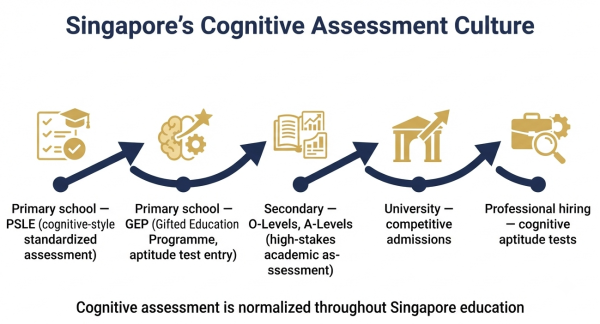
Singapore's acceptance of cognitive ability testing in professional hiring reflects a broader cultural context where rigorous assessment has been central to meritocratic advancement since independence. Several factors make Singapore unique:
A Meritocratic National Framework
Singapore's founding philosophy of meritocracy — selecting and advancing individuals based on demonstrated ability rather than background or connection — aligns naturally with standardized cognitive assessment. Professional hiring that uses objective aptitude testing reflects the same principles that govern the national education system. When employers use cognitive tests to differentiate among strong candidates, they are applying a logic that is socially accepted and institutionally familiar.
Cognitive Assessment Embedded in Education
Singaporeans encounter structured cognitive assessment throughout their education: the Primary School Leaving Examination (PSLE), the Gifted Education Programme (GEP) selection test at Primary 3 and 4, O-Levels and A-Levels with their demanding analytical requirements, and H3 papers at A-Level for the most academically ambitious. This creates broad familiarity with aptitude-style assessment. Cognitive testing in professional hiring feels less like a foreign imposition and more like a continuation of a familiar framework.
Competitive Differentiation Among High-GPA Pools
Singapore's top universities — NUS, NTU, SMU — produce large numbers of high-achieving graduates. A GPA alone is insufficient to differentiate among hundreds of 3.8+ applicants for a limited number of analyst positions at a global bank or consulting firm. Cognitive tests provide an additional signal that is both standardized and difficult to replicate through purely credential-based evaluation.
Multinational Corporate Presence
Singapore is a regional headquarters for hundreds of multinationals across finance, technology, consulting, and professional services. These companies bring their global hiring practices — which typically include cognitive assessment — to Singapore, establishing an industry norm that local firms increasingly follow.
Industries Where Cognitive Testing Is Common in Singapore
| Industry | Typical Roles | Common Assessment Type |
| Banking & Financial Services | Analyst, associate, quant roles at global and local banks | SHL Numerical, quantitative reasoning tests |
| Management Consulting | Consultant, associate at MBB and tier-2 firms | Numerical and abstract reasoning + case study |
| Technology | SWE, data scientist, product analyst | Logical reasoning + technical assessment |
| Government & Statutory Boards | Management Associate programs, PSC scholars | Aptitude assessments, scholarship selection tests |
| FMCG and International Multinationals | Graduate schemes across functions | SHL Verify (numerical, verbal, inductive) |
In banking and finance, numerical reasoning tests are standard — DBS, OCBC, UOB, and international banks all use quantitative assessments for analyst recruitment. In consulting, the McKinsey Problem Solving Test and similar assessments combine numerical reasoning with logical analysis. In technology, abstract reasoning tests accompany technical coding assessments. Government agencies including the Public Service Commission use aptitude components in scholarship and management associate selection. Practice with the Singapore IQ Test and the Recruitment IQ Test for relevant preparation.
How Cognitive Tests Fit in Singapore's Multi-Method Hiring
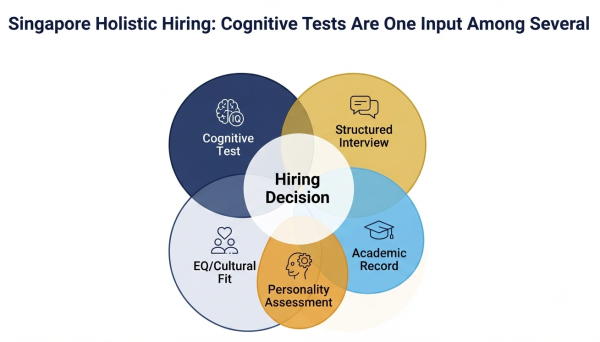
Even in Singapore's cognitively demanding hiring environment, cognitive tests are one input among several:
- Academic record: Singapore employers place significant weight on education — university GPA, honours class, and scholarship history
- Structured interviews: Behavioral and competency-based interviews remain standard at most employers
- Technical or case assessments: Consulting case interviews, coding tests for tech roles, or domain-specific work samples
- Personality assessments: Many multinationals in Singapore include Big Five personality measures or DISC profiles
- EQ and cultural fit: Particularly for client-facing roles and leadership tracks
The cognitive test typically functions as an early-stage screen — eliminating candidates below a threshold before investment in more expensive interview stages. See the broader framework at IQ vs soft skills in hiring.
Preparing for Cognitive Assessments in Singapore Hiring
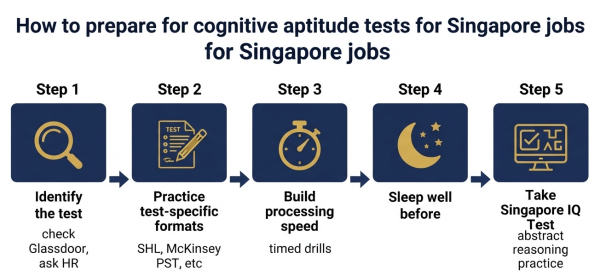
Effective preparation for Singapore cognitive hiring assessments follows the same principles as preparation for any recruitment cognitive test, with some Singapore-specific considerations:
- Identify which test your target employer uses: Check the employer's Glassdoor page, ask HR contacts, or research the firm's standard assessment process. Singapore hiring practices at multinationals are well-documented online
- Practice with test-type-specific materials: SHL Numerical for banking; abstract and logical reasoning for consulting and tech; the Singapore IQ Test for practice with the academic-style rigorous assessment common in local hiring
- Build processing speed under time pressure: Singapore's high-volume assessment processes reward both speed and accuracy — timed practice is essential
- Understand the multi-stage process: Cognitive tests in Singapore hiring often precede rather than replace other assessments — passing a cognitive screen advances you to interviews, not directly to an offer
For the complete preparation guide, see How to Prepare for a Recruitment IQ Test. For context on culture-fair testing (relevant for international applicants to Singapore), see Recruitment vs Culture Fair IQ Tests.
Frequently Asked Questions
Why do Singapore companies use cognitive ability tests in hiring?
Singapore's meritocratic culture, high-achieving graduate pools requiring differentiation, multinational corporate practices, and education system that normalizes cognitive assessment all contribute. Practical reasons: cognitive tests reduce interviewer bias in diverse applicant pools, differentiate among high-GPA candidates, and predict learning speed in fast-evolving sectors. See why employers trust IQ tests.
Which industries in Singapore use aptitude tests?
Banking and financial services (SHL Numerical, quantitative reasoning), management consulting (numerical/abstract + case study), technology (logical reasoning + coding), government and statutory boards (Management Associate aptitude tests, PSC scholarship selection), and most FMCG multinationals (SHL Verify graduate schemes).
What types of cognitive tests are used in Singapore hiring?
SHL Verify numerical and inductive tests (most international companies), McKinsey PST-style assessments (consulting), abstract/logical reasoning (tech), and locally administered aptitude tests for government roles. Practice with the Singapore IQ Test and Recruitment IQ Test.
How can I prepare for a Singapore cognitive hiring assessment?
Identify which test your employer uses, then practice with test-type-specific materials under timed conditions. For banking, focus on numerical data interpretation. For consulting and tech, practice abstract and logical reasoning. Build processing speed through timed practice. See the complete guide at how to prepare for a recruitment IQ test.

Comments
Share Your Thoughts